
Selecting the right conveyor belt for wet copper concentrate is an important decision for copper mining and mineral-processing operations in Chile. Unlike coarse copper ore, copper concentrate usually consists of fine mineral particles that can become sticky, cohesive, or difficult to discharge when moisture levels increase. These characteristics create challenges involving material carryback, belt contamination, spillage, pulley traction, and conveyor maintenance.
In Chilean copper operations, concentrate conveyors may connect filtration facilities, storage buildings, stockpiles, truck-loading stations, and port terminals. Operating conditions can vary significantly between inland mining areas and coastal export facilities. A conveyor belt suitable for an enclosed concentrate-handling system may require additional protection when operating outdoors in a coastal environment.
For many conventional wet copper concentrate conveyors, an abrasion-resistant EP rubber conveyor belt with an appropriately selected cover compound is a practical starting point. However, the final specification must consider actual belt tension, moisture, concentrate characteristics, conveyor length, inclination, cleaning requirements, and the operating environment.
Quick answer: For wet copper concentrate handling in Chile, an EP fabric rubber conveyor belt with suitable abrasion resistance is often a practical choice for short- to medium-duty conveyors where the calculated tension permits. Steel cord belts may be preferable for long-distance or high-tension applications. The selected rubber cover must suit the material’s abrasion, moisture, and chemical exposure. Effective belt cleaning, appropriate pulley lagging, dust and spillage control, and properly designed loading chutes are equally important for reliable operation.
Why Is Wet Copper Concentrate Difficult to Convey?
Copper concentrate is produced after mineral processing and typically contains a substantial proportion of fine particles. Depending on the ore and processing method, the concentrate may contain copper-bearing sulfide minerals, other mineral constituents, and residual process moisture.
After filtration, the concentrate may still retain enough moisture to behave as a cohesive bulk material. Additional exposure to rain, storage conditions, or changes in moisture distribution can further affect its handling characteristics.
Common problems include:
- Wet concentrate adhering to the carrying surface of the belt.
- Material carryback after discharge at the head pulley.
- Accumulation of fine material around return rollers and pulleys.
- Chute buildup, restricted flow, and inconsistent loading.
- Spillage from overloading, mistracking, or inadequate containment.
- Reduced drive traction where water and contamination affect the pulley contact surface.
The main challenge is therefore not simply supporting the material’s weight. The complete conveyor system must also transport, discharge, and clean a fine, moisture-sensitive bulk material reliably.
1. Understand the Difference Between Copper Ore and Copper Concentrate
Copper ore and copper concentrate should not automatically use the same belt specification.
Primary crushed copper ore can contain relatively large, angular particles that cause significant impact, cutting, and gouging. In comparison, copper concentrate is generally much finer and often creates greater challenges involving adhesion, carryback, dust, and material buildup.
| Selection Factor | Coarse Copper Ore | Wet Copper Concentrate |
| Particle Characteristics | Larger, frequently angular particles | Predominantly fine particles |
| Main Handling Concern | Impact, cutting, abrasion | Adhesion, carryback, buildup, spillage |
| Belt Cover Priority | Abrasion and cut resistance | Suitable abrasion resistance and compatibility with wet material |
| System Priority | Impact support and loading protection | Cleaning, containment, discharge, and tracking |
Although both applications may use rubber conveyor belts, their cover requirements and maintenance priorities can be different.
2. Is an EP Rubber Conveyor Belt Suitable for Wet Copper Concentrate?
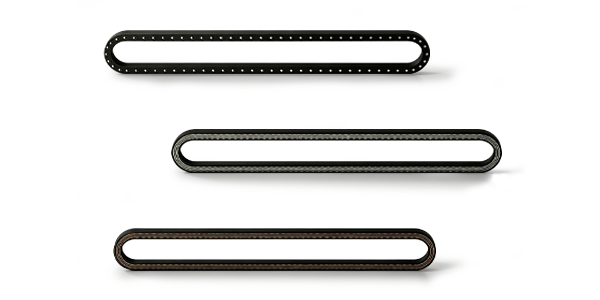
For many conventional concentrate-handling conveyors, an EP rubber conveyor belt is a suitable option. EP fabric construction generally uses polyester in the longitudinal direction and nylon in the transverse direction, providing useful tensile strength, dimensional stability, and flexibility.
EP belts can be manufactured with different tensile ratings, ply arrangements, rubber covers, and thicknesses. This makes them adaptable to many concentrate-handling duties.
However, the selection must be based on the conveyor’s actual design tension, belt width, pulley arrangement, and required splice strength.
The presence of water in copper concentrate does not, by itself, require a special belt carcass. The important questions are whether the belt structure can handle the mechanical loading and whether the rubber covers are compatible with the operating environment.
For more information on carcass construction and cover selection, see How to Choose Rubber Conveyor Belts for Heavy-Duty Bulk Material Handling.
3. When Should a Steel Cord Conveyor Belt Be Considered?
Steel cord conveyor belts may be appropriate for long-distance concentrate conveyors, high-capacity systems, or installations where the calculated operating tension exceeds the practical capability of the proposed fabric belt.
Steel cord belts offer high tensile strength and low longitudinal elongation, making them suitable for certain long or heavily loaded conveying systems.
However, they are not automatically necessary for wet copper concentrate. Their selection introduces additional considerations involving pulley diameters, splice construction, belt monitoring, maintenance capability, and initial investment.
The decision should be based on conveyor engineering calculations rather than the material being transported.
4. Select the Right Rubber Cover for Wet Concentrate
The carrying cover is directly exposed to wet copper concentrate. It should provide suitable resistance to abrasion and remain mechanically stable under repeated loading, flexing, and cleaning contact.
Fine copper concentrate may be less likely to cause large-particle cutting than coarse ore, but its mineral particles can still produce abrasion, particularly around transfer points and areas where material moves relative to the belt.
Buyers should request a specified rubber cover grade with appropriate documented mechanical properties rather than relying on broad descriptions such as heavy-duty rubber or waterproof rubber.
If the concentrate contains process chemicals or has unusual acidity, alkalinity, or dissolved salts, the selected cover compound should also be checked for chemical compatibility.
Important distinction: Water resistance, abrasion resistance, and chemical resistance are not identical properties. A belt suitable for wet concentrate should be specified according to the actual water exposure, mineral abrasion, and any relevant process-water chemistry.
5. Does Wet Copper Concentrate Require a Special Anti-Stick Belt?
Sticky concentrate can make buyers interested in low-adhesion or specially formulated cover compounds. However, no single rubber belt surface can be assumed to prevent carryback under every moisture condition.
Material adhesion depends on particle size, moisture distribution, mineral composition, belt surface condition, contact pressure, and the way concentrate discharges from the conveyor.
A supplier may propose a cover formulation intended to improve material release, but its suitability should be supported by relevant experience or testing using representative concentrate samples.
For many installations, effective primary and secondary cleaning, well-designed discharge chutes, and controlled loading provide more dependable carryback management than changing the belt compound alone.
6. Determine Belt Width and Speed from Actual Capacity
Conveyor belt width and speed should be selected using the required wet concentrate throughput, bulk density, conveyor inclination, and intended material cross-section.
Wet concentrate bulk density can vary with mineral composition, moisture, consolidation, and handling conditions. Therefore, an assumed value taken from a different copper operation should not automatically be used for a new project.
Higher belt speed may reduce the cross-sectional loading required for a given throughput, but it can also influence transfer behavior, spillage, cleaning efficiency, and belt wear.
For cohesive concentrate, consistent and controlled loading is often more important than maximizing conveyor speed. The final design should provide sufficient capacity without producing unstable flow or material accumulation.
7. How Does Concentrate Moisture Affect Belt Selection?
Moisture influences material behavior, but its effect is not always linear. A small change in moisture may produce a noticeable change in the cohesion or flow characteristics of fine concentrate.
Some material conditions lead to sticky deposits, while other conditions may produce a more mobile wet material. The handling behavior must be established from representative samples and actual process conditions.
Before purchasing the belt, obtain information about normal moisture, expected maximum moisture, filtration performance, and potential rain exposure.
Where moisture changes significantly, the conveyor design should consider possible variations in loading, carryback, discharge, and chute performance.
If the concentrate is handled before final dewatering or behaves as a highly fluid slurry, a conventional open belt conveyor may not be appropriate without additional containment or process changes. That condition requires a separate conveying-system assessment.
8. Belt Cleaning Is Critical for Wet Copper Concentrate
Material carryback is one of the main operational challenges when transporting wet copper concentrate. Even after most of the material discharges at the head pulley, fine particles may remain attached to the belt.
As the belt returns, this material may fall onto the conveyor structure or build up on return rollers. Accumulation can affect tracking, increase maintenance, and create material-recovery and housekeeping problems.
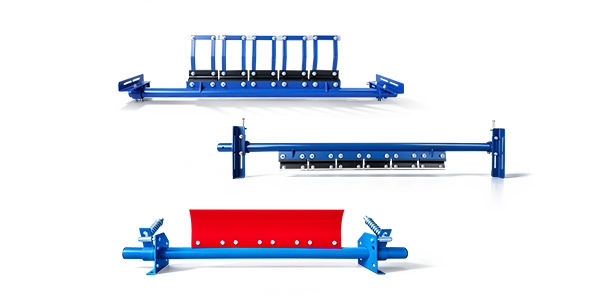
Primary Belt Cleaner
A primary cleaner positioned near the head pulley removes much of the remaining concentrate immediately after discharge. Polyurethane blades are commonly used for this purpose.
Secondary Belt Cleaner
A properly designed secondary cleaner can remove finer residual material. Depending on the belt, splice, support conditions, and cleaning equipment, polyurethane or tungsten carbide-tipped configurations may be considered.
Cleaner contact width, blade material, tensioning, and maintenance access should be specified together with the belt. An unsuitable cleaner can accelerate wear or provide inadequate cleaning despite being correctly positioned.
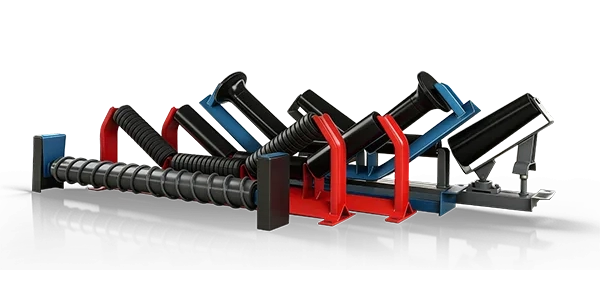
9. Select Conveyor Rollers That Resist Buildup and Contamination
Wet concentrate can accumulate on the return strand and around roller surfaces. Repeated buildup may create uneven support conditions and contribute to belt mistracking.
Conveyor rollers should have suitable bearing protection, sealing arrangements, shell construction, and load capacity for the application.
In selected return positions, spiral or disc-type return rollers may help reduce persistent buildup. However, these rollers should not be used as substitutes for an effective belt cleaning system.
Wet fines and moisture also create contamination risks for roller bearings. Sealing quality and protection against corrosive exposure should therefore be considered.
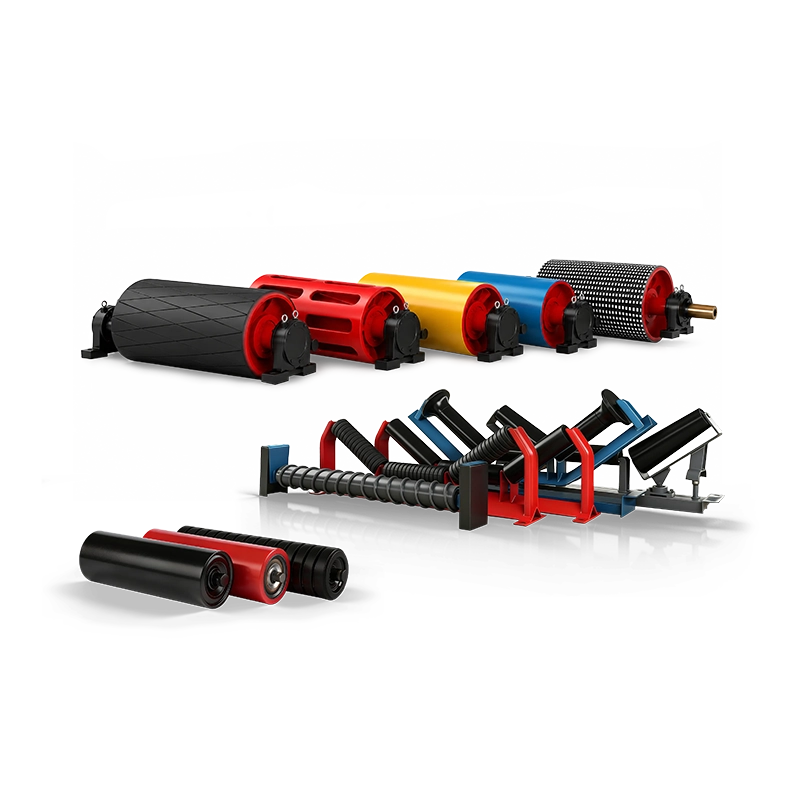
Explore suitable carrying, return, spiral, and other configurations in the SWCONS conveyor roller range.
10. Choose Pulley Lagging for Wet Operating Conditions
Wet operating conditions can affect traction between the drive pulley and the conveyor belt. If the available friction is insufficient, belt slipping may occur during operation or startup.
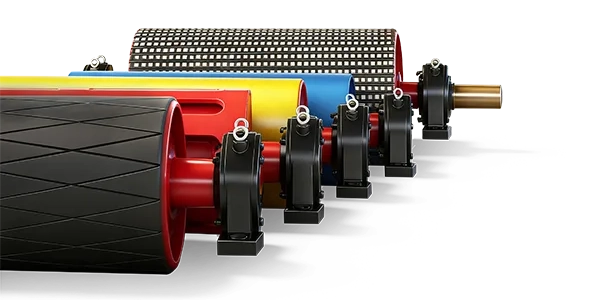
Rubber pulley lagging with suitable surface patterns may help manage water and improve traction under the intended conditions.
| Lagging Type | Selection Consideration |
| Plain Rubber | May be suitable where traction conditions and moisture exposure are manageable |
| Diamond-Grooved Rubber | Provides a grooved surface that may assist drainage under suitable operating conditions |
| Herringbone Rubber | May assist water movement where directional operation and groove orientation are appropriate |
| Ceramic Lagging | May be considered for demanding traction and wear conditions after mechanical evaluation |
The selection should account for actual belt tension, wrap angle, operating environment, and required friction characteristics. Ceramic lagging is not automatically necessary for every wet concentrate conveyor.
For related pulley selection considerations, see the Conveyor Pulleys Guide.
11. Check Conveyor Inclination and Material Rollback
Inclined conveying requires particular attention because wet copper concentrate may behave differently from dry granular material.
A smooth rubber conveyor belt can be suitable for moderate inclines when the material remains stable. However, the acceptable angle should be determined from representative material testing and the actual operating conditions.
For steeper applications, buyers sometimes consider chevron or cleated belts. These can improve retention for certain materials, but raised profiles may also trap sticky concentrate and make cleaning more difficult.
A high-incline solution should therefore be selected only after evaluating material flow, cleaning access, belt geometry, and the practical alternatives. Simply increasing cleat height does not guarantee successful wet concentrate conveying.
12. Consider Chile’s Different Operating Environments
Chilean copper operations can experience very different environmental conditions depending on location and elevation.
Northern Chile and Inland Mining Areas
Some northern mining operations experience strong solar radiation, dust, substantial day-night temperature variation, and dry ambient conditions. Exposed belts and rubber components may require suitable resistance to weathering and ultraviolet exposure.
High-Altitude Copper Mining Operations
At high elevations, low ambient temperatures, temperature changes, and challenging maintenance access may influence the selected rubber compound, lubrication, spare-parts planning, and overall conveyor reliability.
Coastal Copper Concentrate Terminals
Coastal export facilities may encounter humidity, salt-containing air, and marine corrosion exposure. These conditions are especially relevant to pulley shafts, roller bearings, idler frames, structures, and equipment coatings.
The correct belt specification should reflect the actual installation rather than treating all Chilean copper conveyors as operating under identical conditions.
13. Design Loading Chutes to Reduce Spillage and Buildup
Even a correctly selected conveyor belt may perform poorly if the loading chute is unsuitable for wet concentrate.
Fine, cohesive material can stick to chute walls, accumulate near discharge openings, and create irregular flow. Sudden release of accumulated material may produce temporary loading surges and spillage.
Chute design should consider the material’s actual flow characteristics, including adhesion and moisture variation. Centered loading, suitable wear liners, controlled skirt pressure, and accessible cleanout points can help improve performance.
Conveyor covers, covered transfer points, and appropriate drainage or containment arrangements may also be required where rainfall, dust, or concentrate loss presents an operating or environmental concern.
14. Verify Belt Splicing and Pulley Compatibility
The replacement belt must be compatible with the existing pulley diameters, take-up travel, and splice method.
EP fabric and steel cord belts have different splicing requirements. The manufacturer should confirm the recommended splice construction, materials, preparation method, and required equipment for the selected belt rating.
For wet concentrate conveyors, splice integrity is particularly important because repeated exposure to moisture and abrasive material can aggravate problems where a joint is poorly constructed or damaged.
Before ordering, confirm minimum pulley diameters, belt flexing requirements, operating tension, and the available installation space. Avoid selecting a stronger or thicker belt without reviewing the complete mechanical arrangement.
15. Recommended Conveyor Belt Options for Different Duties
| Application | Potential Belt Selection | Additional Priority |
| Conventional Plant Transfer Conveyor | EP fabric belt with suitable abrasion-resistant cover | Carryback cleaning and chute flow |
| Long-Distance, High-Tension Conveyor | Steel cord belt or engineered fabric alternative, subject to calculations | Tension, splice strength, pulley compatibility |
| Wet Concentrate with High Carryback | Suitable smooth rubber belt selected from mechanical duty | Primary and secondary cleaners, material-release assessment |
| Exposed Coastal Conveyor | Appropriate EP or steel cord belt with suitable environmental properties | Corrosion protection, rainfall control, drainage |
| Inclined Concentrate Conveyor | Smooth belt where material stability permits; specialized design if necessary | Rollback, discharge, cleaning, and incline verification |
These recommendations are preliminary selection directions. Final construction, cover grade, and tensile rating require project-specific engineering information.
16. Common Mistakes When Buying Belts for Wet Copper Concentrate
Mistake 1: Selecting the Same Belt Used for Coarse Copper Ore
Concentrate and coarse ore can have very different loading, cleaning, and wear characteristics. Their belt specifications should be assessed separately.
Mistake 2: Choosing Belt Strength from Width Alone
Belt tensile strength must be calculated from actual loads, geometry, drive conditions, and operating tension.
Mistake 3: Assuming a Waterproof Belt Solves Carryback
Carryback is strongly influenced by material adhesion and the cleaning arrangement. Resistance to water exposure does not guarantee good material release.
Mistake 4: Ignoring Wet Pulley Traction
Improper lagging, contamination, or unsuitable tension can contribute to belt slipping and additional wear.
Mistake 5: Neglecting Conveyor Cleaning and Return Rollers
Persistent carryback can undermine the performance of an otherwise suitable belt and create repeated maintenance problems.
Mistake 6: Ignoring Moisture Variations
A conveyor designed for one concentrate moisture condition may experience loading, discharge, and cleaning problems when the process changes.
17. What Information Should Be Included in the RFQ?
An accurate RFQ helps the manufacturer determine whether an EP fabric belt, steel cord belt, or another construction is appropriate.
| Category | Information Required |
| Material Properties | Copper concentrate type, bulk density, particle size, moisture range, chemistry if relevant |
| Conveyor Geometry | Length, vertical lift, inclination, belt width, trough arrangement |
| Operating Conditions | Capacity, belt speed, operating hours, startup conditions |
| Belt Construction | EP or steel cord, tensile rating, cover grade, top and bottom cover thickness |
| Pulley and Drive Data | Pulley diameters, lagging, wrap angle, take-up arrangement, belt tension |
| Installation Environment | Chile site location, elevation, ambient temperature, rainfall, coastal exposure |
| Cleaning and Discharge | Cleaner type, carryback conditions, chute design, material buildup history |
| Procurement and Delivery | Belt length, quantity, splice requirements, drawings, delivery deadline |
18. A Practical Checklist for Chilean Copper Concentrate Conveyor Belts
01. Confirm that the conveyed material is copper concentrate rather than coarse ore.
02. Obtain representative moisture and material-flow information.
03. Determine belt width, speed, capacity, and operating tension.
04. Select EP fabric or steel cord construction from mechanical requirements.
05. Specify the rubber cover’s abrasion and environmental properties.
06. Check any unusual chemical exposure from process water.
07. Review primary and secondary belt cleaning arrangements.
08. Verify pulley lagging, wrap angle, and take-up performance.
09. Check return rollers, chute buildup, and spill containment.
10. Confirm splice method, minimum pulley diameter, and installation requirements.
11. Approve the complete belt specification and relevant inspection requirements before production.
How to Compare Conveyor Belt Suppliers for Chilean Copper Projects
A suitable supplier should understand the difference between coarse ore conveying and wet concentrate handling. The recommendation should address mechanical belt requirements and the practical effects of moisture, adhesion, and contamination.
Buyers should compare belt construction, cover properties, dimensional specifications, splice compatibility, quality documentation, production lead time, and the supplier’s ability to coordinate associated conveyor components.
For international orders destined for Chile, confirm the finished belt length, packaging, lifting requirements, shipping arrangements, and delivery schedule. Large or heavy belt rolls can require advance planning for inland transport and site handling.
Conveyor Belt Solutions for Chilean Copper Concentrate Handling from SHENGYUAN
SHENGYUAN supplies conveyor belts, rollers, idlers, pulleys, belt cleaners, frames, and related components for mining, mineral processing, ports, cement plants, coal handling, and other heavy-duty bulk-material applications.
For Chilean copper concentrate projects, belt requirements can be reviewed according to the actual conveying capacity, moisture conditions, belt tension, rubber cover requirements, operating environment, and installation dimensions.
The SWCONS conveyor belt product range provides a starting point for exploring rubber belt constructions used in industrial bulk-material handling.
Through custom conveyor solutions, belt and related component specifications can be coordinated with customer drawings, operating parameters, and replacement requirements.
Looking for a conveyor belt for wet copper concentrate in Chile?
Send the copper concentrate characteristics, normal and maximum moisture levels, bulk density, conveyor length, belt width, speed, capacity, inclination, pulley diameters, operating tension, current belt specification, and installation location. If an existing belt suffers from carryback, slipping, premature wear, or tracking problems, include photographs and maintenance records so the replacement requirements can be reviewed more accurately.
Conclusion: Choose the Belt and the Cleaning System Together
For many wet copper concentrate conveyors in Chile, an EP rubber conveyor belt with suitable abrasion resistance is a practical starting point. Where conveyor length and tension requirements are substantially higher, steel cord construction may be more appropriate.
However, belt construction alone does not determine performance. Moisture-sensitive concentrate handling also requires well-designed loading chutes, effective primary and secondary cleaners, suitable return rollers, reliable pulley traction, and appropriate containment.
Chile’s environmental conditions must also be considered. Inland, high-altitude, and coastal installations may have different requirements for temperature, weathering, corrosion protection, and maintenance access.
The most suitable conveyor belt for wet copper concentrate is not simply the strongest or most expensive belt. It is the belt whose carcass, rubber cover, tensile rating, splice design, and supporting conveyor equipment are properly matched to the concentrate’s actual properties and the operating conditions of the Chilean site.