

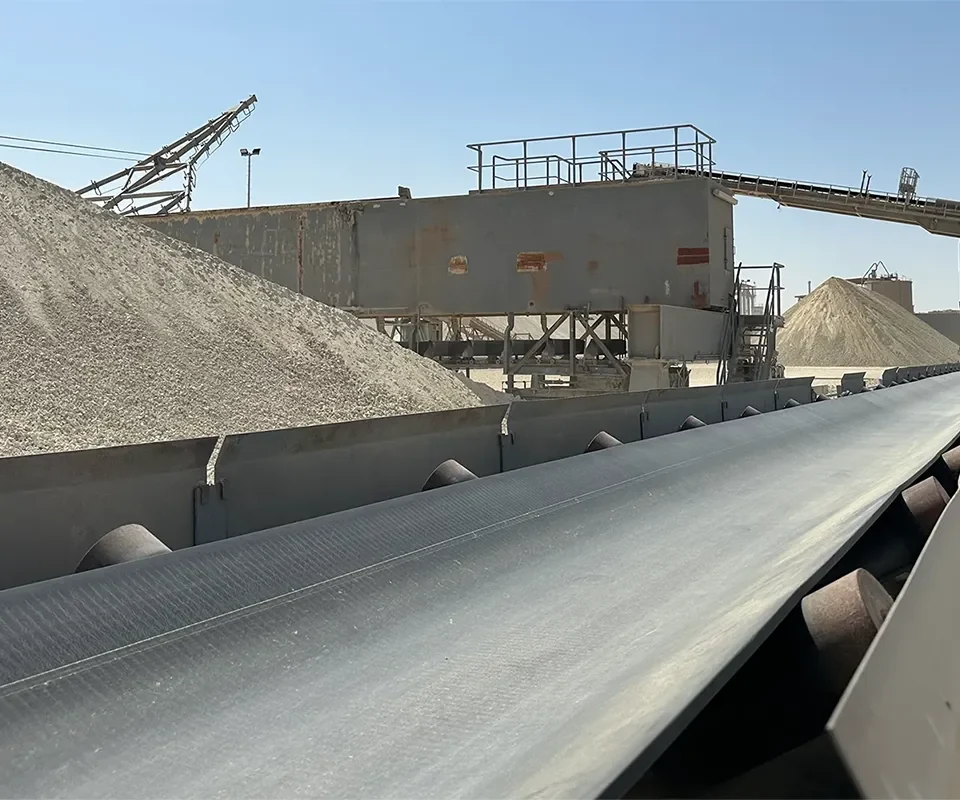
Choosing conveyor belts for long overland conveyors with limited take-up travel requires careful attention to belt elongation, tensile strength, carcass construction, and operating tension. In mining, quarrying, coal handling, and other heavy-duty bulk-material handling applications, a conveyor belt must maintain reliable operation over long distances while accommodating changes in belt length during installation, loading, starting, stopping, and normal service.
For a long-distance conveyor, even a relatively small percentage of belt elongation can produce several metres of additional belt length. If the take-up system has insufficient available movement, it may reach its travel limit before the conveyor has completed its expected operating life.
This problem is particularly important when an existing mine overland conveyor has a restricted take-up tower, limited trolley movement, or insufficient installation space for a longer tensioning system. Increasing the conveyor’s take-up travel may require substantial structural modifications, making belt construction an important part of the solution.
Different conveyor belt carcasses have different elongation characteristics. Polyester-nylon (EP), nylon-nylon (NN), and steel cord belts may all provide suitable mechanical performance under specific conditions, but they do not require identical take-up allowances.
The correct choice must balance elastic elongation, permanent elongation, working tension, belt modulus, take-up travel, splice allowance, pulley compatibility, and the complete operating load range.
Quick answer: For long overland conveyors with limited take-up travel, prioritize a belt construction with sufficiently low longitudinal elongation at the actual working tension. Steel cord belts are often strong candidates because of their high tensile strength and low elongation. Suitable low-elongation EP fabric belts may also be practical where the operating tension and required take-up movement remain within the available limits. NN belts generally require closer examination because nylon reinforcement tends to exhibit greater longitudinal elongation. Final selection must be based on supplier-specific elongation data, conveyor tension calculations, take-up geometry, splice requirements, and the available movement in both directions.
Why Limited Take-Up Travel Matters on Long Overland Conveyors
The take-up system performs several important functions in a belt conveyor. It helps maintain adequate tension for drive pulley traction, limits excessive sag between idlers, and accommodates changes in the effective length of the belt.
These responsibilities become more demanding as conveyor length increases. A mine overland conveyor may extend several kilometres, so small changes in longitudinal belt strain can represent substantial overall length changes.
When the available take-up travel is limited, several problems may develop:
- The take-up pulley or carriage may approach its mechanical travel limit.
- The system may become unable to compensate for additional belt elongation.
- Insufficient belt tension may contribute to drive pulley slip.
- Excessive belt sag may develop in certain conveyor sections.
- The remaining movement may be insufficient for startup or stopping transients.
- Future belt shortening or splice replacement may require additional maintenance.
- Unexpected tension changes may increase wear or create operating instability.
It is important to distinguish between a take-up with insufficient physical travel and a take-up that cannot provide the required tension. These are related but different design problems.
For additional background, see Belt Conveyor Take-Up Systems: Types and Selection Guide.
1. Understand Elastic and Permanent Belt Elongation
Before comparing conveyor belt materials, buyers should understand the difference between elastic elongation and permanent elongation.
Elastic Elongation
Elastic elongation is the recoverable change in belt length caused by tensile loading. As belt tension increases, the belt stretches. When tension decreases, the belt tends to recover toward its previous length.
This behavior is particularly important during startup, acceleration, loaded operation, deceleration, and changes in material throughput.
The amount of elastic elongation depends on the belt’s longitudinal stiffness and the tension applied to it. Two belts with the same nominal tensile strength may have different elastic elongation characteristics.
Permanent Elongation
Permanent elongation is the portion of belt length change that does not recover after unloading under the specified evaluation conditions.
It may develop through the initial settling of the carcass and other time-dependent material behavior. The amount depends on the belt construction, applied tension, temperature, and operating history.
Permanent elongation can gradually consume available take-up movement even when the conveyor operates at a relatively stable load.
| Characteristic | Elastic Elongation | Permanent Elongation |
| Main Cause | Changes in tensile loading | Nonrecoverable and time-dependent changes in belt length |
| Recovery | Generally recoverable after unloading | Does not fully recover under the evaluation conditions |
| Operational Importance | Take-up movement during operating changes | Long-term consumption of take-up adjustment |
| Selection Requirement | Working-tension elongation data | Expected residual elongation and service allowance |
Both must be considered when determining the take-up movement required throughout the life of the conveyor. Because elastic movement and permanent elongation occur at different times, engineering calculations should evaluate the full range of take-up positions rather than simply combining unrelated maximum values.
2. Compare EP, NN and Steel Cord Conveyor Belts
Carcass construction is one of the most important factors affecting longitudinal belt elongation.
For long overland conveyors with restricted take-up movement, the comparison should focus on the belt’s actual elongation under working tension, not simply its nominal tensile rating.
EP Fabric Conveyor Belts
EP belts use polyester yarns in the longitudinal direction and nylon yarns in the transverse direction. This construction combines useful tensile strength, flexibility, and dimensional stability.
Compared with conventional NN carcasses of otherwise comparable design, EP reinforcement generally offers lower longitudinal elongation because polyester has different mechanical properties from nylon.
Suitable EP belts may therefore be considered for overland conveyors where fabric construction is preferred and the available take-up travel is sufficient for the calculated elongation.
NN Nylon Conveyor Belts
NN belts use nylon reinforcement in both longitudinal and transverse directions. They can offer useful flexibility and impact-related performance for certain bulk-material handling duties.
However, nylon-based longitudinal reinforcement commonly exhibits greater elongation than polyester-based reinforcement. This can increase the take-up movement required on a long conveyor.
Where take-up travel is severely restricted, an NN belt should not be selected without verifying its actual working-tension elongation and long-term dimensional behavior.
Steel Cord Conveyor Belts
Steel cord belts use longitudinal steel cords as the primary tensile reinforcement. Their high longitudinal stiffness and relatively low elongation make them important candidates for long-distance, high-tension mine overland conveyors.
Where a fabric belt would require more take-up movement than the existing system can provide, a suitably specified steel cord belt may offer a practical alternative.
Nevertheless, steel cord belts require careful attention to splice construction, pulley diameter, carcass strength, belt mass, troughability, and longitudinal rip protection.
| Comparison | EP Fabric Belt | NN Nylon Belt | Steel Cord Belt |
| Longitudinal Reinforcement | Polyester | Nylon | Steel cords |
| Relative Elongation | Generally lower than comparable NN belts | Generally greater longitudinal elongation | Typically low longitudinal elongation |
| Main Advantage | Balanced mechanical performance and stability | Flexibility and useful impact performance | High strength and dimensional stability |
| Take-Up Consideration | Verify elongation against travel limit | May require substantial travel allowance | Often favorable where available travel is restricted |
| Important Limitation | Higher elongation than some steel cord designs | Longitudinal stretch and adjustment requirements | Splicing, pulley compatibility and rip protection |
| Potential Application | Suitable moderate- to long-distance bulk conveyors | Selected impact-intensive applications | Long-distance, high-tension overland conveyors |
These are general material tendencies. The actual difference depends on belt construction, tensile rating, reinforcement grade, working tension, and supplier-specific testing.
3. Why Steel Cord Belts Are Often Preferred When Travel Is Limited
The main reason for considering a steel cord belt is its high longitudinal stiffness. Under comparable working conditions, a correctly engineered steel cord belt can generally limit elastic elongation more effectively than conventional fabric alternatives.
On a short conveyor, the difference in elongation between belt constructions may represent only a relatively small movement. On a conveyor extending several kilometres, that same percentage difference can become operationally significant.
Steel cord belts can also provide the high tensile ratings required for demanding mine overland installations, including conveyors with substantial elevation changes, high throughput, and significant drive forces.
However, buyers should not automatically switch to steel cord solely because the available travel is short. The conveyor must also accommodate the selected belt’s mechanical and maintenance requirements.
For related product information, see Steel Cord Conveyor Belts for Long-Distance Conveyors.
4. Do Not Confuse Belt Tensile Strength with Low Elongation
One common purchasing mistake is assuming that choosing a higher tensile-strength belt automatically solves a take-up travel problem.
Belt tensile rating indicates the specified strength capacity of the carcass. Longitudinal stiffness, sometimes described through belt modulus or stress-strain behavior, determines how much the belt elongates under a particular tensile load.
Although strength and stiffness can be related through carcass design, they are not interchangeable specifications.
Two belts may have the same nominal tensile rating but different operating elongation because of differences in reinforcement material, weave, cord construction, ply arrangement, and manufacturing methods.
For take-up-constrained projects, request actual elastic and permanent elongation data, or suitable modulus information, for the proposed belt construction and relevant working-tension range.
Key procurement principle: A high-strength belt is not necessarily a low-elongation belt. Specify both the required tensile rating and the acceptable longitudinal elongation behavior under actual operating conditions.
5. Calculate Required Take-Up Travel from Belt Length Change
The required take-up travel depends on the change in effective belt length and the geometry of the take-up arrangement.
For a simplified calculation, the total change in belt length resulting from a uniform incremental longitudinal strain can be written as:
ΔL = L × ε
ΔL: Change in belt length; L: Belt loop length; ε: Incremental longitudinal strain expressed as a decimal.
In a common arrangement where a movable take-up pulley changes the length of two nearly parallel belt spans, its movement changes the effective belt path by approximately twice the pulley travel.
Under this simplified geometry:
Take-Up Pulley Travel ≈ ΔL / 2
This relationship applies only to the stated two-span geometry and does not include installation, splice, maintenance, or operating reserve allowances.
The relationship should not be applied blindly to every gravity, winch, or reeved take-up system. The actual movement ratio depends on the path geometry and arrangement of the movable pulleys.
Furthermore, belt tension is not uniform around a long conveyor. A detailed design should account for elongation along the actual carrying and return tension profiles rather than applying one constant strain to every section.
6. Example: Belt Elongation on a 3 km Overland Conveyor
Consider an illustrative overland conveyor with a center distance of approximately 3000 m and a circulating belt length of approximately 6000 m, before accounting for smaller additional pulley-path lengths.
Assume that two proposed belt constructions have different hypothetical incremental elongation values over the operating conditions being compared.
| Calculation Item | Option A | Option B |
| Belt Loop Length | 6000 m | 6000 m |
| Assumed Incremental Elongation | 0.20% | 0.60% |
| Resulting Belt Length Change | 12 m | 36 m |
| Approximate Two-Span Pulley Travel | 6 m | 18 m |
Suppose the available take-up stroke is 10 m. Option A would require approximately 6 m for this assumed length change, leaving 4 m of nominal travel that would still need to be assessed against installation position, splice work, operating transients, and other reserves.
Option B would require approximately 18 m of travel under the same simplified assumptions, exceeding the available stroke before additional allowances are considered.
The example illustrates why belt stiffness can become decisive on long conveyors. The assumed elongation values are not guaranteed properties of particular EP, NN, or steel cord products.
Actual belt selection should use supplier-specific data at the calculated tension levels and a verified take-up movement model.
7. Determine the Actual Available Take-Up Movement
The nominal stroke of the take-up system is not always the same as the movement available for future belt elongation.
A gravity take-up tower may have a specified total travel, but part of that movement may already be consumed by the installed belt length and initial tensioning position.
Physical stops, structural clearances, counterweight position, carriage limits, and safety devices may further restrict usable movement.
For an existing conveyor, record:
- Total mechanical take-up stroke.
- Current position relative to each travel limit.
- Movement available to compensate for additional elongation.
- Movement available in the opposite direction.
- Required clearances for startup, stopping, and dynamic movement.
- Allowance for belt shortening or future splice replacement.
- Limit-switch positions and approved operating boundaries.
A take-up may appear to have adequate total stroke but still be unsuitable if the initial pulley position leaves insufficient travel in the direction required during normal operation.
8. Assess Take-Up Travel in Both Directions
The take-up must accommodate more than progressive belt elongation.
During changes in conveyor tension, the belt can extend or recover elastically. Depending on the take-up arrangement, this causes the movable pulley or carriage to change position in either direction.
If all available travel is allocated to long-term elongation, the system may have insufficient remaining movement to handle other operating conditions.
The required movement range should be determined from the minimum and maximum take-up positions across the complete operating envelope, including the installed condition, running states, and applicable transients.
For a constrained installation, the initial take-up position should be selected through an approved engineering and installation procedure, not by placing the pulley arbitrarily near one end of its stroke.
9. Evaluate Belt Elongation at Actual Working Tension
A belt’s elongation should be evaluated at the tensile loads it will actually experience, not only at an arbitrary fraction of its rated strength.
On a long overland conveyor, belt tension varies along the route. The tension near the drive pulley may differ substantially from the tension in the return section or near the take-up.
Slope, material load, operating resistance, drive arrangement, and take-up location all influence the tension profile.
The manufacturer should receive the calculated belt tension distribution and provide appropriate stress-strain or elongation data for the proposed carcass.
This is particularly important when comparing a high-modulus EP belt with a steel cord alternative. The difference in elongation should be assessed under comparable operating conditions and the same design assumptions.
10. How Belt Modulus Affects Take-Up Travel
Longitudinal belt modulus describes the relationship between tensile loading and elongation within the relevant test or design range.
A belt with greater longitudinal stiffness generally experiences less elastic elongation than a lower-stiffness belt under an equivalent applied load, all other relevant conditions being equal.
However, conveyor belts may not follow a perfectly linear stress-strain relationship over all loading conditions. Material behavior can also change with repeated loading, temperature, and service history.
For procurement, ask suppliers for usable elongation data or the appropriate modulus information for the intended working-tension range rather than relying on a single unsupported stiffness claim.
A relevant reference is ISO 9856:2016, which provides methods for determining conveyor belt elastic and permanent elongation and calculating elastic modulus.
Laboratory test data help characterize the belt, but they do not independently determine the take-up travel of a complete overland conveyor. The installed belt length, tension profile, operating conditions, and take-up geometry must still be evaluated.
11. Starting and Stopping Can Create Additional Travel Requirements
Long overland conveyors experience transient tension changes during startup, acceleration, deceleration, and stopping.
Because the conveyor belt has substantial length and elasticity, changes in drive force do not produce identical tension changes at every point instantaneously.
Tension disturbances travel through the belt and can produce temporary differences in elongation and take-up movement.
For this reason, steady-state elongation calculations may not be enough for particularly long or high-powered conveyors.
Dynamic analysis may be required to determine maximum belt tension, minimum tension, take-up displacement, take-up velocity, and the behavior of the system during acceleration and braking.
Controlled starting and stopping can help manage transient loads, but they cannot eliminate the underlying elongation characteristics of the belt.
Important: A belt that fits within the take-up travel during normal steady operation may still be unsuitable if startup or stopping causes the movable pulley to reach a travel limit. Evaluate the operating and dynamic movement range before approving a low-travel belt specification.
12. Take-Up System Type Changes the Selection Process
Different take-up arrangements respond differently to belt elongation and tension changes.
Gravity Take-Up
A gravity take-up uses a counterweight to provide tension through a movable pulley or carriage arrangement. Its position changes as the belt’s effective length changes.
A low-elongation belt may reduce the required movement, but the counterweight force, available stroke, dynamic behavior, and structural clearances must still be verified.
Winch Take-Up
A winch take-up may adjust the pulley position manually or through a controlled mechanism, depending on the design.
Some arrangements hold position between adjustments, while others use automatic tension control. Their response to changes in belt elongation is therefore not identical.
When the available travel is limited, the control strategy and ability to maintain the required tension across all operating conditions become important.
Fixed-Position Take-Up Arrangements
A fixed-position arrangement does not automatically compensate for operating belt-length changes through continuous pulley movement. As elongation develops, the belt tension may change unless the position is adjusted.
For a long conveyor, this behavior requires careful evaluation of the expected belt strain, adjustment frequency, and minimum operating tension.
13. Low Elongation Does Not Remove the Need for Correct Tension
Selecting a low-elongation belt can reduce the take-up movement required, but it does not eliminate the need to maintain adequate belt tension.
The conveyor must still provide enough tension at the drive pulley to transmit the required torque without unacceptable slip. It must also control belt sag and maintain suitable contact with the supporting idlers.
An excessively high take-up force is not a reliable solution to inadequate travel. Increasing tension can increase stresses in the belt, pulleys, bearings, shafts, and supporting structure.
The selected belt and take-up arrangement must satisfy both the required tension range and the necessary movement range.
14. Check Drive Pulley Traction and Lagging
Take-up tension is closely related to drive pulley traction.
If the belt tension falls below the level required for reliable torque transmission, drive pulley slip may occur. This can produce rubber cover wear, lagging damage, heat generation, and operating interruptions.
When comparing belts for a limited-travel system, the pulley wrap angle, lagging condition, required drive force, and expected friction should also be reviewed.
Suitable lagging and pulley geometry can support traction performance, but they do not directly eliminate the belt-length changes that the take-up must accommodate.
The final belt and pulley specification should be compatible under normal running, startup, and stopping conditions.
15. Verify Pulley Diameter Before Switching to Steel Cord Belts
Changing from a fabric belt to a steel cord belt can reduce elongation requirements, but the replacement must be compatible with the existing pulleys.
Steel cord belts have different bending and carcass characteristics from fabric belts. Minimum recommended pulley diameter depends on belt tensile rating, cord construction, splice design, and pulley duty.
A pulley diameter suitable for the previous EP belt may not automatically meet the requirements of a proposed steel cord replacement.
Check the drive, tail, bend, snub, and take-up pulleys, together with transition distances, belt cleaners, and supporting idlers.
If major pulley replacement is required, the resulting cost and installation work should be included in the comparison between belt options.
16. Splice Design and Future Maintenance Allowance
The belt splice is a critical part of a long overland conveyor. It must provide the required mechanical performance and maintain reliable operation under repeated loading.
Fabric and steel cord belts use different splice constructions and installation procedures. Steel cord splices in particular require careful preparation and control of the cord arrangement, splice length, materials, and curing process.
For conveyors with limited take-up travel, the installation plan should also address the length of belt required for closing the initial splice and the movement available for future repair or re-splicing.
Splice allowances should not be confused with elastic elongation. They are separate installation and maintenance considerations that must be included in the overall belt-length and take-up-position plan.
Where the available take-up travel is very restricted, future shortening and re-splicing procedures should be agreed before the new belt is installed.
17. Consider Temperature, Moisture and Environmental Conditions
Belt elongation and operating behavior can be affected by environmental conditions.
High ambient temperatures, hot conveyed material, and repeated thermal cycles may change the behavior of rubber and reinforcement materials. Different textile and steel cord constructions can respond differently to these conditions.
Moisture exposure can also affect certain textile reinforcement systems and related belt components. For outdoor overland conveyors, humidity, rain, temperature changes, and long-term weather exposure should be included in the specification.
When evaluating a replacement belt, request material properties relevant to the expected operating environment instead of assuming laboratory values remain unchanged under all site conditions.
18. Low Rolling Resistance and Belt Elongation Are Different Requirements
Low rolling resistance is an important consideration for some long overland conveyors because the belt and idlers contribute significantly to system operating resistance.
However, low rolling resistance and low longitudinal elongation are not the same property.
Low rolling resistance generally concerns the belt’s behavior as it passes over supporting idlers and the resulting energy losses. Longitudinal elongation concerns the response of the carcass to tensile loading.
An overland belt may need both characteristics, but they should be specified and evaluated separately.
Reducing operating resistance may influence conveyor tensions, but it does not guarantee that the available take-up travel will be sufficient for the selected belt.
19. Warning Signs That Take-Up Travel Is Becoming Insufficient
On an existing conveyor, take-up movement records and operating observations can help identify whether the current belt and take-up arrangement are approaching their limits.
| Observed Condition | Possible Explanation | Recommended Investigation |
| Take-Up Near Travel Limit | Belt elongation or incorrect initial positioning | Measure position and compare with original setup |
| Progressive Take-Up Movement | Permanent elongation or changes in operating conditions | Review belt age, load history, and tension records |
| Drive Pulley Slip | Insufficient traction, low tension, or lagging problems | Check take-up, drive force, wrap and lagging |
| Excessive Belt Sag | Insufficient local tension or support problems | Review tension distribution and idler spacing |
| Abnormal Take-Up Movement During Starts | Transient tension changes or take-up dynamics | Review startup records and dynamic analysis |
| Repeated Belt Shortening | Long-term elongation exceeding adjustment expectations | Review belt modulus, permanent elongation, and available travel |
These symptoms do not independently prove that the belt has excessive elongation. Take-up mechanical problems, pulley friction, idler resistance, incorrect tension settings, and installation errors can produce similar symptoms.
Any investigation near moving take-up equipment must follow approved isolation and safety procedures. Counterweights and other tensioned equipment can store substantial mechanical energy.
20. Can a Higher-Tension Belt Solve a Short Take-Up Problem?
A stronger belt may provide useful mechanical capacity, but simply increasing its tensile rating does not guarantee reduced take-up travel.
The relevant question is whether the proposed carcass provides the required longitudinal stiffness and permanent elongation performance at the conveyor’s actual tension levels.
Changing to a stronger or stiffer construction can also influence pulley requirements, troughability, weight, and splicing procedures.
Therefore, a replacement belt should be selected through a complete mechanical review rather than by increasing the tensile rating alone.
21. When Should the Take-Up System Be Modified Instead of the Belt?
Sometimes no practical belt construction can satisfy all the mechanical requirements within the available take-up travel.
For example, the selected belt may need a particular tensile rating, carcass flexibility, splice design, or pulley diameter that limits the available low-elongation options.
In such cases, the engineering team may need to evaluate modifications to the take-up arrangement.
Possible measures include increasing the available stroke, modifying the take-up location, changing the approved take-up geometry, or considering a different tension-control arrangement.
Any modification must account for pulley forces, structural loading, control behavior, counterweight or winch capacity, guarding, and travel limits.
When the calculated minimum required movement exceeds the safely available travel, selecting a stronger belt or increasing initial tension is not a substitute for correcting the design constraint.
22. Standards and Technical Data for Belt Selection
Technical standards provide useful reference methods for establishing belt properties and conveyor loading requirements.
| Reference | Purpose | Relevance to Limited Travel |
| ISO 9856:2016 | Determination of elastic and permanent elongation and calculation of modulus | Supports comparison of carcass elongation properties |
| ISO 5048:1989 | Calculation of conveyor operating power and tensile forces | Supports determination of operating tension requirements |
| ISO 14890:2026 | Requirements for textile-construction conveyor belts for general use | Supports fabric belt specification |
| ISO 15236-1:2016 | Design, dimensions, and mechanical requirements for steel cord belts | Supports steel cord construction specification |
These standards address different aspects of conveyor belt performance and design. They should not be interpreted as providing a universal allowable take-up travel for every long overland conveyor.
The complete take-up movement requirement must be established through project-specific calculations using the appropriate belt data and conveyor arrangement.
23. A Practical Selection Process for Limited Take-Up Travel
Step 1: Confirm conveyor geometry. Record center distance, belt loop length, route profile, drive arrangement, and take-up location.
Step 2: Measure the available take-up travel. Establish the total stroke, current position, and allowable movement in both directions.
Step 3: Obtain conveyor tension calculations. Include normal, maximum, minimum, startup, stopping, and other relevant conditions.
Step 4: Compare belt carcasses. Evaluate EP, NN, steel cord, and suitable special constructions using their actual elongation data.
Step 5: Calculate belt-length changes. Consider elastic elongation, permanent elongation, and relevant environmental effects.
Step 6: Convert length changes into pulley travel. Use the actual take-up geometry and movement ratio.
Step 7: Include installation and maintenance needs. Check initial positioning, splice requirements, future repair, and reserve travel.
Step 8: Verify conveyor compatibility. Check pulley diameters, idlers, drive traction, belt strength, and splice construction.
Step 9: Review dynamic behavior. Confirm acceptable take-up movement and tension during relevant starting and stopping conditions.
Step 10: Approve the complete belt specification. Obtain engineering acceptance before production, installation, or structural modification.
24. What Information Should Be Included in the Belt RFQ?
For limited-travel overland conveyors, the request for quotation should include additional elongation and take-up information beyond the conventional belt width, tensile rating, and cover thickness.
| RFQ Category | Information Required |
| Conveyor Geometry | Center distance, total belt loop length, elevation profile, conveyor alignment |
| Material and Capacity | Material type, bulk density, maximum lump size, throughput |
| Belt Requirements | Width, speed, tensile rating, carcass type, cover grade, cover thickness |
| Tension Information | Tension distribution, maximum and minimum tension, startup and stopping loads |
| Take-Up Details | Type, pulley arrangement, stroke, initial position, available travel, tension force |
| Elongation Requirements | Maximum acceptable working elongation, permanent elongation, modulus data |
| Splice Requirements | Splice method, joint requirements, installation and future repair allowances |
| Pulley and Idler Compatibility | Pulley diameters, trough angles, idler spacing, mounting geometry |
| Operating Environment | Temperature, moisture, outdoor exposure, abrasiveness, operating schedule |
| Quality and Delivery | Applicable standards, test data, manufacturing requirements, roll lengths and delivery |
25. Common Mistakes When Selecting Belts for Limited Take-Up Travel
Mistake 1: Selecting Only by Tensile Rating
Tensile strength does not independently establish elongation. The relevant longitudinal stiffness and permanent elongation characteristics must be verified.
Mistake 2: Using a Generic Elongation Percentage
Different manufacturers and carcass constructions have different elongation behavior. Generic percentages may be useful for preliminary screening but should not replace actual belt data.
Mistake 3: Confusing Belt Loop Length with Take-Up Stroke
Belt length change and take-up pulley movement are not necessarily equal. The conversion depends on the actual take-up geometry.
Mistake 4: Ignoring the Initial Take-Up Position
A system can have adequate nominal stroke but insufficient usable travel if the pulley is incorrectly positioned at installation.
Mistake 5: Assuming Steel Cord Automatically Solves Every Problem
Steel cord belts commonly offer low elongation, but pulley compatibility, splice construction, rip protection, carcass strength, and the full travel requirement must still be checked.
Mistake 6: Increasing Counterweight Force Instead of Checking Travel
Increasing take-up tension cannot create additional mechanical stroke and may increase belt and pulley loading.
Mistake 7: Ignoring Startup and Braking Conditions
A belt may operate normally at steady speed but require additional take-up movement during transient conditions.
Mistake 8: Forgetting Future Splice Maintenance
Available travel must be considered together with installation positioning and the belt-length adjustments required for future maintenance.
How to Compare Conveyor Belt Suppliers for Low-Travel Applications
For long overland conveyors, buyers should compare suppliers according to more than initial price and nominal belt tensile rating.
A suitable supplier should be able to explain the proposed belt construction, provide relevant elongation or modulus information, identify applicable test standards, and clarify any assumptions behind the recommended operating limits.
The quotation should clearly identify the carcass material, tensile rating, cover construction, splice requirements, and dimensional specifications.
For take-up-constrained projects, ask the supplier to confirm whether the proposed belt is expected to remain within the calculated allowable elongation range under the specified working conditions.
Where the existing system is close to its movement limit, require a formal engineering review rather than relying on a general statement that a particular carcass type has low elongation.
Long-Distance Conveyor Belt Solutions from SHENGYUAN
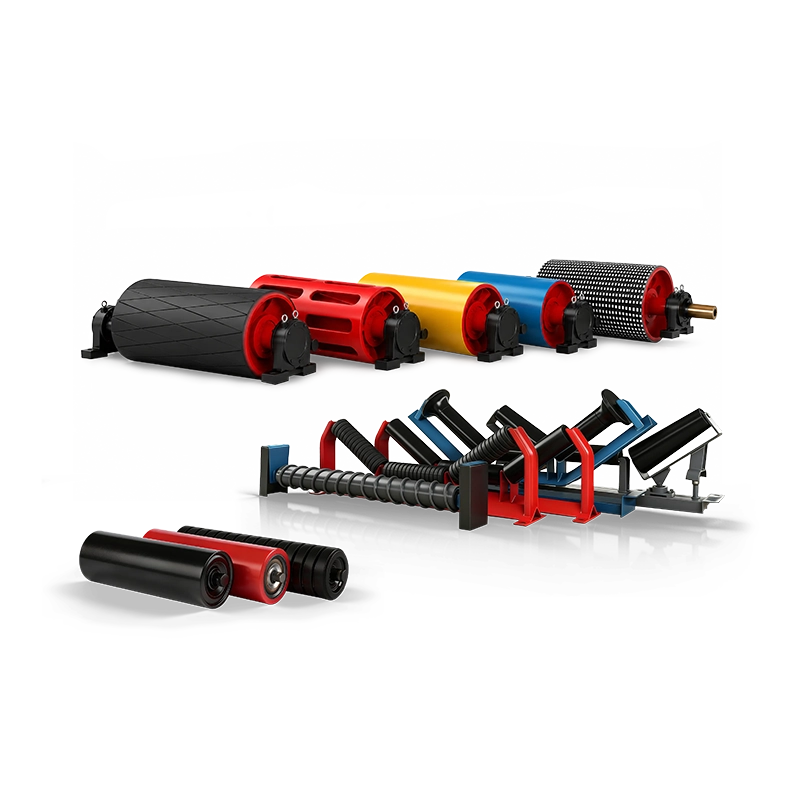
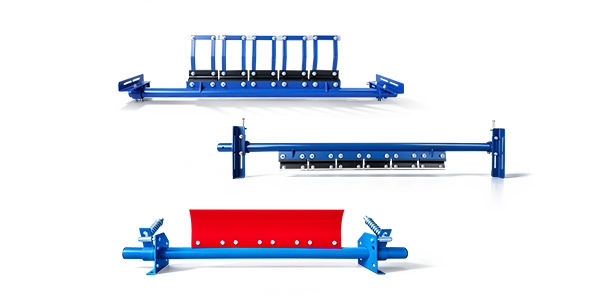
SHENGYUAN supplies conveyor belts, rollers, idlers, pulleys, cleaners, frames, and related components for mining, quarrying, coal handling, cement plants, power stations, ports, steel production, and other heavy-duty bulk-material handling applications.
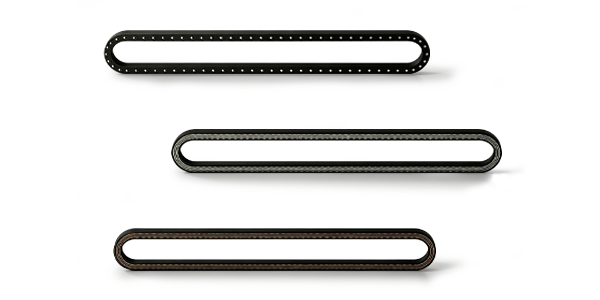
The SWCONS conveyor belt range includes EP fabric belts, NN nylon belts, steel cord belts, and other industrial rubber conveyor belt constructions.
For long overland conveyor projects, belt specifications can be reviewed according to required tensile strength, carcass construction, operating tension, elongation requirements, take-up travel, cover performance, and pulley compatibility.
Through custom conveyor solutions, component requirements can be coordinated using customer drawings, conveyor operating data, and project-specific mechanical specifications.
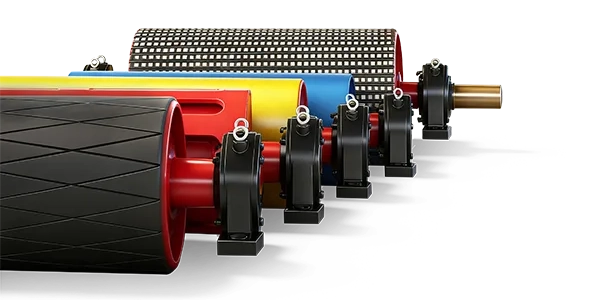
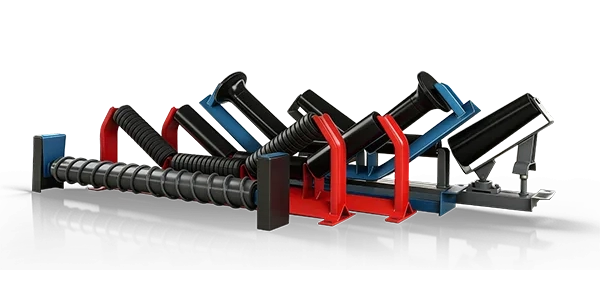
Where a belt replacement affects take-up pulley dimensions, bearings, roller arrangements, or other interfaces, these components should be reviewed together to help avoid installation problems.
Need a low-elongation conveyor belt for a long overland conveyor?
Send the conveyor center distance, total belt loop length, belt width and speed, material capacity, required tensile rating, carrying and return tension data, take-up type, available stroke, current take-up position, pulley diameters, belt construction, splice requirements, and existing elongation or travel problems. These details provide a stronger basis for comparing EP, NN, and steel cord belts and determining whether the proposed replacement can operate within the available take-up range.
Conclusion: Select Belt Stiffness and Take-Up Travel Together
Long overland conveyors with limited take-up travel require a careful balance between belt elongation, tensile strength, operating tension, and mechanical compatibility.
EP fabric belts can offer a useful combination of strength and dimensional stability, while NN belts may require greater consideration of longitudinal elongation. Steel cord belts are often attractive for long-distance, high-tension applications where low elongation is particularly important.
However, no belt construction should be selected using a generic elongation percentage alone. Elastic and permanent elongation must be evaluated using the actual operating tension, supplier data, and conveyor configuration.
The take-up calculation should also account for the movable pulley geometry, usable stroke in both directions, initial installation position, maintenance requirements, and relevant transient operating conditions.
When a low-elongation belt cannot satisfy all these requirements within the available movement, modifying the take-up arrangement may be necessary.
The best conveyor belt for a long overland system with limited take-up travel is not simply the strongest belt or the one with the lowest advertised elongation. It is the belt whose verified stiffness, strength, splice performance, and operating characteristics match the conveyor’s complete tension and take-up movement requirements.