
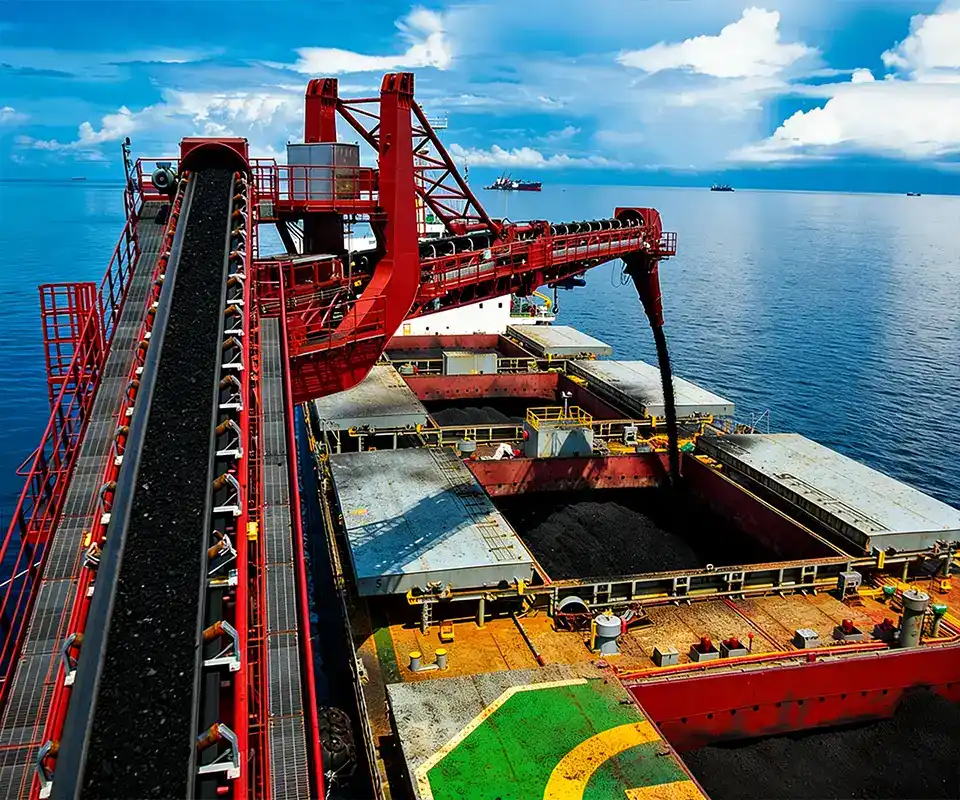
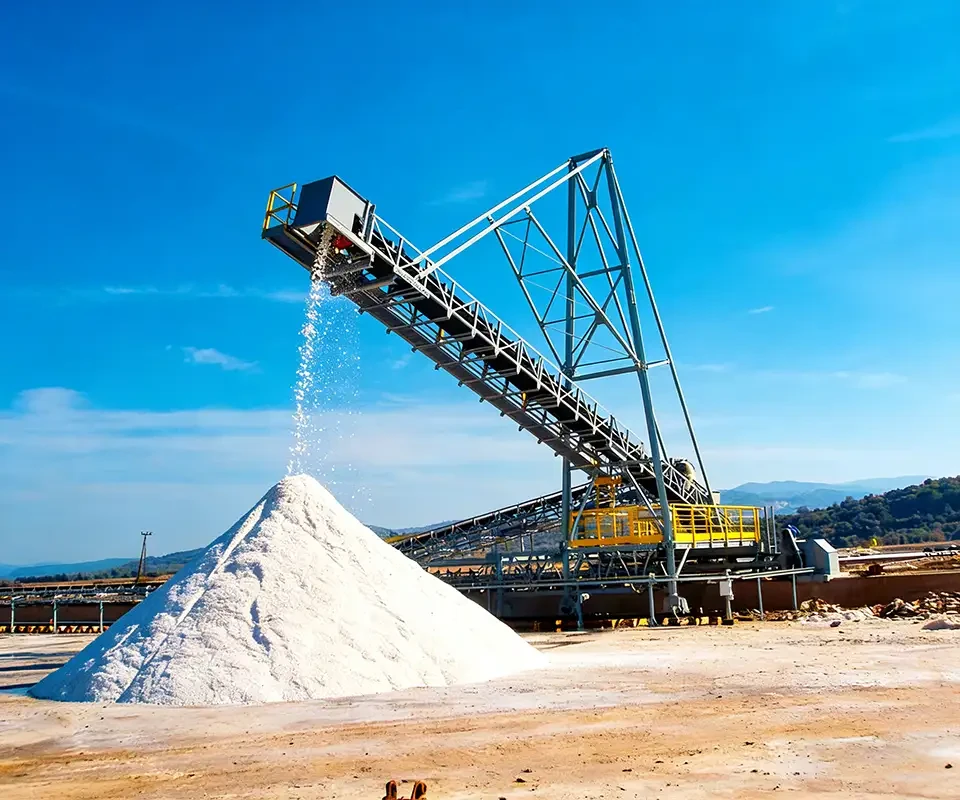
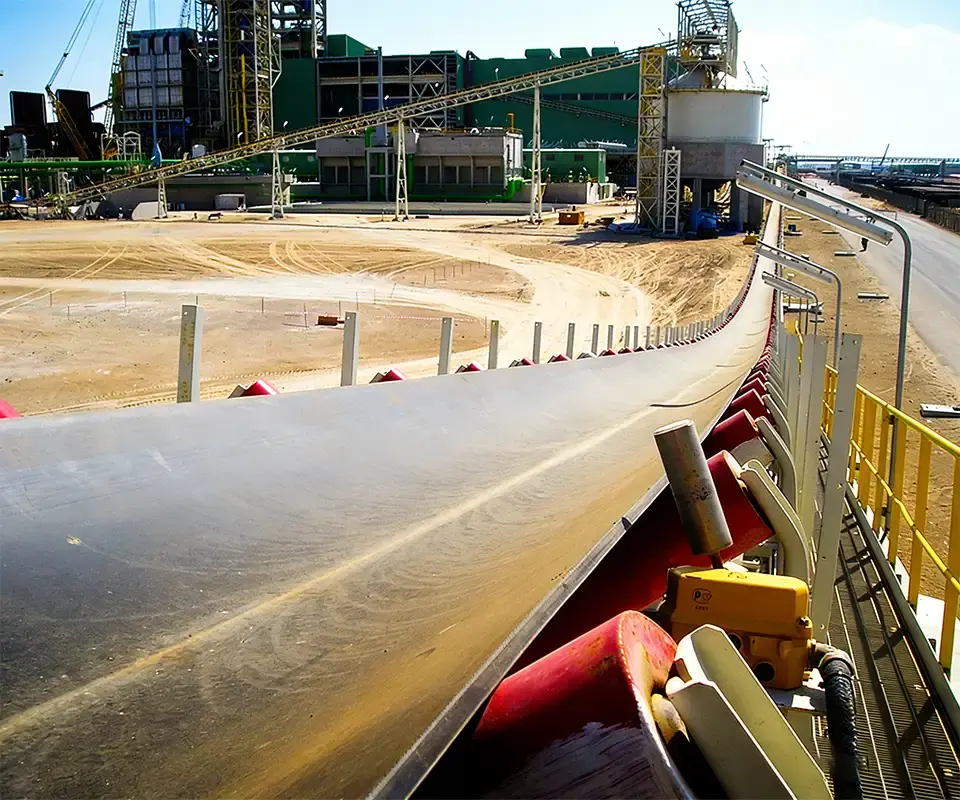
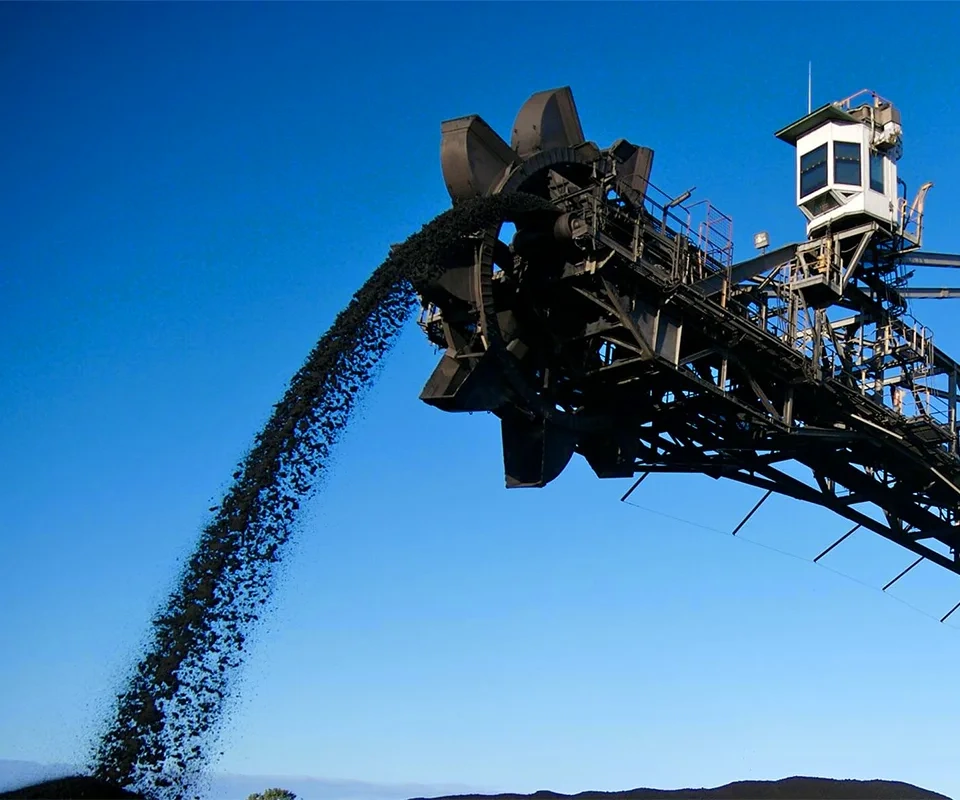
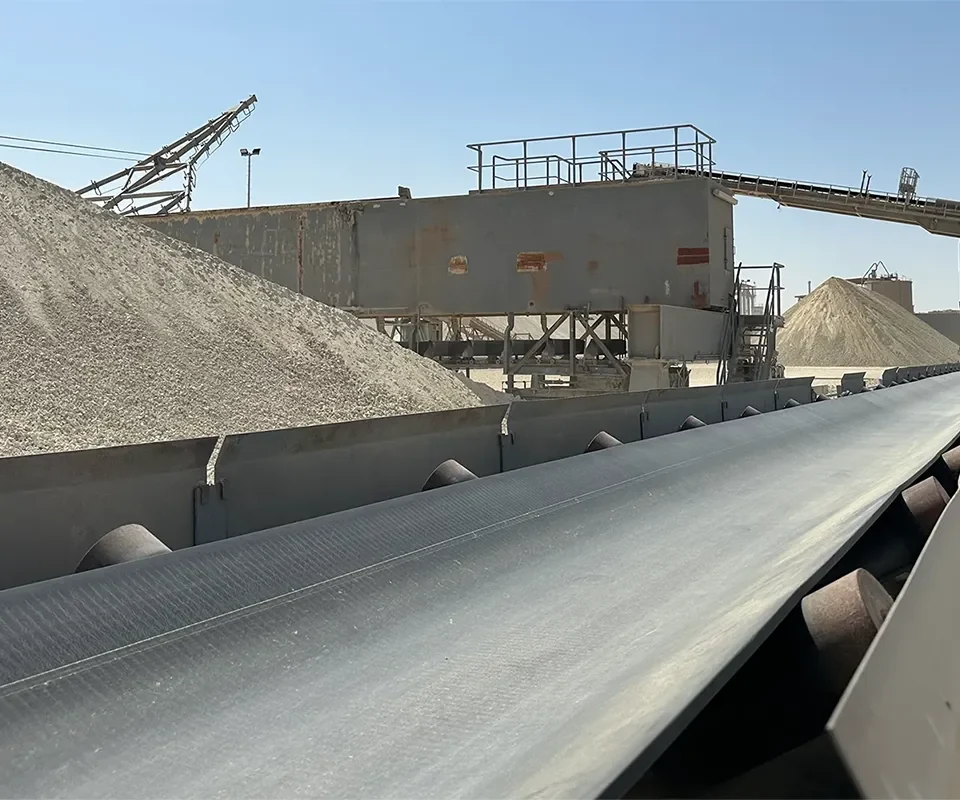
Selecting conveyor belts for filtered tailings stacking requires careful consideration of moisture content, fine-particle behavior, material adhesion, abrasion, conveyor loading, and stacking equipment configuration. In copper, iron ore, gold, and other mineral-processing operations, filtered tailings are commonly transported from filtration plants to storage facilities using fixed conveyors, overland conveyors, mobile conveyors, and stacking systems.
Unlike conventional dry bulk materials, filtered tailings can retain substantial moisture after dewatering. Depending on particle size, mineral composition, filter performance, and operating conditions, the material may behave as a relatively stable filter cake, a cohesive mass that adheres to conveyor surfaces, or a wetter material with reduced handling stability.
These characteristics can create problems involving belt carryback, material buildup, conveyor mistracking, chute blockage, uneven loading, and premature component wear. At the same time, excessively dry filtered tailings may create dust and fine-particle loss during conveying and discharge.
The conveyor belt must also match the mechanical requirements of the stacking system. A long-distance overland conveyor transporting filtered tailings may require a different carcass construction from a short mobile stacker or a repositionable distribution conveyor.
Therefore, the correct conveyor belt should be selected according to filter cake moisture, particle-size distribution, bulk density, adhesion, abrasiveness, belt width, speed, tensile strength, rubber cover properties, incline angle, cleaning requirements, and stacking-system geometry.
Quick answer: For many filtered tailings stacking applications, an appropriately rated EP rubber conveyor belt with a suitable abrasion-resistant cover is a practical starting point. Long-distance or high-tension conveyors may require steel cord belts, while mobile stacking conveyors often benefit from fabric constructions that meet their pulley, flexibility, and operating requirements. However, belt selection must account for the actual filter cake moisture range, adhesion, chemical composition, handling stability, loading surges, carryback, and stacking conditions. No belt material or rubber compound can independently compensate for unstable wet tailings, poor chute design, or inadequate belt cleaning.
What Is Filtered Tailings Stacking?
Filtered tailings stacking is a mine waste management method in which tailings are mechanically dewatered before being transported and placed in a designated tailings storage facility.
The dewatering process commonly includes thickening followed by filtration. Filtration reduces the water content of the tailings and produces a filter cake that may be suitable for mechanical transport by conveyors or trucks, depending on its properties and the project design.
Although the method is frequently called dry stacking, the material is not necessarily completely dry. Filtered tailings retain moisture, and their physical behavior can differ significantly between mineral-processing plants.
An illustrative conveyor-based filtered tailings handling system may include:
- A filter cake collection conveyor beneath the filtration equipment.
- An intermediate transfer conveyor or surge-handling arrangement.
- A fixed overland conveyor transporting tailings toward the storage facility.
- A shiftable or mobile distribution conveyor.
- A tripper, radial stacker, or mobile stacking conveyor.
- Supporting chutes, pulleys, idlers, cleaners, and control equipment.
Not every mine uses this configuration. Some operations combine conveying with truck transport, temporary stockpiles, rehandling, moisture conditioning, and mechanical spreading or compaction.
The conveyor belt is responsible for transporting the filter cake. The overall tailings facility design must separately address placement, drainage, compaction where required, geotechnical stability, and environmental controls.
1. Start with the Actual Filter Cake Properties
The first step in selecting a conveyor belt is understanding the physical and chemical properties of the filtered tailings.
Tailings from different mines can behave differently even when they originate from similar mineral commodities. Particle-size distribution, clay content, mineral composition, process reagents, and filtration conditions influence the final filter cake characteristics.
A copper tailings filter cake containing fine cohesive particles may require different handling arrangements from relatively coarse filtered iron tailings. The same material can also change behavior as moisture content increases or decreases.
| Material Property | Conveyor Risk | Selection Consideration |
| Moisture Content | Stickiness, spillage, unstable flow | Cover suitability, cleaning and loading behavior |
| Fine-Particle Content | Carryback, dust and buildup | Belt surface, cleaning system and enclosure |
| Bulk Density | High material loading | Belt width, tensile rating and idler loads |
| Abrasiveness | Cover wear and component erosion | Rubber abrasion resistance and cover thickness |
| Clay and Cohesive Content | Adhesion and chute blockage | Cleaning performance and transfer-point design |
| Chemical Composition | Possible rubber or metal deterioration | Chemical compatibility and component protection |
A representative material-handling test program should establish these properties across the expected operating range, rather than relying only on a single sample collected under ideal filter performance.
2. Why Filter Cake Moisture Is the Most Important Starting Parameter
Moisture content has a major influence on whether filtered tailings can be transported reliably by a conventional belt conveyor.
Industry publications frequently discuss filtered tailings containing residual moisture in ranges around 12% to 20%, but this is not a universal specification or guaranteed conveying range. Actual moisture requirements depend on tailings properties, the filtration technology, the transportation system, and the approved stacking method.
For procurement, it is important to define whether reported moisture values are calculated on a wet-mass or dry-mass basis. Different reporting conventions can produce different numerical values for the same sample.
As moisture increases, some filter cakes become more cohesive and adhere strongly to the belt. At higher moisture levels, certain tailings may also lose the handling stability required for reliable open-belt conveying.
As moisture decreases, material adhesion may reduce in some applications, but dust generation and fine-particle losses can become more significant.
Important: The objective is not simply to select a conveyor belt that tolerates the highest possible moisture content. The filter cake itself must remain suitable for the planned transportation method. If the material becomes excessively wet or unstable, changes to filtration, surge handling, or transport strategy may be necessary.
3. Evaluate Both Normal and Abnormal Filtration Conditions
Filtered tailings conveyors should not be designed solely for the average moisture content achieved during stable filtration.
Filter performance can change because of feed characteristics, cloth condition, filter cycle settings, equipment availability, or other process factors. These changes may produce filter cake that is wetter, stickier, or less consistent than the nominal design material.
The conveyor specification should therefore identify normal operating moisture, the maximum acceptable moisture for conveying, expected variation, and the operating response when the filter cake falls outside the approved handling range.
Depending on the project, this response may involve diversion to a temporary stockpile, process adjustment, reduced feed rate, or another approved handling strategy.
A stronger belt, thicker rubber cover, or more aggressive cleaner cannot guarantee reliable transport if the tailings no longer behave as a stable bulk material.
4. Select EP, NN or Steel Cord Belt Construction
Carcass selection depends primarily on belt tension, conveyor length, mechanical loading, flexibility, elongation requirements, and the arrangement of the stacking system.
EP Fabric Conveyor Belts
EP conveyor belts use polyester reinforcement longitudinally and nylon reinforcement transversely. They provide a practical combination of tensile strength, dimensional stability, and flexibility for many heavy-duty bulk-material handling applications.
For filtered tailings collection conveyors, intermediate conveyors, and certain mobile stacking conveyors, a suitably rated EP fabric belt may be a good starting point.
The required ply construction, tensile rating, and cover specification must be selected from the actual conveyor duty rather than from the material name alone.
NN Nylon Conveyor Belts
NN belts use nylon reinforcement in both longitudinal and transverse directions. They can provide useful flexibility and mechanical performance in certain demanding loading applications.
However, NN belts generally require closer consideration of longitudinal elongation. This is particularly important for long conveyors or mobile stacking equipment with limited take-up movement.
Steel Cord Conveyor Belts
Steel cord belts are often considered for long-distance, high-capacity, and high-tension mine conveyors because of their high longitudinal strength and relatively low elongation.
They may be appropriate for the main overland conveyor transporting filtered tailings from the filtration plant to the storage facility, depending on the calculated tension and length.
However, they are not automatically suitable for every short mobile conveyor or tripper arrangement. Pulley diameters, bending requirements, splices, and maintenance procedures must be verified.
| Belt Construction | Potential Application | Main Selection Concern |
| EP Fabric Belt | Collection, transfer and selected mobile stacking conveyors | Tensile rating, cover wear, flexibility and allowable elongation |
| NN Nylon Belt | Selected flexible, impact-demanding conveyor duties | Longitudinal elongation and take-up requirements |
| Steel Cord Belt | Long-distance, high-tension tailings overland conveyors | Pulley diameter, splices, carcass integrity and installation requirements |
For a broader explanation of carcass construction, see How to Choose Rubber Conveyor Belts for Heavy-Duty Bulk Material Handling.
5. Choose a Suitable Rubber Cover for Abrasive Fine Tailings
Filtered tailings may contain fine mineral particles that cause progressive wear of the carrying-side rubber cover.
Even when large sharp particles are absent, continuous contact with abrasive fines can damage the belt over long operating periods. Material trapped between the belt and supporting components can produce additional local abrasion.
An appropriate abrasion-resistant rubber compound is therefore an important option for many filtered tailings handling systems.
However, maximum abrasion resistance is not the only selection criterion. The cover must also be compatible with the expected moisture, chemical environment, cleaning system, temperature, and flexibility requirements.
Some projects may require additional chemical resistance if the filter cake contains process residues or chemical constituents that can affect standard rubber compounds.
The correct cover grade should be chosen from actual material properties and relevant testing, not simply the assumption that all mining tailings require the same rubber formulation.
6. Does a Thicker Rubber Cover Reduce Tailings Carryback?
Increasing cover thickness can provide additional material for abrasion and wear, but it does not automatically reduce the adhesion of wet tailings to the belt.
Carryback is influenced by material moisture, fine-particle content, rubber surface condition, belt speed, pulley geometry, and the effectiveness of the cleaning system.
A thicker cover may improve wear allowance in abrasive conditions. However, it also increases belt weight, cost, and sometimes bending demands around smaller pulleys.
For mobile stacking equipment, unnecessary belt thickness can also affect flexibility and compatibility with compact pulley arrangements.
Cover thickness should be selected for abrasion, expected wear life, and mechanical requirements. Carryback should be addressed primarily through suitable material handling and belt cleaning.
7. Select Belt Width and Speed for Filter Cake Capacity
Belt width and speed determine the available conveying capacity together with the material cross-sectional area and bulk density.
For filtered tailings, the assumed material profile should be based on its actual cohesive and flow characteristics. A surcharge angle taken from a general dry aggregate table may not accurately represent wet filter cake.
The material may enter the conveyor as irregular filter cake pieces, break apart during transfers, or form a more continuous bed after traveling along the belt. These changes can affect the material cross-section and its behavior at discharge points.
A wider belt can provide additional carrying area at a given speed, but the final width must also suit the troughing idlers, pulleys, loading equipment, stacking geometry, and available structural space.
Increasing belt speed may raise theoretical capacity, but it can also change transfer-point behavior, cleaning performance, dust generation, and material spillage.
For a filtered tailings stacking system, belt speed should be selected with the loading and discharge arrangements, rather than maximized independently.
8. Account for Filter Cake Discharge Surges
An important challenge occurs at the filter cake collection conveyor, particularly where pressure filters release material in batches.
A filter press may discharge a substantial quantity of cake over a relatively short period, creating a temporary loading rate much higher than the average plant production rate.
If the conveyor belt and receiving chute are selected using only average hourly throughput, they may be unable to handle these temporary surges without overflow, buildup, or blockage.
Therefore, buyers should obtain both the average production rate and the maximum expected instantaneous or short-duration discharge rate at the collection conveyor.
The filter discharge sequence, number of filters operating simultaneously, and any surge buffering or feeder controls should be reviewed as part of capacity selection.
This issue is also discussed in the 2025 Australian Centre for Geomechanics paper Pressure Filter Collection Systems: Sizing and Optimisation, which emphasizes the importance of accounting for temporary filter cake discharge surges.
9. Belt Carryback Is a Major Maintenance Risk
Carryback occurs when material remains attached to the belt after the main discharge point and travels along the return side.
Filtered tailings can create significant carryback when moisture and fine particles cause the material to adhere strongly to the rubber cover.
If carryback is not controlled, material can accumulate on return rollers, pulleys, conveyor structures, and the ground beneath the conveyor.
This can contribute to:
- Increased housekeeping and maintenance requirements.
- Uneven roller buildup and vibration.
- Belt tracking problems.
- Premature wear of bearings and seals.
- Additional material loss along the conveyor route.
- Contamination of nearby structures or drainage systems.
- Potential environmental management problems.
A suitable belt cleaning system is therefore part of the overall filtered tailings conveyor specification, not an optional accessory to consider only after installation.
10. Choose Belt Cleaners for Wet and Sticky Tailings
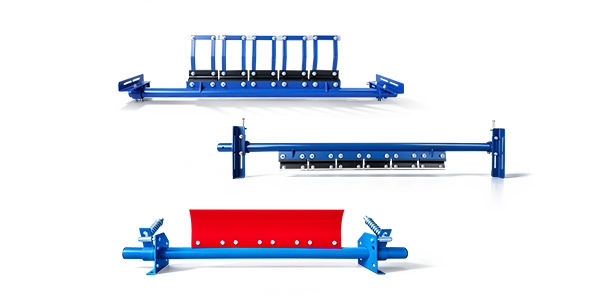
Primary and secondary belt cleaners can be used to reduce material remaining on the belt after discharge.
Primary Belt Cleaner
A primary cleaner is commonly installed near the head pulley to remove much of the material adhering to the belt surface.
Polyurethane blades are frequently considered because they can provide flexible contact with the belt and are available in different hardness and wear-resistant formulations.
Secondary Belt Cleaner
A secondary cleaner may be installed after the head pulley to remove residual fines that remain after primary cleaning.
Polyurethane or appropriately designed tungsten carbide blades may be considered depending on material properties, belt condition, splice compatibility, operating direction, and the cleaner manufacturer’s requirements.
For particularly cohesive tailings, multiple cleaning stages may require evaluation. However, higher blade pressure does not always improve cleaning and can accelerate cover wear or damage the belt if incorrectly applied.
The cleaner should also remain suitable for the conveyor’s operating speed, belt width, discharge arrangement, and maintenance access.
11. Check Return Rollers and Pulley Buildup
Material that escapes the cleaning system can accumulate on return rollers and pulleys.
As buildup becomes uneven, it can change the effective roller surface geometry and contribute to belt movement, vibration, and localized wear.
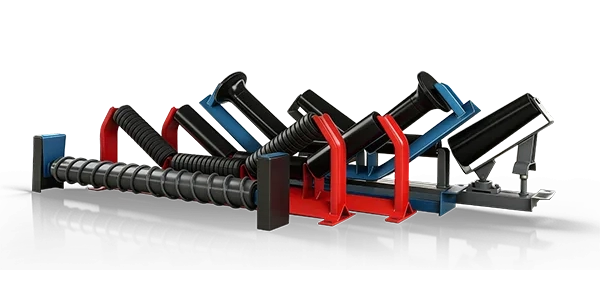
In selected applications, spiral return rollers or rubber disc return rollers may help manage certain deposits, but their effectiveness depends on the tailings characteristics and roller design.
The use of special return rollers should not replace the need for effective belt cleaning and suitable chute discharge.
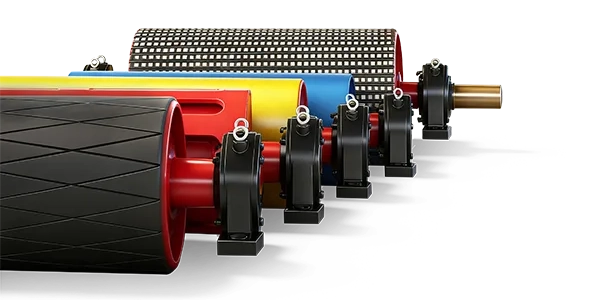
Drive pulley lagging should also be reviewed. Wet fine particles between the belt and pulley can affect traction and contribute to surface wear. Rubber or ceramic lagging may be considered where appropriate, but friction performance must be verified for the operating conditions.
Related roller options can be reviewed in the SWCONS conveyor roller range.
12. Design Transfer Points for Cohesive Filter Cake
Transfer points can be among the most problematic locations in a filtered tailings conveying system.
Wet filter cake may adhere to chute walls, accumulate in corners, or fail to flow consistently through narrow openings. At the same time, material discharged in irregular lumps can create concentrated loading on the receiving belt.
Chute design should therefore be based on tested material flow properties, including wall friction, adhesion, particle-size distribution, and moisture-dependent behavior.
Suitable wear liners, chute geometry, access points, and material-flow control may help reduce buildup, but no single liner material is guaranteed to eliminate sticking under every condition.
Receiving conveyors should provide appropriate impact support and accommodate the maximum credible short-duration material flow.
The loading chute should also place material near the centerline of the receiving belt where practical. Off-center loading can cause mistracking even when the belt, pulleys, and idlers are correctly aligned.
13. Incline Angle and Filter Cake Stability
Conveyor incline angle must be selected according to how the actual filter cake behaves on the moving belt.
Moist filter cake may exhibit cohesion that allows it to maintain a relatively stable mass under certain conditions. However, the same material may deform, slump, or slide when moisture content, vibration, loading, or belt speed changes.
Therefore, high material cohesion should not be treated as proof that a conventional smooth belt can operate reliably at any selected incline angle.
For steep sections, chevron or sidewall conveyor belts may be evaluated where their geometry and maintenance requirements are suitable.
However, cleats and sidewalls can create additional cleaning and material-retention challenges when handling sticky tailings. They should not be selected simply because the material is wet.
The final incline arrangement should be based on representative material testing and the conveyor’s full operating range.
14. Belt Requirements for Mobile and Shiftable Stacking Conveyors
Filtered tailings stacking facilities may use mobile stacking conveyors, grasshopper conveyors, radial stackers, and shiftable conveyors to distribute material across the storage area.
These systems can have different belt requirements from the main fixed overland conveyor.
Mobile and repositionable conveyors may include relatively short belt loops, multiple discharge arrangements, changing conveyor elevations, and compact pulley installations.
Their belts must provide suitable tensile strength while remaining compatible with the installed pulley diameters, take-up travel, frame structure, and operating conditions.
An EP fabric belt may be appropriate for many such applications, but its suitability must be confirmed through the equipment design. Special belt constructions may be required where the stacking conveyor has unusual mechanical or environmental demands.
For projects using traveling trippers, the belt must also be compatible with the repeated bending and pulley path associated with the tripper arrangement.
15. Check Belt Tension, Take-Up Travel and Splice Design
The belt carcass must withstand the calculated operating tension, startup forces, stopping loads, and other applicable mechanical conditions.
For long-distance conveyors, longitudinal elongation can be an important consideration. Steel cord belts are often useful where high tension and low elongation are required, while fabric belts may need greater take-up allowance depending on their construction and working tension.
The take-up system must maintain adequate tension for traction and belt support while accommodating expected changes in belt length.
Splice design also affects service reliability. The splice should match the belt construction, required strength, pulley arrangement, and site maintenance capabilities.
For mobile stacking equipment, maintenance access and available space for splice work may be limited. These practical constraints should be considered when choosing belt type and installation method.
16. Evaluate Dust, Rain and Outdoor Environmental Exposure
Filtered tailings conveyors often operate outdoors across long routes and exposed stacking areas.
Dryer material can generate airborne dust during loading, conveying, and discharge. Wind can increase the loss of fine particles from exposed conveyor systems.
Rainfall can introduce the opposite problem by increasing surface moisture, changing material consistency, and contributing to wet buildup or spillage.
Outdoor belt specifications should therefore consider UV exposure, ambient temperature, seasonal moisture, weather protection, and the condition of the material throughout the route.
Conveyor covers, properly designed enclosures, drainage, and dust-control systems may be necessary depending on the site and environmental requirements.
The selection of an abrasion-resistant rubber belt does not eliminate the need to manage windblown dust, runoff, or potentially contaminated tailings residues.
17. Chemical Compatibility and Corrosion Protection
Filtered tailings can contain dissolved salts, residual processing reagents, or other chemical constituents, depending on the mineral-processing operation.
The chemical environment should be evaluated when selecting belt covers, splice materials, cleaner blades, pulleys, idlers, and structural protection.
Where acidic or alkaline exposure is significant, an appropriate chemically resistant belt compound may be required. However, the suitability of a rubber compound should be verified against the actual chemicals, concentrations, temperature, and exposure duration.
Corrosive moisture can also affect steel roller shafts, bearings, pulley shells, and other metallic parts.
A complete system review is especially important where tailings contain constituents that could affect equipment durability or require special environmental controls.
18. Compare Belt Options for Different Filtered Tailings Conveyor Positions
| Conveyor Position | Main Challenge | Selection Priority |
| Filter Cake Collection Conveyor | Batch discharge, wet cake, loading surges | Suitable EP or other engineered belt, adequate capacity and impact support |
| Intermediate Transfer Conveyor | Carryback, abrasion and chute buildup | Suitable abrasion-resistant cover and effective cleaning |
| Long Overland Conveyor | High tension, long distance, continuous operation | EP or steel cord construction selected from tension and elongation requirements |
| Shiftable Distribution Conveyor | Repositioning, support alignment, changing discharge location | Belt flexibility, tracking stability and mechanical compatibility |
| Mobile Stacking Conveyor | Compact pulleys, tripper duty, discharge buildup | Suitable carcass, pulley compatibility, wear protection and cleaning |
This comparison is a preliminary engineering reference. It does not establish a universal belt construction for each conveyor position. Actual tensile loads, moisture behavior, belt dimensions, and equipment geometry must determine the final specification.
19. Common Problems and Their Likely Causes
| Observed Problem | Possible Cause | Recommended Investigation |
| Severe Belt Carryback | Wet cohesive fines, unsuitable cleaner arrangement | Check moisture, blade contact, cleaner configuration and discharge |
| Chute Blockage | High adhesion, unsuitable chute geometry, discharge surges | Review flow testing, chute geometry and maximum feed rate |
| Belt Mistracking | Off-center loading, roller buildup, poor alignment | Inspect loading, cleaners, rollers and pulleys |
| Rapid Cover Wear | Abrasive fines, trapped material, unsuitable rubber grade | Check abrasion, cover thickness, cleaning and support conditions |
| Spillage at Collection Conveyor | Filter discharge peak exceeds receiving capacity | Measure discharge surge and inspect chute or feeder design |
| Material Slides on Incline | Unsuitable slope, changing moisture or unstable material bed | Test material behavior and review incline and belt profile |
| Excessive Dust at Discharge | Dry fines, wind exposure, uncontrolled discharge | Review moisture, enclosure, discharge height and dust control |
These symptoms provide possible explanations rather than definitive root causes. Material sampling, operating records, mechanical inspection, and appropriate engineering analysis are needed to confirm the actual problem.
20. What Tests Should Be Completed Before Belt Selection?
For major filtered tailings stacking projects, representative material testing can reduce the uncertainty associated with belt, chute, and cleaner selection.
Useful tests or evaluations may include moisture-content measurement, particle-size analysis, bulk density, abrasion characteristics, wall friction, adhesion, angle of repose, and flow behavior under different moisture conditions.
Pilot-scale conveying tests may be justified when the material is especially cohesive or when operating conditions differ significantly from previous projects.
These tests can help determine whether the material remains suitable for open-belt conveying and whether additional cleaning, chute modifications, or process controls are required.
They should also include the expected range of filtration results, not only the best achievable filter cake quality.
Industry guidance from SRK Consulting on Filter-Pressed Dry Stacking emphasizes that transport and placement decisions should be evaluated alongside filtration performance and the broader tailings management system.
21. What Information Should Be Included in the Belt RFQ?
A complete request for quotation allows suppliers to recommend an appropriate conveyor belt instead of selecting a generic mining belt based only on width and length.
| RFQ Category | Required Information |
| Tailings Characteristics | Mineral type, particle size, density, clay content, abrasiveness, adhesion |
| Moisture Conditions | Normal and maximum moisture, reporting basis, expected variation and upset conditions |
| Chemical Properties | Relevant pH, dissolved salts, reagents and chemical exposure |
| Production Capacity | Average throughput, design throughput, peak filter cake discharge rate |
| Conveyor Geometry | Length, lift, incline, horizontal alignment, fixed or mobile arrangement |
| Belt Specifications | Width, speed, tensile rating, carcass type, top and bottom cover thickness |
| Tension and Splice | Operating tensions, take-up travel, pulley diameters, splice requirements |
| Cleaning and Transfer | Primary and secondary cleaners, chute drawings, loading and discharge conditions |
| Environmental Exposure | Ambient temperature, dust, rainfall, sunlight, corrosive conditions |
| Quality and Delivery | Applicable standards, test data, roll lengths, quantity, destination and schedule |
22. Practical Conveyor Belt Selection Checklist
01. Confirm the filtered tailings type, particle-size distribution and bulk density.
02. Establish normal, maximum and abnormal filter cake moisture conditions.
03. Verify that the material remains suitable for the planned conveying method.
04. Determine average production and maximum short-duration filter discharge rates.
05. Select belt width and speed from material capacity and actual flow behavior.
06. Compare EP, NN and steel cord carcasses using calculated tension and flexibility requirements.
07. Select the rubber cover grade and thickness according to abrasion and chemical exposure.
08. Evaluate primary and secondary belt cleaning requirements.
09. Check chute geometry, impact support, and material transfer conditions.
10. Verify incline suitability and material stability on the moving belt.
11. Confirm pulley diameter, take-up travel, splice and idler compatibility.
12. Review mobile stacker, tripper and shiftable conveyor requirements.
13. Include dust, rain, corrosion and environmental management requirements.
14. Approve belt specifications and supporting component interfaces before production.
23. Common Mistakes When Choosing Belts for Filtered Tailings
Mistake 1: Assuming Filtered Tailings Are Completely Dry
Filtered tailings normally retain residual moisture, and their behavior can change considerably as moisture varies. Belt and chute selection must reflect this range.
Mistake 2: Selecting Only an Abrasion-Resistant Cover
Abrasion resistance is important, but it does not independently solve wet material adhesion, chemical exposure, or cleaning problems.
Mistake 3: Ignoring Filter Discharge Surges
Average production rates may underestimate the short-duration loading created by batch filter presses. The collection conveyor and chute must be evaluated for these conditions.
Mistake 4: Increasing Belt Speed Without Reviewing Material Behavior
Higher speed can increase nominal capacity but may also affect discharge, dust, loading stability, wear, and cleaning performance.
Mistake 5: Using One Belt Construction Throughout the Entire Stacking System
Fixed overland conveyors, collection conveyors, and mobile stackers may have different tension, pulley and flexibility requirements.
Mistake 6: Treating Carryback as a Belt Material Problem Alone
Wet tailings carryback often requires coordinated cleaning, chute design, material moisture control, and suitable return-side support.
Mistake 7: Ignoring Abnormal Moisture Conditions
A system that handles normal filter cake successfully may experience severe spillage or blockage when filtration performance changes.
Mistake 8: Assuming Conveyor Selection Guarantees Stable Tailings Stacking
Conveyor belts transport material, but stack stability, placement moisture, compaction, drainage and geotechnical performance require separate engineering controls.
How to Compare Conveyor Belt Suppliers for Filtered Tailings Projects
When sourcing conveyor belts for filtered tailings stacking, buyers should compare more than nominal belt strength, rubber thickness and price.
A suitable supplier should be able to review the proposed carcass construction, cover properties, belt dimensions, splice requirements, and compatibility with the conveyor’s mechanical arrangement.
The supplier should also understand that moist filter cake can create operational challenges beyond ordinary dry aggregate conveying, particularly at loading points, transfer chutes, cleaners, return rollers and mobile stacking equipment.
Where project requirements are demanding, request relevant belt material data, dimensional specifications, inspection requirements, and clarification of any assumptions used in the recommendation.
For replacement projects, provide the existing belt specification together with operating problems such as excessive carryback, cover wear, mistracking, spillage, splice failure, or insufficient take-up movement.
The most effective procurement process coordinates the conveyor belt with its surrounding mechanical components and the project’s approved material-handling design.
Conveyor Belt Solutions for Filtered Tailings Handling from SHENGYUAN
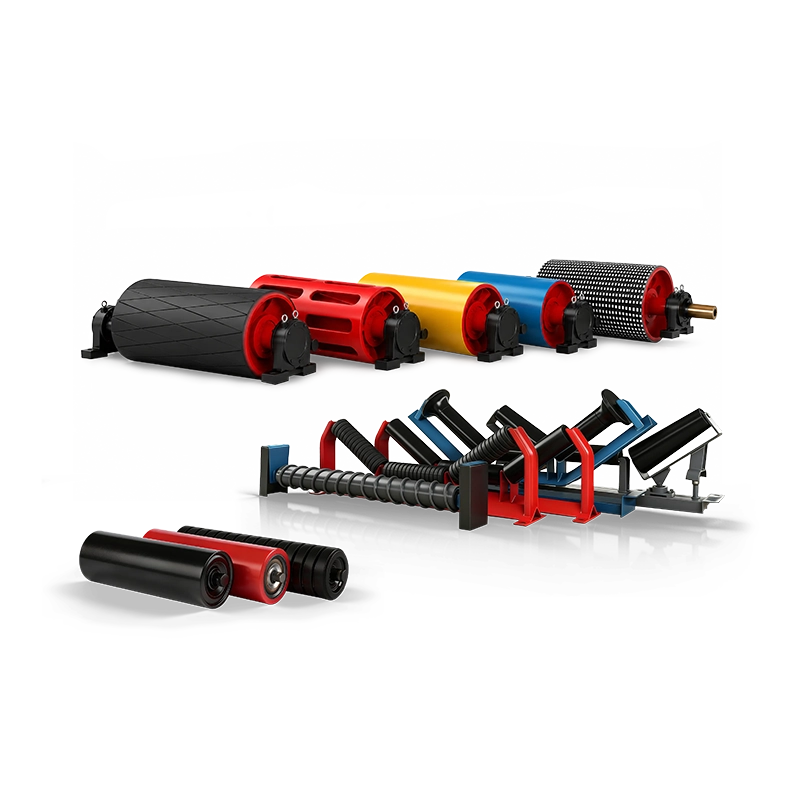
SHENGYUAN supplies conveyor belts, rollers, idlers, pulleys, belt cleaners, frames and related components for mining, quarrying, mineral-processing facilities, ports, cement plants, steel plants, power stations and other heavy-duty bulk-material handling applications.
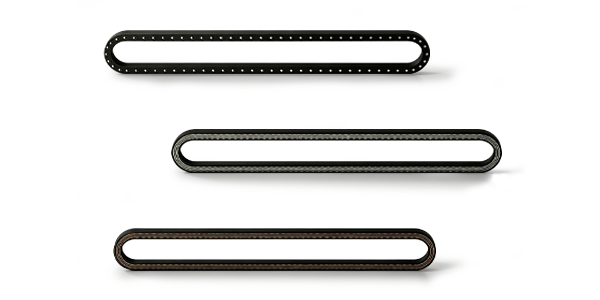
The SWCONS conveyor belt range includes EP fabric belts, NN nylon belts, steel cord belts, abrasion-resistant rubber belt constructions and other specialized conveyor belt types.
For filtered tailings handling projects, belt specifications can be reviewed according to moisture conditions, material abrasiveness, belt width, conveying capacity, tensile rating, cover thickness, incline angle, pulley dimensions, splice requirements and operating environment.
Related conveyor components, including carrying rollers, return rollers, drive pulleys, take-up pulleys and belt cleaners, can also be considered when coordinating a complete material-handling equipment specification.
Through custom conveyor solutions, project requirements can be reviewed using customer drawings, belt specifications, operating data and approved mechanical interfaces.
Need conveyor belts for a filtered tailings stacking system?
Send the tailings material type, particle-size distribution, normal and maximum moisture content, bulk density, abrasiveness, chemical conditions, conveying capacity, peak filter discharge rate, belt width and speed, conveyor length, incline angle, required tensile rating, cover thickness, pulley diameters, take-up arrangement, stacking equipment configuration and existing operating problems. These details provide a stronger basis for selecting the appropriate belt construction and coordinating related conveyor components.
Conclusion: Select the Belt for Filter Cake Behavior and the Complete Stacking System
Choosing conveyor belts for filtered tailings stacking requires a detailed understanding of both material behavior and conveyor engineering requirements.
Filter cake moisture, particle-size distribution, adhesion, abrasiveness, bulk density and chemical characteristics influence how the material loads, travels and discharges from the belt. These properties should be evaluated across the expected operating range, including abnormal filtration conditions.
EP fabric belts may be suitable for many collection, transfer and mobile stacking conveyors. Steel cord belts are often considered for long-distance and high-tension overland applications. NN and specialized belt constructions may also be appropriate where their mechanical properties meet the project requirements.
However, the choice of carcass and rubber cover is only part of the solution. Effective belt cleaning, suitable chute geometry, adequate impact support, properly selected idlers and pulleys, correct take-up tension, and reliable splice construction all contribute to conveyor performance.
The conveying system must also be coordinated with the broader filtered tailings management plan, including moisture control, material placement, drainage and the operational requirements of the storage facility.
The best conveyor belt for filtered tailings stacking is not simply the thickest abrasion-resistant belt or the strongest carcass available. It is the belt whose verified mechanical properties, cover performance, dimensions and cleaning compatibility match the actual filter cake and the complete conveying and stacking system.