
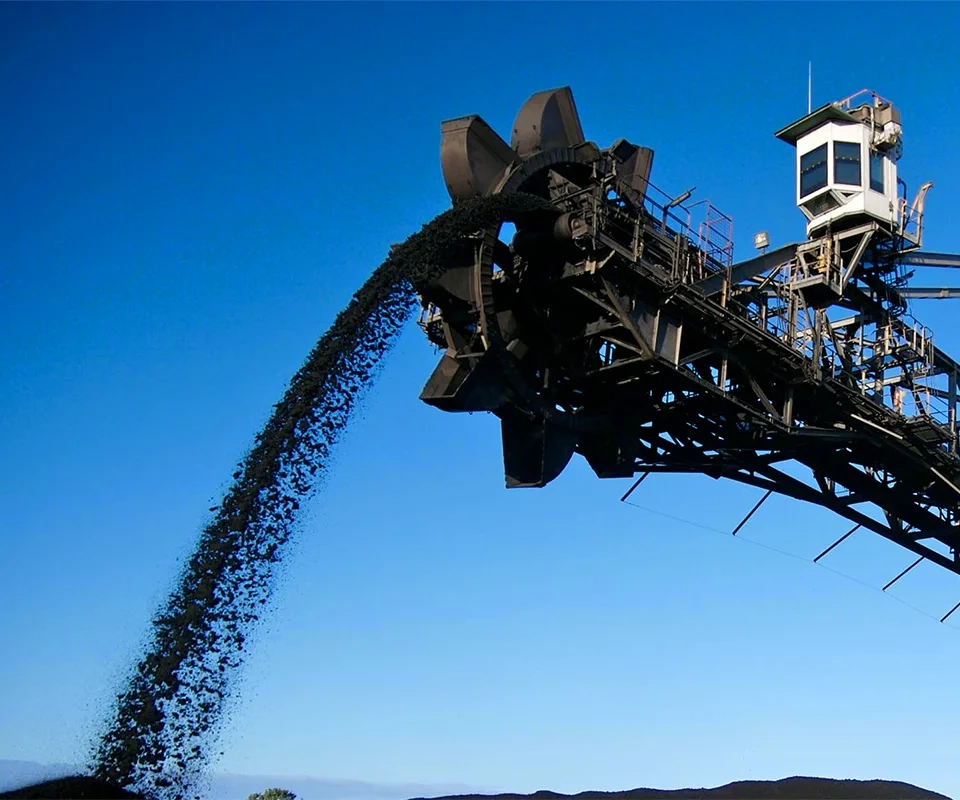
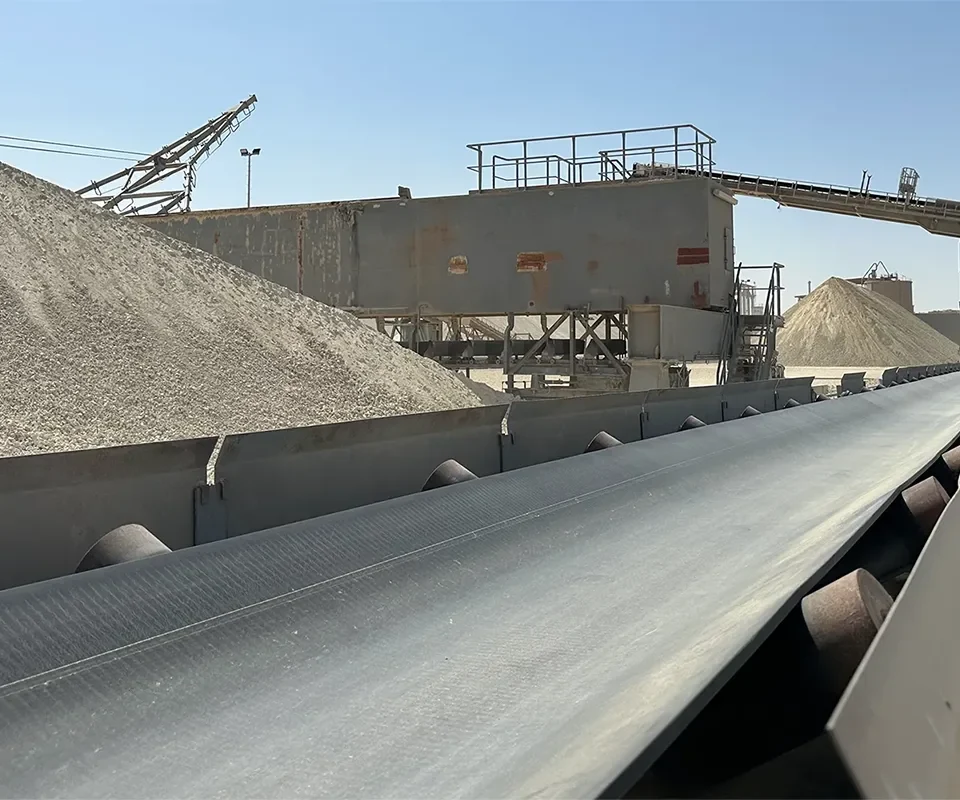
Sidewall conveyor belts are widely used when limestone must be lifted through a steep incline but plant space does not allow a long conventional belt conveyor. By combining a base belt with corrugated sidewalls and transverse cleats, the system creates individual material pockets that help prevent limestone from rolling or sliding backward as the belt rises.
However, buying a sidewall belt is more complicated than ordering a standard flat rubber conveyor belt. Belt width, sidewall height, cleat height, cleat spacing, carcass strength, transverse rigidity, cover compound, lump size, capacity, belt speed, incline angle, pulley diameter, and transfer-point conditions all affect performance.
For limestone handling, the belt must also resist abrasion, repeated flexing, impact at the loading point, and possible moisture or dust. The correct purchasing specification should therefore be based on the complete conveyor duty rather than simply stating “sidewall belt for limestone.”
Quick answer: When buying a sidewall conveyor belt for steep-incline limestone, provide the incline angle, vertical lift, horizontal conveyor length, required capacity, limestone bulk density, maximum lump size, moisture condition, belt speed, and loading method. Then select the base belt, sidewall height, cleat height and pitch, cover grade, carcass strength, transverse stiffness, pulley compatibility, and splice design as one complete system.
Why Use a Sidewall Belt for Steep Limestone Conveying?
On a conventional troughed conveyor, the allowable incline is limited by the tendency of the material to slide or roll backward. Coarse limestone, especially when dry and rounded, can become unstable as the conveyor becomes steeper.
A corrugated sidewall belt changes the conveying principle. The sidewalls contain the material laterally, while cross cleats divide the load into pockets. This allows the conveyor to operate at much steeper angles than many conventional troughed-belt arrangements, depending on material behavior and system design.
The result can be a shorter conveyor footprint, reduced transfer points, and more compact plant layout. This can be useful in crushing plants, cement plants, limestone quarries, storage systems, and process lines where elevation must be gained within limited space.
Understand the Three Main Parts of a Sidewall Belt
A typical steep-incline sidewall belt consists of three main elements:
| Component | Main Function |
| Base Belt | Carries tensile load and provides the main belt structure |
| Corrugated Sidewalls | Contain limestone along both belt edges |
| Cross Cleats | Form material pockets and resist rollback on steep sections |
These parts cannot be selected independently. A very high sidewall with undersized cleats, for example, may not use the available belt volume effectively. Likewise, large cleats mounted on an unsuitable base belt can create excessive flexing stress.
1. Start with the Required Incline Angle and Vertical Lift
The conveyor geometry should be the starting point for sidewall-belt selection. Tell the supplier the horizontal length, vertical lift, incline angle, and whether the conveyor includes horizontal loading or discharge sections.
The steeper the conveyor becomes, the more important the cleats and sidewalls become for controlling material movement.
A belt operating at a moderate incline may require relatively shallow cleats, while a very steep installation generally requires deeper pockets and greater attention to cleat geometry and spacing.
Important: Do not select sidewall height from incline angle alone. Capacity, lump size, belt width, cleat spacing, and material filling must also be considered.
2. Provide Limestone Bulk Density and Capacity
Required tonnes per hour is one of the most important purchasing parameters, but it should be combined with bulk density.
Sidewall-belt capacity depends on the usable volume of each pocket, cleat pitch, belt speed, and how completely the pockets can be filled without causing spillage.
Two limestone products with different bulk densities may require different belt widths or pocket volumes even when the required mass capacity is identical.
Provide both normal capacity and expected peak capacity. If feed surges occur from a crusher, hopper, or feeder, the sidewall conveyor should not be selected only from the long-term average throughput.
3. Maximum Limestone Lump Size Is Critical
Maximum lump size affects almost every major sidewall-belt dimension.
Large lumps need enough clearance between the sidewalls and enough space between adjacent cleats. If the pocket is too small, large pieces may bridge between cleats, strike the sidewalls, or create unstable loading.
Do not provide only the average limestone size. The supplier should know the largest credible lumps produced by the crusher or screening system, including occasional oversize pieces where relevant.
Sharp limestone can also cut or abrade belt covers and sidewall components, so particle shape should be mentioned when severe.
4. Choose the Correct Sidewall Height
Corrugated sidewalls prevent material from spilling laterally and help define the usable pocket volume.
Higher sidewalls can increase carrying volume, but they also increase the size and flexibility requirements of the complete belt. Sidewalls must repeatedly flex as they pass around pulleys and transition through the conveyor.
The selected height should provide adequate containment without unnecessarily increasing belt complexity, pulley requirements, and cost.
For existing systems, provide the current sidewall height and photographs. If the existing belt experiences sidewall cracking or separation, include this failure information rather than simply ordering the same height again.
5. Match Cleat Height to Sidewall Height and Lump Size
Cross cleats prevent limestone from sliding backward on the incline. Their height determines how deep the individual material pockets can be.
Cleat height should be coordinated with sidewall height. In many designs, the cleat is lower than the full sidewall height so there is sufficient clearance and flexibility while still maintaining useful material retention.
Limestone lump size also matters. The pocket should be deep enough to contain the material without forcing large pieces against the top of the sidewall or allowing them to roll over the cleat.
6. Cleat Pitch Determines Pocket Volume and Material Stability
Cleat pitch is the distance between successive cross cleats. Together with belt width, sidewall height, and cleat height, it determines the approximate size of each material pocket.
Very wide spacing can allow material to shift substantially within each pocket, especially on steep sections. Very close spacing increases the number of cleats, belt weight, flexing frequency, and manufacturing complexity.
The correct pitch should therefore balance required capacity, maximum lump size, incline angle, and material stability.
7. Select the Base Belt Carcass from Tension and Flexing Duty
The base belt carries the tensile load of the conveyor and supports the sidewalls, cleats, and limestone.
Fabric constructions such as EP belts are commonly used in many bulk-material applications because they combine practical tensile strength, flexibility, and dimensional stability.
However, carcass strength should be selected from actual belt tension, conveyor length, vertical lift, drive arrangement, belt weight, and material load rather than simply copying a tensile rating from another conveyor.
For a broader explanation of carcass materials, cover grades, and belt construction, see the Heavy-Duty Rubber Conveyor Belt Selection Guide.
8. Transverse Rigidity Is Especially Important
A sidewall base belt must often remain relatively stiff across its width while still being flexible in the longitudinal direction so it can bend around pulleys.
This transverse rigidity helps support the sidewalls and cleats, especially on steep vertical or near-vertical sections where the material load acts strongly on the pocket structure.
If transverse stiffness is inadequate, the belt may deform across its width, sidewalls may move excessively, and cleat alignment can become unstable.
When comparing suppliers, ask how the proposed base-belt construction provides the required crosswise rigidity.
9. Use an Abrasion-Resistant Cover for Limestone
Crushed limestone can be highly abrasive, particularly when material contains sharp particles and fines.
The belt cover compound should therefore be selected for abrasion resistance and the actual operating environment. Top-cover thickness should provide sufficient wear reserve while maintaining the flexibility required by the sidewall system.
If the limestone is unusually hot, oily, chemically contaminated, or handled in another special condition, tell the supplier so the cover compound can be reviewed accordingly.
The SWCONS conveyor belt range includes standard and special-purpose belt constructions for different bulk-material duties.
10. Check Pulley Diameters Before Changing Belt Construction
Sidewall belts are thicker and structurally more complex than many conventional flat belts. The sidewalls and base belt must flex repeatedly as they pass around drive, tail, and deflection sections.
Pulley diameters must therefore be compatible with the selected base belt and sidewall construction. Using pulleys that are too small can increase flexing stress and shorten belt, splice, or sidewall life.
When replacing an existing sidewall belt, provide drive pulley, tail pulley, bend pulley, and any relevant deflection dimensions to the supplier before changing carcass strength or sidewall size.
11. Belt Speed Should Be Selected Carefully
Higher belt speed can increase capacity, but it also changes loading behavior inside each pocket.
At excessive speed, coarse limestone may bounce during loading, generate more dust, strike cleats harder, or become less stable through curved sections.
A moderate speed may improve material control in some steep-incline applications, but the final value must still meet required throughput.
For more information about balancing capacity, material behavior, lump size, wear, and dust, see the Conveyor Belt Speed Selection Guide.
12. Loading Design Has a Major Effect on Sidewall Life
The loading point should place limestone into the center of the available belt pocket without repeatedly striking the sidewalls or cleats.
If material enters with excessive horizontal velocity, it can impact one sidewall more heavily than the other. If the drop height is too large, large pieces can damage both the top cover and cleat attachments.
Chute geometry should therefore guide the limestone into the pocket as smoothly as practical. Large-lump applications may also require suitable impact support beneath the horizontal loading section.
Maintenance clue: If only one sidewall shows severe wear or repeated separation, inspect loading position and belt alignment before assuming the sidewall material itself is defective.
13. Moist Limestone Can Change the Required Belt Design
Dry crushed limestone may flow relatively freely, while wet limestone fines can become sticky and remain inside corners formed by sidewalls and cleats.
Material buildup reduces usable pocket volume and may interfere with clean discharge at the head of the conveyor.
Tell the supplier whether the material is dry, damp, washed, or seasonally variable. Sticky applications may require greater attention to cleat shape, pocket geometry, discharge behavior, and cleaning access.
14. Sidewall and Cleat Bonding Quality Is Critical
Sidewalls and cleats experience continuous cyclic flexing. Every time the belt passes through a pulley or curved section, the bonded interfaces are stressed.
Poor bonding can lead to local separation, cracking, or complete cleat failure. Once a cleat begins separating, limestone can force material into the damaged area and accelerate failure.
When comparing suppliers, ask how sidewalls and cleats are attached to the base belt and what quality-control process is used for the complete assembly.
15. Splice Design Must Match the Complete Sidewall Belt
Splicing a sidewall belt requires more planning than joining a flat belt because cleats and sidewalls must also be considered around the splice area.
The base-belt splice should provide sufficient tensile strength while maintaining flexibility. Sidewall and cleat arrangement near the joint should allow the belt to pass smoothly through the conveyor without creating excessive local stress.
Ask the supplier for the recommended splice method, materials, joint length, and on-site installation procedure before the belt arrives.
Common Buying Mistakes for Limestone Sidewall Belts
Mistake 1: Ordering from Belt Width and Incline Angle Only
These two values do not define capacity, pocket size, lump clearance, belt tension, or cover requirements.
Mistake 2: Choosing the Tallest Sidewall Available
Higher sidewalls increase potential volume but also affect belt flexibility, pulley requirements, structure, and cost.
Mistake 3: Ignoring Maximum Lump Size
Oversize limestone can bridge between cleats or repeatedly damage sidewalls if pocket geometry is too small.
Mistake 4: Increasing Belt Speed to Solve Capacity Problems
Higher speed can create more impact, dust, unstable loading, and cleat wear. Pocket volume and belt width should also be evaluated.
Mistake 5: Copying a Failed Belt Without Studying the Failure
Repeated sidewall cracking, cleat separation, excessive abrasion, splice problems, or edge wear may indicate a system issue rather than normal belt life.
Use the Existing Belt Failure Pattern as Purchasing Data
| Observed Failure | What to Investigate |
| Sidewall Cracking | Flexing, pulley diameter, sidewall construction, aging |
| Sidewall Separation | Bonding, loading impact, belt alignment |
| Broken Cleats | Large lumps, impact, cleat design, pulley interaction |
| Top-Cover Wear | Abrasion, loading point, limestone sharpness |
| Splice Failure | Tension, workmanship, pulley size, splice design |
What Information Should Be Included in the RFQ?
Provide: conveyed material and limestone condition;
bulk density;
maximum lump size;
required normal and peak capacity;
incline angle;
vertical lift and conveyor length;
belt width and belt speed;
existing sidewall height;
cleat height and cleat pitch;
base-belt tensile rating and carcass construction;
cover thickness and required abrasion resistance;
drive, tail, bend, and relevant pulley diameters;
loading drop height and chute arrangement;
dry or wet limestone condition;
current belt failure history;
conveyor drawings and installation photos.
How to Compare Sidewall Conveyor Belt Suppliers
A capable sidewall-belt supplier should ask about more than belt width and incline angle.
Compare the proposed base-belt carcass, cover compound, transverse rigidity, sidewall height, cleat type, cleat height, pitch, bonding method, pulley requirements, splice recommendation, and expected installation dimensions.
The supplier should also ask about limestone lump size, capacity, moisture, loading impact, and conveyor geometry before finalizing the belt configuration.
For a replacement project, provide the old belt specification and drawings where available. If the old design repeatedly failed, the new supplier should review the cause rather than reproduce every detail automatically.
Buying Sidewall Conveyor Belts from SHENGYUAN
SHENGYUAN supplies conveyor belts, rollers, idlers, pulleys, cleaners, frames, and related components for mining, quarrying, limestone, cement, coal handling, ports, steel plants, power stations, and other bulk-material handling systems.
For steep-incline limestone projects, sidewall-belt selection can be based on conveyor geometry, capacity, maximum lump size, belt speed, sidewall height, cleat arrangement, carcass strength, abrasion conditions, and existing pulley dimensions.
The conveyor belt range includes sidewall and other heavy-duty belt constructions for bulk-material handling applications.
Through custom conveyor solutions, belt requirements can also be coordinated with existing pulleys, rollers, idlers, and related conveyor components where dimensional compatibility is important.
Need a sidewall conveyor belt for steep-incline limestone?
Send the incline angle, vertical lift, conveyor length, capacity, limestone bulk density, maximum lump size, moisture condition, belt width, speed, pulley diameters, loading arrangement, current sidewall and cleat dimensions, and photos of the existing conveyor. These details provide a much better basis for selecting the belt than belt width and incline angle alone.
Conclusion: Buy the Complete Pocket System, Not Just the Base Belt
A sidewall conveyor belt for steep-incline limestone is a complete material-containment system. The base belt carries tension, corrugated sidewalls contain the material, and cross cleats prevent limestone from rolling backward.
These components must be selected together with the conveyor geometry, capacity, bulk density, maximum lump size, belt speed, abrasion, moisture, loading impact, and pulley arrangement.
The existing belt failure pattern should also be considered. Sidewall cracking, cleat separation, splice failure, and rapid cover wear often provide useful clues about whether the original system is correctly matched to the application.
The right sidewall conveyor belt is not simply the belt with the highest sidewalls or largest cleats. It is the belt whose pocket geometry, carcass strength, transverse rigidity, cover grade, flexing capability, and pulley compatibility match the actual steep-incline limestone duty.