
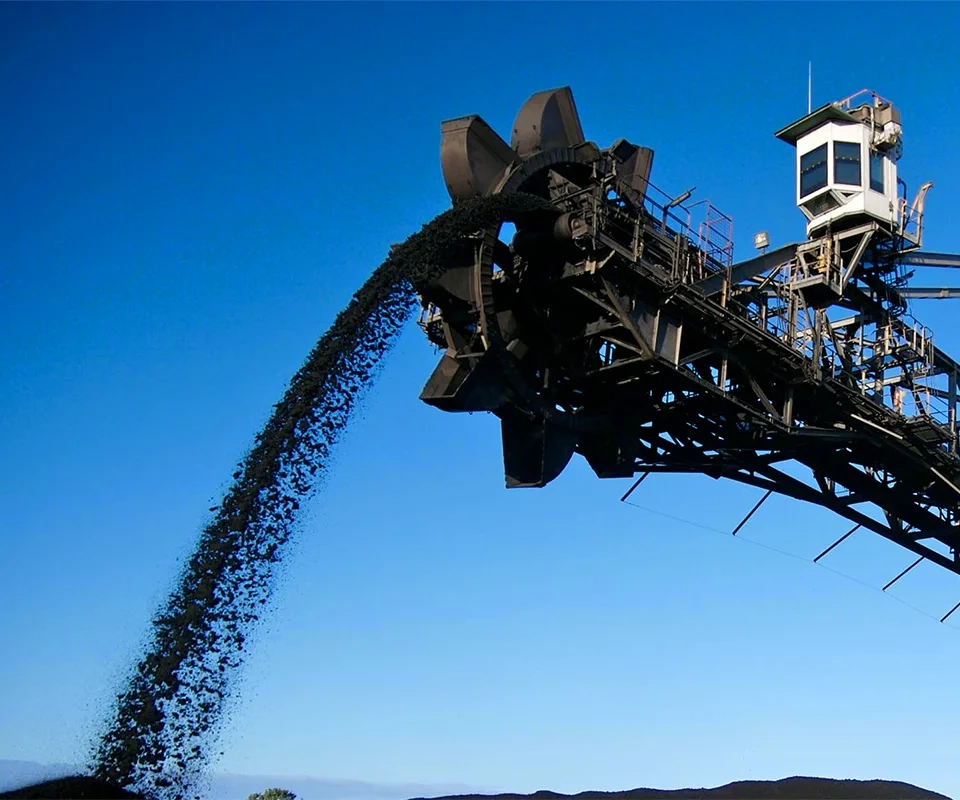
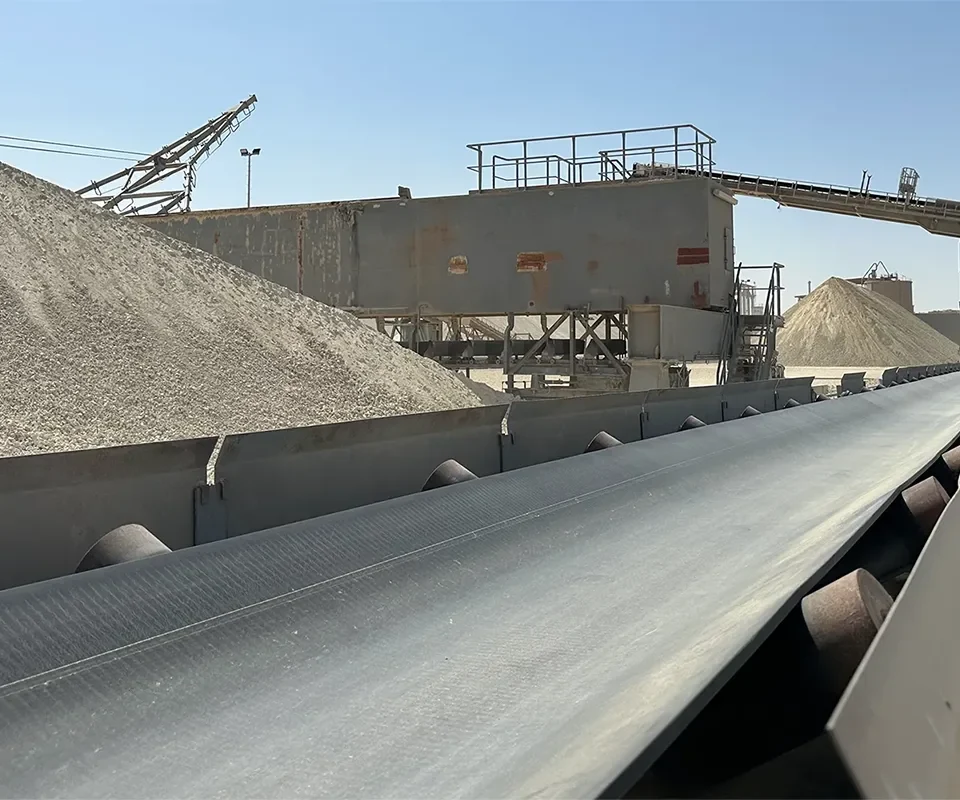
Large-lump ore transfer points are among the most demanding locations on a belt conveyor. When coarse ore falls from a crusher, feeder, chute, or upstream conveyor onto the receiving belt, the loading zone must absorb impact while maintaining the belt profile and protecting the carcass from puncture, cutting, and repeated fatigue.
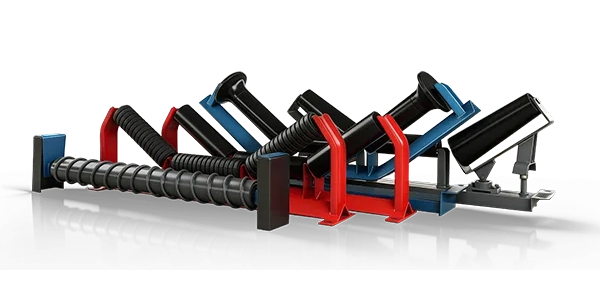
Impact idler sets are commonly installed beneath these transfer points. Their rubber-ring rollers absorb part of the impact energy and support the belt while material enters the conveyor. However, selecting impact idlers by belt width alone is not enough for large-lump ore.
A useful purchasing specification should consider maximum lump size, bulk density, drop height, belt width, belt speed, trough angle, idler spacing, roller diameter, shaft and bearing capacity, rubber-ring construction, frame strength, and loading-zone length. The chute and belt-support arrangement should also be evaluated because even a heavy-duty impact idler cannot fully compensate for uncontrolled material impact.
Quick answer: When buying impact idler sets for large-lump ore, start with maximum lump size, bulk density, drop height, belt width, belt speed, and required trough angle. Then confirm roller diameter, shaft and bearing size, rubber-ring arrangement, frame strength, and loading-zone spacing. For severe impact zones, impact idlers are often installed at much closer spacing than normal carrying idlers, but final spacing should be selected from actual impact duty rather than a fixed number.
Why Large-Lump Ore Transfer Points Need Special Idlers
Normal carrying idlers are designed primarily to support the loaded belt along the conveyor. At a transfer point, the loading condition is different because material arrives with vertical and horizontal velocity before settling onto the belt.
Large ore lumps can create concentrated impact loads rather than evenly distributed weight. A single heavy lump falling onto a poorly supported belt may deform the belt sharply between idlers, damage the top cover, strain the carcass, or overload the idler frame.
Impact idlers use resilient rubber rings around the roller body to absorb part of this shock and reduce direct metal-to-belt contact. Their purpose is not merely to carry the belt but to protect the belt and supporting structure at the loading point.
For a broader explanation of carrying, impact, transition, self-aligning, return, and spiral idlers, see the Conveyor Idler Types and Applications Guide.
1. Start with Maximum Lump Size
Maximum lump size is one of the first parameters to provide when requesting impact idlers for ore handling.
Large lumps concentrate impact over a smaller belt area. A conveyor carrying fine crushed ore at the same tonnage can impose a very different loading condition from a conveyor handling occasional 200 mm or 300 mm rocks.
Do not provide only the average particle size. Tell the supplier the maximum credible lump size that can reach the receiving belt, including occasional oversize material if it is known to occur.
Buying principle: Impact duty is often determined by the largest and heaviest pieces rather than the average material size.
2. Provide Bulk Density, Not Just Tonnes per Hour
Conveyor capacity alone does not describe the force acting at the loading point. Bulk density affects the mass of material occupying the same volume and helps define the actual material load on the belt.
Dense iron ore, for example, can create a more demanding support condition than a lighter bulk material at similar volumetric flow.
Provide both design capacity and material bulk density where available. This helps the supplier evaluate the idler load, frame, shaft, and bearing arrangement more accurately.
3. Drop Height Is Critical
Drop height directly affects the impact velocity of ore reaching the receiving belt. Even a relatively small reduction in uncontrolled free fall can significantly improve loading-zone conditions.
Measure the vertical distance from the point where material leaves the chute or upstream equipment to the approximate belt surface at the impact zone.
Also tell the supplier whether material slides along a chute before reaching the belt or falls freely. Chute geometry can reduce or increase the effective impact depending on how well it controls material velocity.
A severe drop-height problem should not be solved only by installing stronger idlers. Chute geometry should be reviewed so material reaches the belt with more controlled direction and velocity.
4. Choose the Correct Trough Angle
Impact idler sets are commonly arranged in troughing configurations so the belt maintains the same general carrying profile through the loading zone.
Practical heavy-duty configurations often use trough angles such as 35° or 45°, depending on the conveyor design. The impact idler should normally match the belt profile required at that location rather than introducing a sudden geometry change.
If an existing conveyor uses a specific trough angle, measure or confirm it before ordering replacement impact sets. An incorrect angle can affect belt support, skirt sealing, and material containment.
5. Impact Idler Spacing Should Be Much Closer Than Normal Carrying Spacing
Normal carrying idlers are typically spaced farther apart because they support a relatively stable material load. At the loading point, closer spacing is used to reduce belt deflection and distribute impact across more supports.
As a practical engineering reference, impact idlers are often installed at approximately 300 mm or 500 mm spacing in loading zones, while normal carrying idlers may commonly be around 1000–1200 mm apart.
These are reference values rather than universal rules. Severe large-lump ore transfer points may require a different arrangement based on drop height, belt width, material density, frame stiffness, and allowable belt deflection.
For more information on carrying, impact, return, and curved-section spacing, see the Conveyor Idler Spacing Guide.
6. Select Roller Diameter for the Complete Duty
Roller diameter affects bearing speed, shell strength, rubber-ring size, and overall impact-idler construction.
A larger roller is not automatically better, but heavy-duty mining conveyors often benefit from robust roller construction that can tolerate repeated impact and long operating hours.
The supplier should evaluate roller diameter together with belt speed, bearing size, shaft diameter, tube construction, and actual load. Do not choose roller diameter from belt width alone.
7. Check the Rubber-Ring Construction
The rubber rings are the most visible difference between an impact roller and a standard steel carrying roller, but their design should not be evaluated only by appearance.
Important considerations include ring diameter, ring spacing, rubber hardness, wear resistance, bonding or retention method, and how the rings are distributed along the roller face.
The rubber should provide enough resilience to absorb shock while remaining durable under repeated ore impact and belt contact. Excessively soft material may deform quickly, while excessively hard material may provide less cushioning.
For replacement applications, photograph the existing impact roller and provide ring dimensions if the current arrangement has performed well.
8. Shaft and Bearing Capacity Matter as Much as the Rubber Rings
Impact rollers are sometimes selected mainly from the rubber-ring pattern while the internal mechanical design receives less attention. This is a mistake in large-lump ore service.
Repeated shock loads are transferred through the shell and rubber rings into the bearings, shaft, and frame. A weak shaft or undersized bearing arrangement can fail even when the rubber rings remain in good condition.
Ask the supplier about shaft diameter, bearing type, bearing capacity, seal arrangement, and tube construction. Heavy dust, mud, and moisture should also be included in the bearing and seal selection.
The Key Factors for Choosing Conveyor Rollers provides additional guidance on shaft, bearing, seal, and environmental selection.
9. Frame Strength Must Match the Impact Roller Set
A heavy-duty impact roller installed in a weak or badly supported frame will not provide a reliable loading-zone solution.
The frame must hold the roller positions, trough angle, and belt line under repeated impact. Check cross-member thickness, bracket stiffness, weld quality, mounting-hole arrangement, and how the frame connects to the conveyor structure.
For replacement projects, provide the mounting-hole centers, overall frame width, installation height, and existing trough angle. A dimensionally incompatible frame can alter the belt line even if the rollers themselves are correct.
10. Check Whether the Belt Is Supported Continuously Enough
The purpose of close impact-idler spacing is to reduce unsupported belt span. If the gap between support points remains too large for the actual lump size and impact energy, the belt can deform sharply between rollers.
In very severe impact applications, the loading zone may need to be evaluated against an impact-bed or combined support arrangement rather than relying only on conventional impact idlers.
This decision depends on impact severity, belt width, maintenance requirements, available installation space, and the plant’s preferred support concept.
11. Consider Skirt Boards and Chute Design Together with Impact Idlers
Impact idlers form only one part of the loading-zone system. Material must also be contained and centered after it lands.
If the chute throws large ore lumps toward one side, the belt may experience uneven loading and mistracking. If skirt boards are too wide, material may approach the belt edge and spill. If skirt rubber presses too hard against the belt, friction and cover wear can increase.
The loading zone should therefore be designed as one system involving chute geometry, impact support, belt profile, skirt containment, and material settling distance.
For detailed loading-zone guidance, see the SWCONS conveyor technical resources covering chute width, skirt-board design, spillage, and dust control.
12. Inspect the Existing Belt Damage Before Buying New Idlers
The existing conveyor belt can provide useful information about whether the current impact-support arrangement is adequate.
| Observed Problem | What to Investigate |
| Deep Top-Cover Gouges | Large sharp lumps, excessive drop height, chute control |
| Carcass Puncture | Extreme impact, poor support, sharp ore |
| Local Belt Sag | Impact-idler spacing or support stiffness |
| Edge Damage | Off-center loading, skirt contact, mistracking |
| Repeated Roller Failures | Shaft, bearing, frame, spacing, impact severity |
Send clear photographs of damaged belt areas, failed rollers, and the complete transfer point. The location and pattern of damage often reveal more than a general statement such as “impact idlers fail too quickly.”
Common Buying Mistakes for Large-Lump Ore Transfer Points
Mistake 1: Specifying Belt Width Only
Belt width does not define lump size, drop height, impact energy, shaft size, bearing duty, or frame strength.
Mistake 2: Using Normal Carrying-Idler Spacing in the Impact Zone
Wide spacing can allow excessive belt deflection between supports and increase local belt stress.
Mistake 3: Choosing Impact Idlers from Rubber Thickness Alone
The shaft, bearing, shell, frame, and seal arrangement all contribute to service life.
Mistake 4: Ignoring Chute Geometry
A poorly designed chute can create unnecessary impact, side loading, and belt damage regardless of idler quality.
Mistake 5: Copying a Failed Idler Without Reviewing the Failure
If the current rollers repeatedly break shafts, damage bearings, or collapse frames, reproducing the same construction may reproduce the same problem.
What Information Should Be Included in the RFQ?
Provide: material type;
bulk density;
maximum lump size;
drop height;
normal and peak conveyor capacity;
belt width and belt speed;
trough angle;
existing impact-idler spacing;
roller diameter and face length;
shaft and mounting dimensions;
frame dimensions and mounting-hole centers;
dust, moisture, and environmental conditions;
current belt or roller failure history;
photos and transfer-point drawings.
How to Compare Impact Idler Suppliers
A useful supplier should ask about the transfer point rather than quoting from belt width alone.
Compare proposed roller diameter, shaft size, bearing arrangement, seal construction, rubber-ring design, frame structure, trough angle, mounting dimensions, and recommended spacing.
For replacement projects, make sure the supplier can work from existing drawings, photos, site measurements, or old samples. Dimensional compatibility is especially important when a complete impact-idler set must fit an existing conveyor structure.
Where impact duty is severe, ask whether the supplier has reviewed lump size, drop height, bulk density, and belt speed rather than simply increasing rubber-ring size.
Buying Impact Idler Sets from SHENGYUAN
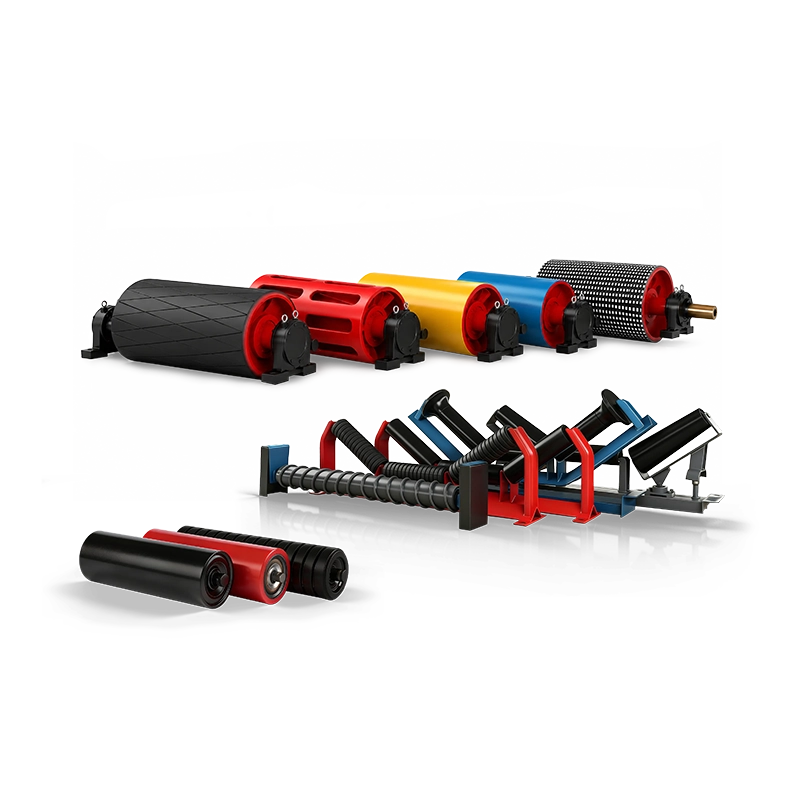
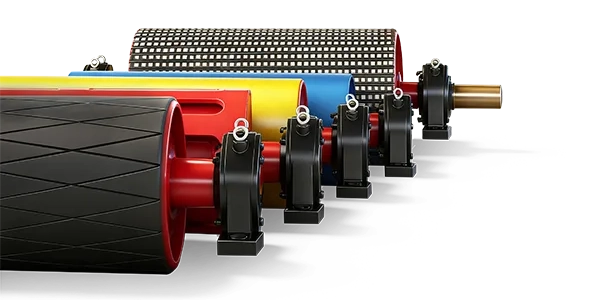
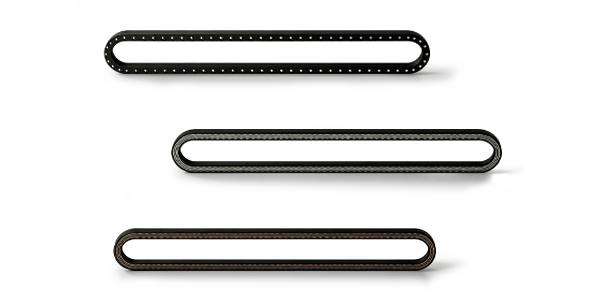
SHENGYUAN supplies conveyor rollers, idlers, pulleys, belts, cleaners, frames, and related components for mining, quarrying, aggregates, cement, coal handling, ports, steel plants, power stations, and other heavy-duty bulk-material handling systems.
The conveyor roller and idler range includes carrying, return, impact, self-aligning, spiral, HDPE, polyurethane, ceramic, and other configurations for different conveyor duties.
For large-lump ore applications, impact-idler selection can be based on actual transfer-point conditions including lump size, bulk density, drop height, belt width, belt speed, trough angle, spacing, shaft, bearings, and frame dimensions.
Through custom conveyor solutions, replacement impact rollers and complete idler frames can also be manufactured according to customer drawings, existing samples, or field measurements.
Need impact idler sets for large-lump ore?
Send the belt width, belt speed, material, bulk density, maximum lump size, drop height, capacity, trough angle, current idler spacing, roller dimensions, frame measurements, loading-zone photos, and any existing belt or roller failure history. These details provide a far better basis for impact-idler selection than belt width alone.
Conclusion: Buy for the Impact Energy, Not Just the Belt Width
Large-lump ore transfer points impose a combination of concentrated impact, heavy material load, abrasion, dust, and repeated cyclic shock on the conveyor belt and idler system.
Impact idlers should therefore be selected from the complete loading condition. Maximum lump size, bulk density, drop height, belt speed, trough angle, spacing, roller construction, shaft, bearings, rubber rings, and frame strength all matter.
The transfer chute should also reduce uncontrolled material velocity and load the belt near the centerline. Impact rollers work best when the loading zone itself is correctly designed.
The right impact idler set is not simply a standard carrying idler with rubber rings. It is a complete heavy-duty support system selected to match the actual impact energy, conveyor geometry, and operating environment at the transfer point.