
Chevron conveyor belts are commonly used when bulk materials must be transported on inclined conveyors where a conventional smooth rubber belt may allow material to slide or roll backward. Their raised V-shaped profiles provide additional resistance to material movement, making them useful for mining, quarrying, aggregates, sand, gravel, limestone, coal, fertilizer, and agricultural bulk-material handling.
However, purchasing a chevron conveyor belt requires more than selecting a belt width and a nominal cleat height. The shape, height, spacing, and arrangement of the raised profiles influence material retention, carrying capacity, cleaning requirements, and belt flexibility. The base belt must also provide sufficient tensile strength and remain compatible with the conveyor pulleys, take-up system, and splice method.
For replacement projects, one of the most overlooked issues is whether the new chevron pattern can be joined correctly using the available splicing equipment. A belt may have the right dimensions and mechanical properties but still create installation difficulties if its raised profiles interfere with the intended splice procedure.
A reliable purchasing specification should therefore cover incline angle, material properties, cleat height, profile pitch, pattern geometry, belt width, carcass strength, cover grade, pulley diameter, splice compatibility, and operating conditions.
Quick answer: When buying a chevron conveyor belt, start with the conveyor incline, material type, bulk density, maximum lump size, moisture, and required capacity. Select a profile height and pitch that provide stable material retention without unnecessary belt weight or cleaning difficulty. Confirm whether the profile is molded integrally or bonded to the belt, then verify carcass strength, pulley compatibility, and the proposed hot-vulcanized, cold-bonded, or mechanical splice arrangement before production.
What Is a Chevron Conveyor Belt?
A chevron conveyor belt is a rubber conveyor belt with raised V-shaped, Y-shaped, or related patterned profiles on its carrying surface. These profiles help hold material in place as the belt moves upward on an incline.
Unlike a conventional flat belt, a chevron belt provides mechanical resistance against material rollback. However, it should not be confused with a corrugated sidewall conveyor belt, which uses substantially taller sidewalls and transverse cleats to create defined material pockets for much steeper conveying arrangements.
Chevron belts are generally selected for inclined applications where an ordinary smooth belt does not provide sufficient material stability but a full sidewall conveyor arrangement is unnecessary.
1. Start with the Actual Conveyor Incline Angle
Incline angle is one of the primary factors affecting chevron-belt selection. As the conveyor becomes steeper, gravity creates a greater tendency for material to slide or roll backward relative to the moving belt.
A conventional smooth belt may provide satisfactory conveying at a modest incline, especially when the material has favorable friction characteristics. A chevron profile becomes more attractive when the material begins to lose stability.
However, no single maximum incline angle applies to every chevron conveyor belt. The practical limit depends on material characteristics, moisture, particle size, profile geometry, belt speed, loading method, and conveyor design.
When sending an RFQ, provide the actual conveyor inclination rather than simply describing the application as a steep conveyor.
2. Understand Why Cleat Height Matters
Cleat height, also called profile height, is the vertical distance from the base-belt carrying surface to the top of the raised chevron pattern.
Higher profiles generally provide greater resistance to material moving backward, but they also increase the patterned belt’s thickness, weight, and potential cleaning difficulty.
Common commercial products include relatively low profiles around 5–6 mm, medium profiles around 10–15 mm, and higher profiles around 17–25 mm or more. These figures describe available product configurations, not universal incline ratings.
| Profile Category | Illustrative Height | Selection Consideration |
| Low Profile | 5–6 mm | Moderate material-retention requirements and relatively small particles |
| Medium Profile | 10–15 mm | Greater rollback resistance for suitable inclined bulk-material applications |
| High Profile | 17–25 mm or higher | More demanding material-retention duties, subject to geometry and operating verification |
A higher profile is not automatically the best option. The profile must be selected together with incline angle, material flow, particle size, belt width, and capacity.
3. Select Cleat Height According to Material Behavior
Different bulk materials behave differently on an inclined belt. Fine sand can slide as a continuous layer, while coarse gravel and crushed limestone may roll or shift between raised profiles.
Material moisture can also change conveying behavior. Damp fines may adhere to the rubber surface, while some wet granular materials become more mobile and difficult to retain.
Buyers should provide the material’s bulk density, maximum lump size, particle-size distribution, moisture condition, and normal operating inclination.
For crushed stone, larger particles may require a profile with sufficient height and spacing to reduce rollback. For fine material, excessively tall profiles may create unnecessary buildup and complicate cleaning without providing a proportionate benefit.
Buying principle: Select chevron profile height from actual material stability, not from incline angle alone. A 20° conveyor handling wet sand may require a different profile from a 20° conveyor handling dry crushed aggregate.
4. Understand Chevron Cleat Pitch
Cleat pitch is another important dimension in chevron-belt procurement. In many product drawings, longitudinal pitch describes the distance between corresponding points on successive repeating chevron profiles measured along the belt’s direction of travel.
Pitch influences the frequency of raised profiles contacting and retaining the material. Closer spacing creates more frequent obstacles to rollback, while wider spacing allows more distance between successive profiles.
However, pitch is only meaningful when considered together with profile height, shape, width, and material behavior. Two belts with identical longitudinal pitch may perform differently if their chevron profiles have different angles or cross-sectional shapes.
When requesting a quotation, ask the supplier to show the pitch dimension clearly on the pattern drawing. This avoids confusion between longitudinal repeat pitch, profile spacing, and other geometric measurements.
5. Choose the Right Chevron Pattern Geometry
Chevron belts are available with different V-pattern arrangements, including open and closed profiles, different profile angles, and patterns extending across different portions of the belt width.
An open V-pattern may provide different material movement and discharge characteristics from a closed or more densely arranged pattern. Profile direction and coverage also influence how material is distributed across the belt.
For moist or sticky materials, pattern geometry should be reviewed for material retention and release. Designs with difficult-to-clean pockets may accumulate fines and reduce effective carrying performance.
Buyers should request a dimensional pattern drawing or representative product sample instead of relying on a photograph alone.
6. Confirm Effective Carrying Width
Nominal belt width is not always equal to the usable profile width. Some chevron belts have smooth edge margins outside the patterned area, while others use different profile coverage arrangements.
These details matter when calculating capacity and checking compatibility with conveyor structures, loading chutes, and tracking arrangements.
The purchasing drawing should identify overall belt width, patterned width, smooth-edge width where applicable, and profile position relative to the belt centerline.
Do not assume two chevron belts with the same nominal width provide the same usable conveying geometry.
7. Select Belt Speed and Capacity Together
Chevron belts should be selected from the required material capacity and the stability of the load on the incline.
Higher speed may increase throughput, but it can also increase material bounce, impact at loading points, dust generation, and the tendency of particles to move unpredictably between raised profiles.
Capacity should therefore be assessed using the actual material cross-section and the specific belt pattern rather than assuming a chevron belt carries exactly the same effective load as an equivalent smooth belt under every operating condition.
The conveyor’s inclination, feed uniformity, and discharge arrangement should also be considered when determining the practical operating speed.
8. Select the Base Belt Carcass from Tension
The raised profiles improve material retention, but the base belt still carries the mechanical tension and must resist repeated flexing around the pulleys.
EP fabric belts are commonly used in industrial bulk-material handling because they offer practical tensile strength, dimensional stability, and flexibility. Other carcass constructions may be suitable depending on conveyor length, loading, tension, and operating requirements.
The tensile rating should be determined from belt tension, conveyor geometry, vertical lift, material load, drive arrangement, and startup conditions rather than selected solely from belt width or profile height.
For a broader explanation of belt carcass selection and cover materials, see How to Choose Rubber Conveyor Belts for Heavy-Duty Bulk Material Handling.
9. Confirm Whether the Chevron Profiles Are Molded or Bonded
Chevron profiles may be formed integrally with the rubber cover during manufacturing or produced using other attachment arrangements, depending on the belt design and manufacturer.
Integral molded profiles are commonly used because the pattern and cover are formed as part of the manufacturing process. Bonded profiles require particular attention to adhesion, construction, and repeated flexing performance.
For heavy-duty applications, ask the supplier to confirm how the profile is manufactured and how its integrity is controlled. The answer affects both expected service performance and the recommended splice procedure.
10. Splice Compatibility Must Be Confirmed Before Purchase
Splice compatibility is one of the most important purchasing considerations for chevron conveyor belts because raised profiles can interfere with conventional flat-belt joining methods.
A smooth belt normally offers a relatively uniform surface for splice preparation and vulcanizing equipment. A chevron belt has raised rubber features that may need special treatment around the joint.
The appropriate splice procedure depends on carcass construction, profile height, cover design, belt tension, available equipment, and the manufacturer’s approved method.
Important procurement requirement: Before ordering a chevron belt, confirm the proposed splice type, splice length, treatment of raised profiles, joint orientation, required materials, and installation equipment. Do not assume an ordinary flat-belt splice procedure can be used without modification.
11. Hot-Vulcanized Splicing for Chevron Belts
Hot-vulcanized splicing is commonly used for rubber conveyor belts where a continuous joint with suitable mechanical performance is required.
For a chevron belt, the splice procedure must accommodate the patterned carrying surface. Depending on the design, raised profiles in the splice area may require controlled removal, reconstruction, special mold arrangements, or another manufacturer-approved treatment.
The splice must maintain the intended carcass strength and flexibility. Profile treatment should not damage the load-carrying carcass or create an abrupt change in surface geometry that causes abnormal stress.
Before purchasing the belt, confirm that the available vulcanizing press can handle its width, splice length, thickness, and profile configuration. The supplier should provide the specific splice materials and procedure for the belt construction being delivered.
12. Cold-Bonded and Mechanical Splice Considerations
Cold-bonded or mechanical joining methods may be considered in certain applications, but their suitability must be checked against the operating tension, belt construction, profile geometry, and site requirements.
Mechanical fasteners can create additional compatibility concerns because fastener installation may require a suitable flat area or preparation of raised profiles. The fastener must also be compatible with the belt thickness, pulley diameters, cleaning equipment, and operating duty.
Cold-bonded joints depend on appropriate materials, preparation, environmental conditions, and the manufacturer’s approved procedure. They should not automatically be treated as equivalent to a designed hot-vulcanized splice for every heavy-duty conveyor.
For important installations, ask the belt manufacturer to confirm the expected joint performance and any operating limitations in writing.
13. Consider Factory-Endless Chevron Belts
For some relatively short conveyors, a factory-endless chevron belt can simplify installation because the joining work is completed before shipment.
However, an endless belt may require sufficient installation access to pass around pulleys and conveyor structures. Some conveyors must be partially dismantled to install a closed-loop belt.
Check the installation method, exact finished belt length, take-up travel, and available access before selecting an endless configuration.
14. Check Minimum Pulley Diameter and Flexing Requirements
Chevron profiles add rubber thickness and create local changes in flexibility. The base belt and patterned cover must repeatedly bend around drive, tail, bend, and take-up pulleys.
The minimum pulley diameter should be checked against the base-belt carcass, belt rating, splice construction, profile design, and manufacturer’s recommendations.
Using pulleys that are too small can increase flexing stress and potentially accelerate cover cracking, profile damage, or splice deterioration.
When replacing a smooth belt with a chevron belt, the existing pulley arrangement should be reviewed rather than assumed suitable. For pulley-related selection factors, see the Conveyor Pulleys Guide.
15. Belt Cleaning Requires Special Attention
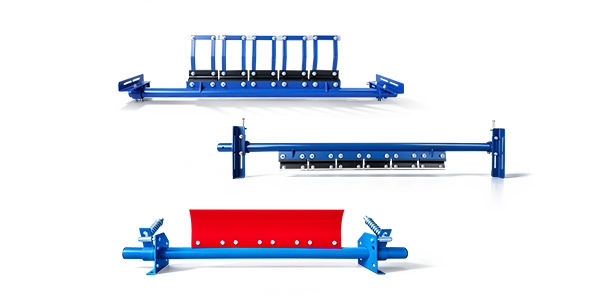
Conventional flat-blade cleaners may not be suitable for direct contact with raised chevron profiles. The blade can strike the raised pattern, experience uneven pressure, or damage the profile if incorrectly installed.
Cleaning solutions may include suitable brushes, specially designed cleaning devices, or other methods selected for the material and belt geometry. The appropriate arrangement depends on whether the conveyed material is dry, sticky, abrasive, or prone to accumulating between profiles.
Return-side buildup should also be considered. Material trapped around raised profiles can transfer to rollers and affect belt tracking.
The cleaner and conveyor geometry should be checked before selecting a new profile height, especially when replacing an existing belt without modifying the cleaning equipment.
16. Select the Correct Cover Compound
The cover rubber and raised profiles should be suitable for the actual conveyed material and operating environment.
Abrasion resistance is important for sand, gravel, crushed stone, and other mineral products. Heat-resistant, oil-resistant, or other special compounds may be necessary where the conveyed material creates additional chemical or temperature exposure.
Where fire-performance or antistatic properties are required, confirm the applicable site requirements and request appropriate supporting documentation. Do not assume that an ordinary patterned rubber belt automatically meets those conditions.
The SWCONS conveyor belt range includes different belt constructions for industrial bulk-material handling requirements.
17. Inspect Profile Quality Before Bulk Procurement
A chevron belt should be evaluated for both base-belt quality and profile manufacturing consistency.
Inspect the actual profile height, pitch, pattern symmetry, edge margins, surface condition, and visible defects. For bonded profiles, adhesion quality is particularly important. For molded designs, examine profile formation and consistency along the belt.
The supplier should also confirm belt width, total thickness, carcass specification, cover compound, and required inspection documentation.
For large or repeat orders, a representative sample can help confirm the pattern geometry before full production.
18. Identify Existing Belt Problems Before Ordering a Replacement
The condition of the old belt can provide valuable information about whether the existing chevron design is suitable.
| Observed Problem | What to Investigate |
| Material Rolling Back | Profile height, pitch, shape, inclination, speed, and loading |
| Worn Chevron Profiles | Abrasion, material sharpness, cover compound, cleaning contact |
| Profile Separation | Bonding construction, repeated flexing, impact, pulley diameter |
| Persistent Material Buildup | Moisture, profile geometry, cleaner compatibility, discharge design |
| Splice Failure | Splice method, belt tension, workmanship, profile treatment, pulley size |
| Repeated Cover Cracking | Belt flexing, pulley diameter, compound suitability, aging |
If the existing belt repeatedly fails, copying the same specification without examining the failure may reproduce the same operating problems.
Common Chevron Conveyor Belt Procurement Mistakes
Mistake 1: Selecting Cleat Height from Incline Angle Alone
Material size, moisture, density, speed, and profile geometry also affect rollback resistance.
Mistake 2: Ignoring Profile Pitch and Pattern Coverage
Two belts with the same nominal width and cleat height may perform differently because their pitch and pattern arrangements differ.
Mistake 3: Ordering Without Confirming Splice Compatibility
Raised profiles can interfere with standard splice preparation and vulcanizing equipment.
Mistake 4: Assuming Higher Profiles Always Increase Capacity
Excessive profile height can add weight and complicate material discharge or cleaning without necessarily improving throughput.
Mistake 5: Ignoring Minimum Pulley Diameter
The selected carcass, patterned cover, and splice must remain compatible with the conveyor’s pulley arrangement.
Mistake 6: Using a Conventional Cleaner Without Verification
An unsuitable flat scraper may damage raised profiles or fail to remove trapped material effectively.
What Should Be Included in the RFQ?
| Category | Information Required |
| Material | Type, bulk density, lump size, moisture, abrasiveness |
| Conveyor Geometry | Incline angle, conveyor length, vertical lift, belt width |
| Operating Duty | Normal and peak capacity, belt speed, operating hours |
| Chevron Profile | Height, pitch, angle, shape, patterned width, edge margins |
| Belt Construction | Carcass, tensile rating, cover compound, cover thickness |
| Pulley Compatibility | Drive, tail, bend, and take-up pulley diameters |
| Splice | Method, profile treatment, joint length, materials, installation equipment |
| Delivery | Belt length, quantity, endless or open configuration, packing, delivery date |
How to Compare Chevron Conveyor Belt Suppliers
A capable supplier should ask about the actual conveyor duty rather than quoting only from belt width and cleat height.
Compare the proposed pattern drawing, height and pitch tolerances, base-belt construction, cover grade, manufacturing method, splice compatibility, and pulley requirements.
For replacement projects, ask whether the supplier can match the existing chevron geometry or recommend a technically justified alternative. Drawings and physical samples can be particularly useful when the original belt specification is incomplete.
A reliable supplier should also explain how the belt will be joined and what installation information must be supplied to the maintenance team.
Chevron Conveyor Belt Procurement with SHENGYUAN
SHENGYUAN supplies conveyor belts, rollers, idlers, pulleys, cleaners, frames, and related components for mining, quarrying, aggregates, cement, ports, coal handling, power plants, steel plants, and other bulk-material handling applications.
For inclined conveying projects, chevron-belt requirements can be reviewed according to the conveyor geometry, material characteristics, belt width, profile height and pitch, tensile strength, pulley dimensions, and splice requirements.
Through custom conveyor solutions, replacement conveyor components can be coordinated according to customer drawings, existing samples, project operating conditions, and dimensional requirements.
Need chevron conveyor belts for an inclined bulk-material conveyor?
Send the material type, incline angle, vertical lift, required capacity, bulk density, maximum lump size, moisture condition, belt width, speed, existing profile height and pitch, pulley diameters, belt length, and preferred splice method. For replacement projects, include photographs and drawings of the existing chevron pattern and splice arrangement.
Conclusion: Specify Cleat Geometry and Splicing as One System
Chevron conveyor belts provide a practical way to improve material retention on inclined conveyors, but their performance depends on more than the presence of raised rubber profiles.
Cleat height, pitch, profile geometry, material characteristics, belt width, speed, and loading conditions should be considered together. The base belt must also be selected from actual tensile requirements, abrasion exposure, and pulley compatibility.
Splice compatibility is especially important because raised profiles can affect joint preparation, vulcanizing equipment, mechanical fasteners, and installation procedures. These requirements should be confirmed before the belt is manufactured or shipped.
The best chevron conveyor belt is not simply the one with the tallest cleats. It is the belt whose profile height, pitch, construction, cover compound, pulley requirements, and approved splice method match the actual inclined conveying application.