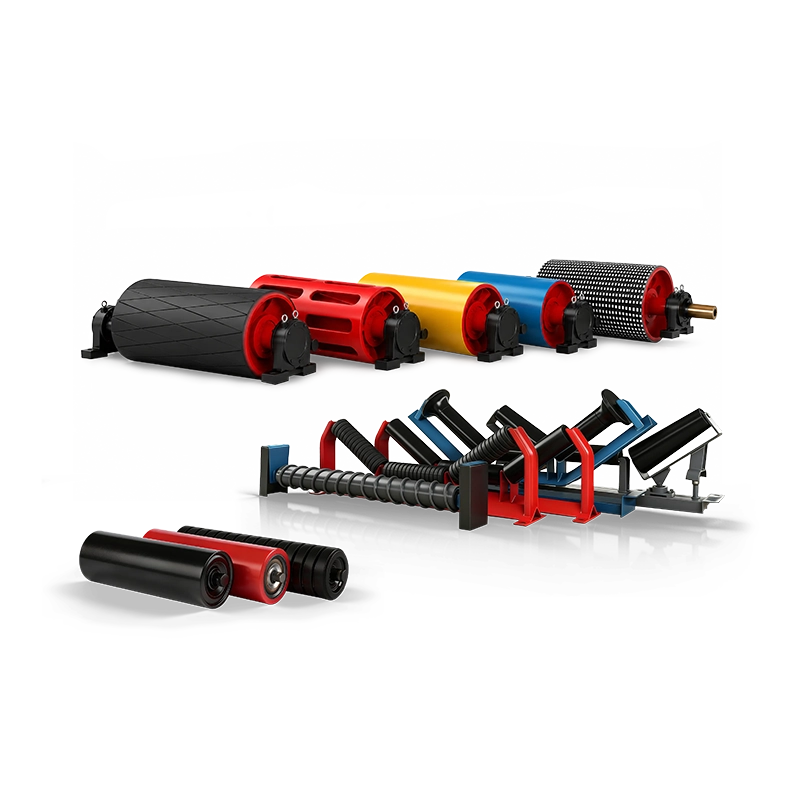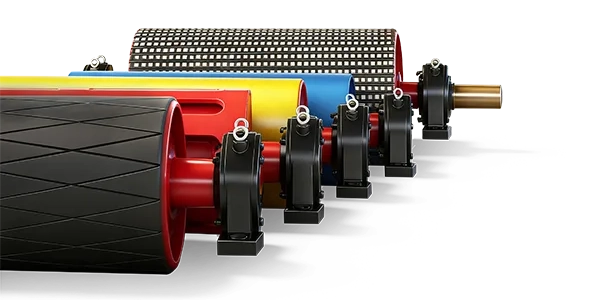




Drive pulleys and bend pulleys are both essential rotating components in a belt conveyor, and from the outside they can look very similar. Both may consist of a steel shell, shaft, hubs, end discs, bearings, and sometimes rubber or other surface covering. Their functions, however, are fundamentally different.
A drive pulley transfers power from the conveyor drive system to the belt, creating the traction needed to move the loaded conveyor. A bend pulley changes the direction of the conveyor belt. In some conveyor arrangements, a non-drive pulley positioned near the drive pulley is also used to increase belt wrap around the drive pulley; this is commonly called a snub pulley.
Understanding this difference is important when purchasing replacement pulleys. Ordering a pulley simply by diameter and belt width can lead to incorrect shaft design, lagging, bearing selection, or hub construction. For mining, quarrying, cement, coal handling, ports, steel plants, and power stations, pulley selection should always begin with the pulley’s actual position and function in the conveyor.
Quick answer: A drive pulley is connected to the drive system and transmits torque to the conveyor belt. A bend pulley is normally non-driven and redirects the belt. A snub pulley is a specific non-drive pulley positioned to increase the belt wrap angle around the drive pulley and improve available traction.
Drive Pulley vs Bend Pulley: Key Differences at a Glance
| Comparison | Drive Pulley | Bend Pulley |
| Primary Function | Transfers drive torque to the belt | Changes belt direction |
| Connection to Motor | Connected through the drive system | Normally not powered |
| Torque Transmission | Yes | Normally no drive torque |
| Main Mechanical Loads | Belt tension plus drive torque | Primarily belt tension and radial load |
| Lagging | Frequently rubber or ceramic lagged | May be bare steel or lagged depending on duty |
| Typical Positions | Head or other drive station | Tail, take-up, return, or directional change position |
What Is a Conveyor Drive Pulley?
A conveyor drive pulley is the pulley that receives rotational power from the drive unit and transfers that power to the conveyor belt. The drive arrangement commonly includes an electric motor, gearbox, coupling, and other supporting equipment.
As the drive pulley rotates, friction between the pulley surface and the belt creates the effective force that moves the belt and transported material. If there is insufficient traction, the belt can slip against the pulley instead of moving at the required speed.
Because it must transmit torque while supporting substantial belt tension, the drive pulley is usually one of the most highly loaded pulleys in the conveyor system. Shaft strength, shell thickness, hub design, bearing capacity, lagging, wrap angle, alignment, and manufacturing accuracy are therefore particularly important.
Is the Drive Pulley Always the Head Pulley?
No. A head pulley is defined primarily by its location at the discharge end of the conveyor, while a drive pulley is defined by its function of transmitting power.
In many conventional conveyors, the head pulley is also the drive pulley, so the two terms are often used interchangeably. In more complex systems, however, the drive may be located elsewhere or multiple drive pulleys may be used. When ordering a replacement pulley, buyers should therefore specify both the pulley position and whether it is driven.
What Is a Bend Pulley?
A bend pulley is a non-drive conveyor pulley used primarily to change the direction of the belt. It guides the belt through the required conveyor route while carrying the tension generated within the belt system.
Bend pulleys can appear at several positions. A tail pulley redirects the belt at the tail of the conveyor. Take-up pulleys guide the belt through a tensioning arrangement. Other bend pulleys can be positioned where the return belt needs to change direction around structures or mechanical equipment.
Although bend pulleys do not normally transmit motor torque, they should not be treated as lightly loaded components. Belt tension can create substantial radial loads on the pulley shell, shaft, hubs, and bearings, particularly on high-capacity and long-distance conveyors.
Important distinction: “Non-drive” does not mean “low load.” A bend or take-up pulley on a high-tension conveyor may still require a heavy-duty shaft, strong shell, suitable bearings, and carefully engineered construction.
What Is the Difference Between a Bend Pulley and a Snub Pulley?
The terms are related but should not always be treated as identical. A bend pulley is a general category describing a pulley that redirects the belt. A snub pulley is positioned specifically to change the belt path near the drive pulley so that the belt contacts a larger portion of the drive pulley circumference.
This additional contact is called increased wrap angle. Increasing wrap angle can improve the drive’s ability to transmit traction between the pulley and belt.
For example, if a conveyor experiences traction limitations at the drive station, engineers may evaluate drive pulley lagging, belt tension, take-up performance, contamination, and wrap angle. A snub pulley can be part of the solution where additional belt contact around the drive pulley is required.
Why Drive Pulleys Usually Need More Attention to Torque
The key structural difference between drive and bend pulleys is torque transmission. A drive pulley must handle both belt forces and the turning force generated by the drive system.
This torque passes through the shaft, hub connection, end discs, shell, pulley surface, and finally into the belt. If any part of this load path is under-designed, problems can develop in the shaft, hub, welds, shell, or connection between the shaft and pulley body.
Drive pulleys may use keyed connections or keyless locking assemblies depending on the design. Heavy-duty applications require the connection method to be evaluated according to actual torque, belt tension, shaft dimensions, starting conditions, and expected duty.
Why Drive Pulley Lagging Is So Important
Because the drive pulley depends on friction to move the belt, its surface condition is directly related to traction. This is why drive pulleys are frequently supplied with rubber or ceramic lagging.
Rubber Lagging
Rubber lagging is widely used in mining and industrial conveyor systems because it improves traction and protects the steel pulley shell. Diamond-grooved or other patterned surfaces can help manage water and contamination at the belt-pulley interface.
Ceramic Lagging
Ceramic lagging is often considered for high-tension, wet, abrasive, or slip-sensitive drive applications. The ceramic elements provide high surface grip and strong wear resistance when correctly selected and bonded.
SHENGYUAN supplies a broad range of heavy-duty conveyor pulleys, including rubber-lagged drive pulleys, ceramic-lagged pulleys, bend pulleys, snub pulleys, tail pulleys, take-up pulleys, and customized pulley designs.
Does a Bend Pulley Need Lagging?
Not every bend pulley requires lagging. Many non-drive pulleys operate successfully with a plain steel surface. Whether lagging is required depends on belt contact, contamination, wear, material buildup, environmental conditions, and the pulley’s function.
A bend pulley exposed to wet or sticky material may benefit from a suitable surface treatment. In other cases, a plain or smooth rubber surface may be appropriate. The key point is that the lagging requirement for a bend pulley should not automatically be copied from the drive pulley.
Purchasing principle: Drive pulleys normally prioritize traction. Bend pulleys normally prioritize reliable redirection, structural strength, bearing performance, and compatibility with belt tension. Their specifications should therefore be evaluated separately.
Do Drive and Bend Pulleys Use the Same Diameter?
Not necessarily. Pulley diameter should be selected according to belt construction, belt strength, splice type, bending requirements, tension, speed, and pulley position.
The drive pulley may require a larger diameter because of torque transmission, belt bending requirements, or drive configuration. Bend pulleys can sometimes use smaller diameters, but they must still remain compatible with the minimum bending requirements of the conveyor belt.
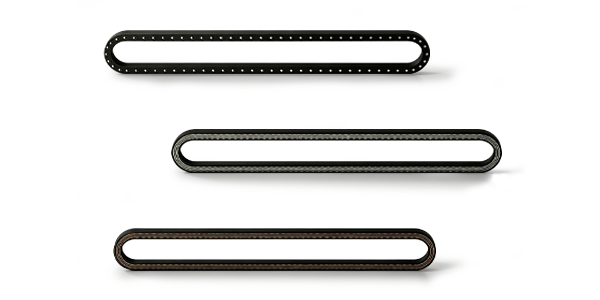
Excessively small pulleys increase belt bending severity. This can accelerate fatigue in the belt carcass and splice area, particularly in high-strength fabric and steel-cord conveyor belts. Pulley diameter should therefore not be reduced simply to lower manufacturing cost.
How Shaft and Bearing Requirements Differ
Both drive and bend pulleys require shafts capable of supporting belt-induced bending loads. However, drive pulley shafts must normally handle torque in addition to bending.
Shaft design should consider bearing locations, hub positions, shaft shoulders, couplings, keyways or locking assemblies, material strength, stress concentration, and installation dimensions. Bearing selection should consider calculated load, rotational speed, alignment, lubrication, contamination, temperature, and required service life.
A common purchasing mistake is assuming that two pulleys of the same diameter can use the same shaft. Their external appearance may be similar while their load conditions are completely different.
Example 1: Head Drive Pulley in a Mining Conveyor
Consider a mining conveyor carrying ore uphill. The head pulley is connected to the gearbox and provides the force that moves the loaded belt. It therefore functions as both the head pulley and drive pulley.
This pulley must handle drive torque, high belt tension, bearing loads, and demanding environmental conditions. Depending on moisture and traction requirements, diamond rubber or ceramic lagging may be selected. Shaft, shell, hubs, bearings, and lagging should be designed as one assembly.
Example 2: Tail Bend Pulley
At the opposite end of the conveyor, the tail pulley redirects the return belt into the carrying run. It is normally not connected to the motor, so it does not transmit drive torque.
However, the tail pulley may operate close to the loading zone, where dust, fines, moisture, and spilled material can accumulate. Good cleaning and sealing around this area are important because material trapped between the belt and pulley can damage the belt and affect tracking.
Example 3: Snub Pulley Near the Drive
A snub pulley can be installed near a drive pulley to redirect the return belt and increase the amount of belt contact around the drive pulley.
The snub pulley itself does not normally drive the belt. Its value comes from modifying belt geometry. By increasing wrap angle, the drive station can achieve greater available traction without relying only on increased belt tension.
If a conveyor develops belt slip, however, installing a snub pulley should not be treated as an automatic solution. Engineers should also inspect lagging condition, take-up tension, contamination, belt load, drive power, and alignment.
How to Tell Which Pulley You Need When Ordering
When requesting a quotation, do not send only a description such as “800 mm conveyor pulley.” Start by identifying its function.
For a drive pulley, provide:
Belt width, belt type and belt speed
Pulley diameter and face width
Drive power and gearbox information
Belt tension and wrap angle where available
Shaft and coupling requirements
Bearing and hub arrangement
Lagging and working environment
For a bend pulley, provide:
Pulley position and purpose
Belt width and belt speed
Pulley diameter and face width
Belt tension and wrap angle
Shaft dimensions and bearing arrangement
Surface requirement and operating environment
For replacement projects, an existing manufacturing drawing is highly valuable. Shaft extensions, bearing centres, keyways, hub positions, face width, overall length, and mounting dimensions should be confirmed before production.
Common Pulley Purchasing Mistakes
Mistake 1: Calling Every Pulley a Drive Pulley
Many pulleys in a conveyor do not transmit power. Identifying whether the pulley is driven, tail, bend, snub, or take-up is essential because each position creates different design requirements.
Mistake 2: Selecting Only by Diameter and Belt Width
Two pulleys can have the same diameter and face width while using completely different shafts, shells, hubs, bearings, and lagging. External dimensions alone are not enough for a reliable quotation.
Mistake 3: Using the Same Lagging on Every Pulley
Drive pulleys require traction, while many bend pulleys do not. Applying expensive ceramic lagging throughout the system can increase purchasing cost without providing equivalent operating value at every position.
Mistake 4: Ignoring Belt Tension on Non-Drive Pulleys
A bend pulley does not transmit drive torque, but belt tension can still produce high bearing and shaft loads. Non-driven pulleys should therefore be designed according to their real load rather than assumed to be light-duty.
Why Choose SHENGYUAN for Drive and Bend Pulleys?
SHENGYUAN specializes in conveyor pulleys, rollers, idlers, and related heavy-duty bulk material handling components for mining, coal handling, cement, aggregates, ports, steel plants, power plants, and industrial conveyor systems.
One advantage of working with a specialized pulley manufacturer is the ability to manufacture different pulley positions according to their actual duty rather than treating every conveyor drum as the same product.
Through its custom conveyor solutions, SHENGYUAN can manufacture pulleys according to customer drawings, replacement dimensions, belt data, shaft arrangements, bearing requirements, working loads, lagging requirements, and environmental conditions.
Custom options can include pulley diameter, face width, shell thickness, shaft dimensions, shaft ends, bearing housings, hub construction, keyless locking arrangements, rubber lagging, diamond-grooved lagging, ceramic lagging, polyurethane surfaces, corrosion protection, and product identification.
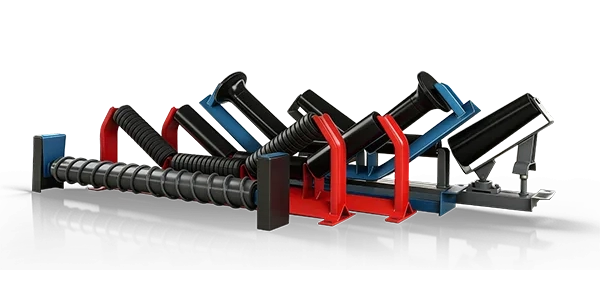
Drive, bend, snub, tail, and take-up pulleys can also be coordinated with conveyor rollers and idlers in the same procurement package. For international projects, SHENGYUAN provides service and logistics support for technical confirmation, order communication, export packaging, and shipment coordination.
Need to replace an existing conveyor pulley?
Provide the pulley drawing, installation position, belt width, belt speed, pulley diameter, face width, shaft dimensions, bearing arrangement, drive power if applicable, belt tension, lagging requirement, operating environment, quantity, and required delivery schedule. Identifying whether the pulley is a drive, bend, snub, tail, or take-up pulley allows a more accurate technical and commercial proposal.
Conclusion: Function Is the Most Important Difference
The essential difference between a drive pulley and a bend pulley is their function. The drive pulley receives mechanical power and transmits torque to the conveyor belt. A bend pulley redirects the belt and supports belt tension without normally supplying drive power.
A snub pulley is a particular non-drive pulley used near the drive station to redirect the belt and increase wrap around the drive pulley. This can improve available traction where the conveyor design requires a greater contact angle.
Because their loads and functions differ, drive and bend pulleys should not automatically use the same shaft, shell, hub, bearing, or lagging specification. Correct pulley purchasing begins by identifying what the pulley does, where it is installed, and what loads it must carry. From there, dimensions and construction can be matched to the actual conveyor duty.