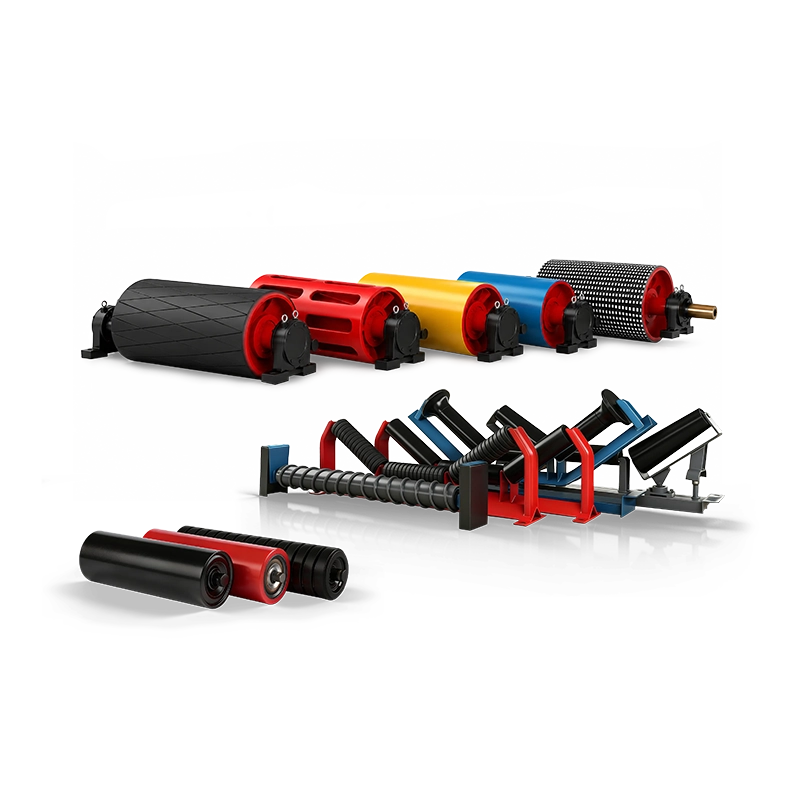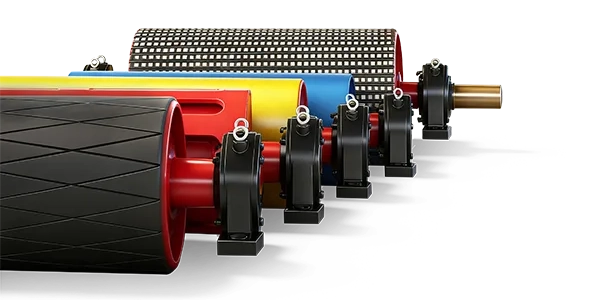

Pulley lagging is one of the most important contact surfaces in a belt conveyor drive system. Although it may appear to be only a layer of rubber bonded to the pulley shell, the lagging pattern directly influences traction, drainage, belt slip, wear, material buildup, and long-term conveyor reliability.
For mining, quarrying, cement, coal handling, aggregates, ports, steel plants, and power stations, three common rubber lagging patterns are plain lagging, herringbone lagging, and diamond-grooved lagging. Each design has a different purpose. Plain rubber provides a simple friction and protection layer. Herringbone grooves provide strong traction and good water drainage but are directional. Diamond grooves provide multidirectional drainage and are particularly useful where the conveyor may operate in both directions.
Choosing the correct pattern should not be based on appearance or price alone. Pulley position, belt direction, belt tension, drive torque, moisture, contamination, wrap angle, material characteristics, and operating environment should all be considered.
Quick answer: Choose plain rubber lagging for moderate-duty and relatively clean conditions. Choose herringbone lagging when strong traction and efficient drainage are required on a conveyor operating mainly in one direction. Choose diamond-grooved lagging when good drainage and traction are needed without directional restrictions, especially on reversible conveyors.
What Is Conveyor Pulley Lagging?
Pulley lagging is a rubber, ceramic, polyurethane, or other surface layer applied to the outer shell of a conveyor pulley. On a drive pulley, its primary purpose is to improve friction between the pulley and conveyor belt. It can also protect the steel shell, improve water evacuation, reduce slip, and provide a replaceable wear surface.
Lagging is particularly important on drive pulleys because torque must be transferred from the pulley into the belt through the contact surface. If the available friction is insufficient, the pulley can rotate without moving the belt at the same surface speed. This condition is commonly described as belt slip.
Repeated slip can generate heat, wear the belt cover, damage lagging, reduce conveying capacity, and create unstable operation. The correct lagging therefore contributes directly to drive reliability.
Plain vs Herringbone vs Diamond Lagging: Quick Comparison
| Lagging Pattern | Main Advantage | Direction Requirement | Typical Application |
| Plain Rubber | Simple traction improvement and shell protection | Non-directional | Dry or moderate-duty conveyors |
| Herringbone | High traction and effective drainage | Directional | One-way mining, coal, cement and aggregate conveyors |
| Diamond Groove | Good traction and multidirectional drainage | Non-directional | Reversible and variable-direction conveyors |
1. Plain Rubber Lagging: Simple and Cost-Effective
Plain rubber lagging has a relatively smooth surface without deep drainage grooves. It creates a rubber contact layer between the steel pulley and conveyor belt, increasing friction compared with bare steel while protecting the pulley shell from direct belt contact.
Its simplicity is an advantage. Manufacturing and replacement are straightforward, and plain lagging can provide good value where the drive does not operate near its traction limit and where water, mud, or heavy contamination are not major concerns.
When Plain Lagging Is a Good Choice
Plain rubber is often suitable for indoor conveyors, relatively dry environments, moderate belt tensions, general industrial applications, and non-critical pulley positions where aggressive drainage grooves are unnecessary.
It may also be selected where the main objective is shell protection rather than maximum traction. For some non-drive pulleys, a smooth rubber surface can protect the belt and pulley without introducing unnecessary groove patterns.
Limitations of Plain Lagging
The main limitation is drainage. If water, slurry, or fine material enters between the belt and pulley, a smooth surface provides fewer paths for contamination to escape. In wet drive applications, this can reduce effective friction and increase the risk of slip.
Best use: Choose plain rubber lagging when the environment is relatively clean and dry, drive traction requirements are moderate, and simple shell protection provides sufficient performance.
2. Herringbone Lagging: High Traction with Strong Drainage
Herringbone lagging uses angled grooves arranged in a V-shaped or chevron-style pattern. The grooves create additional edges and provide channels that help move water and contamination away from the belt-pulley contact area.
This pattern is widely used on drive pulleys in mining, coal handling, aggregates, cement plants, and outdoor conveyor systems where increased traction and drainage are important.
Why Herringbone Lagging Provides Good Traction
The patterned surface creates more pronounced contact edges than smooth rubber. More importantly, the grooves provide a route for moisture and fine contamination to escape instead of remaining trapped beneath the belt.
For wet outdoor conveyors, this drainage capability can help maintain more consistent contact between the belt and pulley surface.
Herringbone Lagging Is Directional
One of the most important characteristics of herringbone lagging is that the groove pattern has an operating direction. The orientation should correspond with the conveyor belt running direction so that the groove pattern performs its drainage function correctly.
If the pattern is installed in the wrong orientation, drainage performance may be reduced. For this reason, the supplier should confirm belt running direction before manufacturing or installing herringbone lagging.
Important purchasing detail: When ordering a herringbone-lagged pulley, clearly identify the belt travel direction or provide a conveyor layout drawing. This prevents the groove pattern from being manufactured for the wrong running direction.
3. Diamond Lagging: A Strong Choice for Reversible Conveyors
Diamond-grooved lagging uses intersecting grooves that create a repeating diamond pattern across the pulley surface. Unlike herringbone grooves, the pattern is not dependent on one primary running direction.
This makes diamond lagging particularly useful for reversible conveyors where the belt may operate in both directions. It can also be attractive where the customer wants good drainage without having to control directional installation.
Why Diamond Grooves Work Well in Wet Conditions
The intersecting channels provide multiple escape paths for water and fine contamination. Because the pattern works across both directions, water management remains effective when belt travel is reversed.
This is especially useful for reversible stockpile conveyors, certain loading and unloading systems, and industrial conveyors where operational direction changes as part of the normal process.
Herringbone vs Diamond Lagging: Which One Should You Choose?
The decision usually depends first on conveyor direction. If the conveyor operates consistently in one direction and requires strong drainage, herringbone lagging is often an excellent solution. If the conveyor reverses regularly, diamond lagging generally provides a more practical pattern because it does not depend on one running direction.
| Operating Condition | Preferred Starting Option |
| Dry, moderate-duty drive | Plain rubber |
| Wet, one-direction conveyor | Herringbone |
| One-direction heavy-duty mining drive | Herringbone or higher-traction lagging after engineering review |
| Reversible conveyor | Diamond groove |
| Wet reversible conveyor | Diamond groove |
| Very high-tension, severe slip risk | Evaluate ceramic lagging rather than rubber pattern alone |
When Rubber Lagging Is Not Enough
Plain, herringbone, and diamond patterns all improve rubber lagging performance, but groove pattern alone cannot solve every traction problem.
High-tension mining conveyors, heavily loaded uphill conveyors, wet drive stations, or systems with recurring slip may require a higher-friction solution such as ceramic lagging. Ceramic elements can provide stronger grip and high wear resistance in demanding applications.
However, ceramic is not automatically better for every conveyor. More aggressive traction surfaces can cost more and may not be necessary for moderate-duty applications. Lagging should always be matched to the actual traction requirement.
The SHENGYUAN conveyor pulley range includes rubber-lagged, diamond-lagged, ceramic-lagged, polyurethane-lagged, drive, bend, take-up, snub, and other customized pulley configurations for heavy-duty bulk material handling.
Pulley Position Matters as Much as Lagging Pattern
Lagging requirements differ significantly between drive and non-drive pulleys. A drive pulley depends on friction to transmit power, so traction is normally the primary consideration. A bend or tail pulley does not normally transfer drive torque, so the surface may instead be selected for belt protection, wear resistance, material release, or environmental protection.
Using premium high-friction lagging on every pulley may increase project cost without creating proportional operating benefits. A better approach is to specify the surface according to each pulley position.
Cost-control principle: Do not specify one lagging type for every pulley. Use stronger traction surfaces where drive performance requires them and simpler surfaces where the pulley performs a non-drive function.
How Moisture Changes Lagging Selection
Water between the belt and pulley can reduce friction. This is one reason outdoor mining conveyors may behave differently during heavy rain than during dry operation.
Grooved lagging provides channels that help water escape from the contact area. Herringbone patterns are particularly effective when installed in the correct direction, while diamond patterns provide multidirectional drainage.
When moisture is combined with high belt tension, mud, clay, ore fines, or repeated slip, the supplier should evaluate whether rubber grooves provide sufficient performance or whether ceramic lagging would offer a better safety margin.
Belt Tension and Wrap Angle Must Also Be Checked
Pulley lagging cannot be selected independently from belt tension and wrap angle. The traction available at a drive pulley depends on the interaction between friction, belt tension, and the amount of belt surface contacting the pulley.
If a conveyor slips under load, simply replacing plain rubber with a more aggressive pattern may not address the real problem. Excessively low take-up tension, insufficient wrap angle, worn lagging, water contamination, pulley misalignment, overloading, or an incorrect drive design may be contributing factors.
A snub pulley may be used to increase wrap around a drive pulley where required. In many cases, improving wrap angle and selecting suitable lagging together provides a more reliable solution than increasing belt tension excessively.
Hot Vulcanized vs Cold-Bonded Lagging
The groove pattern is only part of the lagging specification. Buyers should also confirm how the rubber is bonded to the pulley shell.
Hot vulcanized lagging is applied through a controlled vulcanization process that forms a strong bond between the rubber and prepared pulley surface. It is often preferred for important heavy-duty new pulleys where long-term bonding reliability is a priority.
Cold-bonded lagging uses adhesive systems and can be convenient for maintenance and refurbishment. Its performance depends heavily on surface preparation, adhesive quality, environmental conditions, and installation workmanship.
For critical mining or continuous-duty applications, buyers should specify not only “rubber lagging” but also the required rubber compound, thickness, hardness, groove pattern, and bonding method.
Example 1: Dry Indoor Cement Conveyor
Consider an indoor conveyor operating in a relatively dry environment with moderate belt tension and stable loading. There is no recurring history of water contamination or drive slip.
In this situation, plain rubber lagging may provide sufficient traction and shell protection. Selecting herringbone, diamond, or ceramic lagging without a technical requirement may add cost without creating meaningful additional value.
Example 2: Outdoor Mining Drive Pulley
An outdoor mining conveyor operates continuously in one direction and experiences rain, dust, and occasional wet ore fines. Reliable drive traction is important because belt slip can interrupt production.
Herringbone rubber lagging is a strong starting choice because it combines increased traction with effective drainage. The groove direction must be confirmed before manufacturing and installation.
If belt tension is very high or the conveyor has a history of persistent slip in severe wet conditions, ceramic lagging may also be evaluated.
Example 3: Reversible Stockpile Conveyor
A stockpile conveyor may operate in both directions depending on material flow requirements. Using directional herringbone grooves can create an unnecessary installation limitation because the optimum groove orientation changes when belt direction reverses.
Diamond-grooved rubber is normally a more suitable starting point because its intersecting pattern provides drainage and traction without depending on a single belt direction.
Simple rule to remember: One-way + wet conditions → consider herringbone. Reversible + wet conditions → consider diamond. Moderate and relatively dry duty → plain rubber may be enough. Severe high-tension or slip-prone duty → evaluate ceramic lagging.
Common Pulley Lagging Selection Mistakes
Mistake 1: Choosing by Price Alone
The cheapest lagging may not be economical if it causes recurring slip, premature wear, or frequent replacement. Conversely, the most expensive lagging can also be poor value if the application does not need it.
Mistake 2: Using Herringbone on a Reversible Conveyor Without Review
Herringbone grooves are directional. For a conveyor that regularly reverses, diamond lagging is generally easier to apply because its drainage pattern works in either direction.
Mistake 3: Ignoring Belt Running Direction
When a herringbone pulley is ordered, the belt travel direction should be clearly marked on the drawing. This small detail can prevent a significant manufacturing or installation mistake.
Mistake 4: Increasing Belt Tension to Solve Every Slip Problem
Excessive belt tension increases loads on pulleys, shafts, bearings, splices, and the belt itself. When slip occurs, inspect lagging condition, moisture, take-up operation, wrap angle, material load, and drive design before simply increasing tension.
What Information Should You Provide When Ordering a Lagged Pulley?
01. Pulley type and installation position
02. Belt width, belt speed and belt construction
03. Pulley diameter and face width
04. Drive power and belt tension where available
05. Wrap angle around the drive pulley
06. One-way or reversible belt operation
07. Dry, wet, muddy, dusty, or abrasive operating conditions
08. Required rubber thickness, hardness, and groove pattern
09. Hot vulcanized or cold-bonded construction if specified
10. Existing drawing, quantity, and required delivery date
Why Choose SHENGYUAN for Lagged Conveyor Pulleys?
SHENGYUAN specializes in heavy-duty conveyor pulleys, rollers, idlers, and related components for mining, coal, cement, aggregates, ports, power plants, steel plants, and other bulk material handling industries.
For pulley applications, the company can provide plain rubber, diamond-grooved rubber, ceramic, polyurethane, and other surface configurations according to belt tension, drive duty, operating environment, and customer requirements.
Through its custom conveyor solutions, SHENGYUAN can manufacture pulleys according to customer drawings and customize pulley diameter, face width, shell, shaft, hub connection, bearings, lagging type, rubber thickness, groove pattern, and surface treatment.
This factory-direct approach is particularly useful for mining companies, conveyor maintenance contractors, EPC companies, distributors, and OEMs replacing existing pulleys. Instead of selecting lagging from a fixed catalogue description, buyers can provide actual belt direction, tension, moisture conditions, and operating data so that the pulley surface can be matched to its real duty.
For international orders, SHENGYUAN also provides service and logistics support covering technical confirmation, order coordination, export packaging, and shipment planning.
Need help selecting a lagging pattern?
Provide the pulley position, belt direction, belt width, belt speed, pulley diameter, drive power, belt tension, wrap angle, material, moisture conditions, existing slip problems, operating environment, and drawings. These details make it possible to compare plain, herringbone, diamond, and higher-traction lagging options on a technically meaningful basis.
Conclusion: Match the Lagging Pattern to the Conveyor Duty
Plain, herringbone, and diamond rubber lagging each have a clear role. Plain rubber is a practical solution for moderate and relatively clean operating conditions. Herringbone lagging provides strong traction and effective drainage for one-direction conveyors but must be installed according to belt travel direction. Diamond lagging provides good drainage and traction without a directional restriction, making it particularly suitable for reversible conveyors.
The final selection should also consider belt tension, drive torque, wrap angle, moisture, contamination, pulley position, rubber compound, bonding method, and required service life. Where the drive operates under severe wet, high-tension, or slip-prone conditions, ceramic lagging may deserve evaluation instead of simply choosing a more aggressive rubber groove.
The best pulley lagging is not the pattern with the highest price or the deepest grooves. It is the surface that provides sufficient traction, drainage, belt protection, and service life for the actual conveyor operating conditions.