
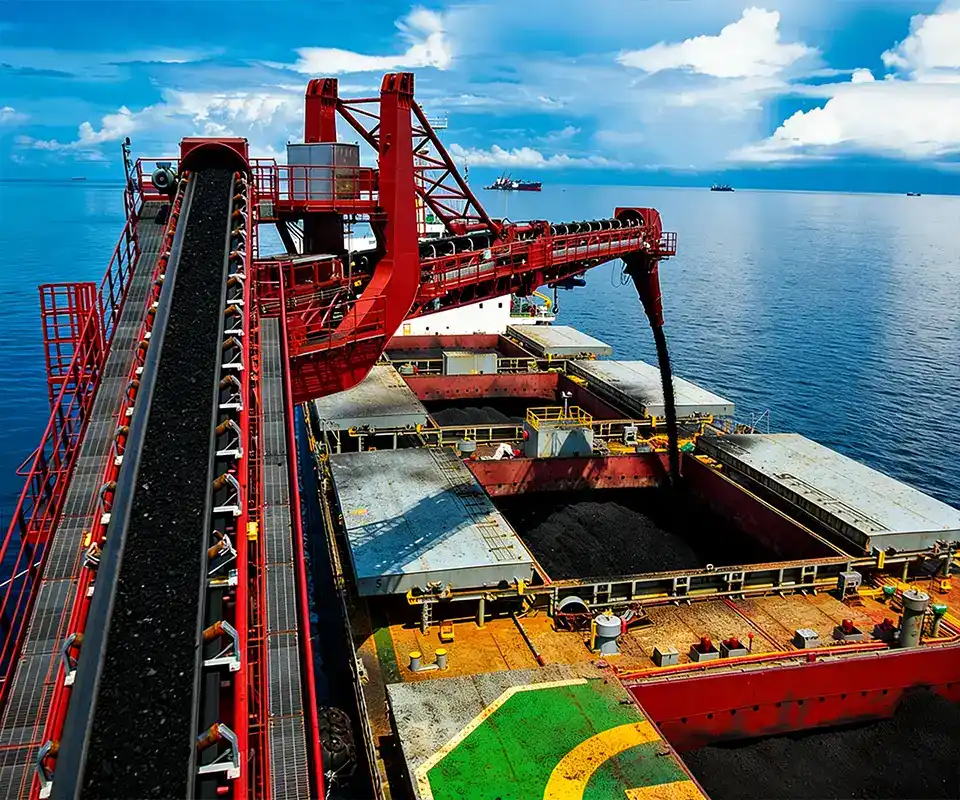
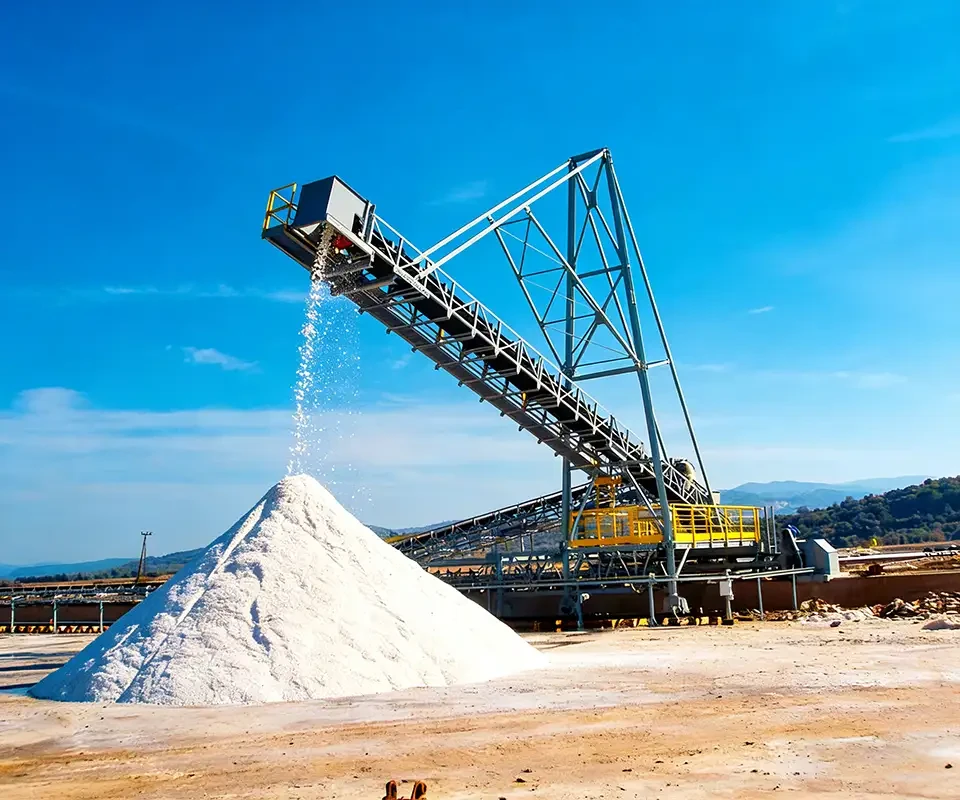
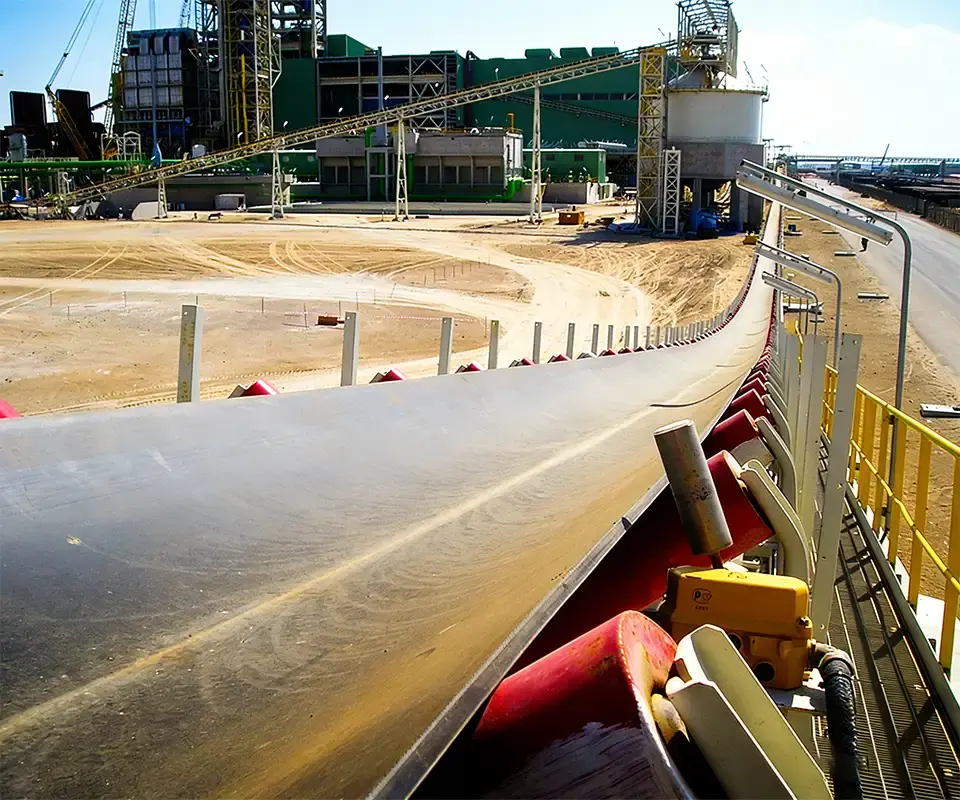
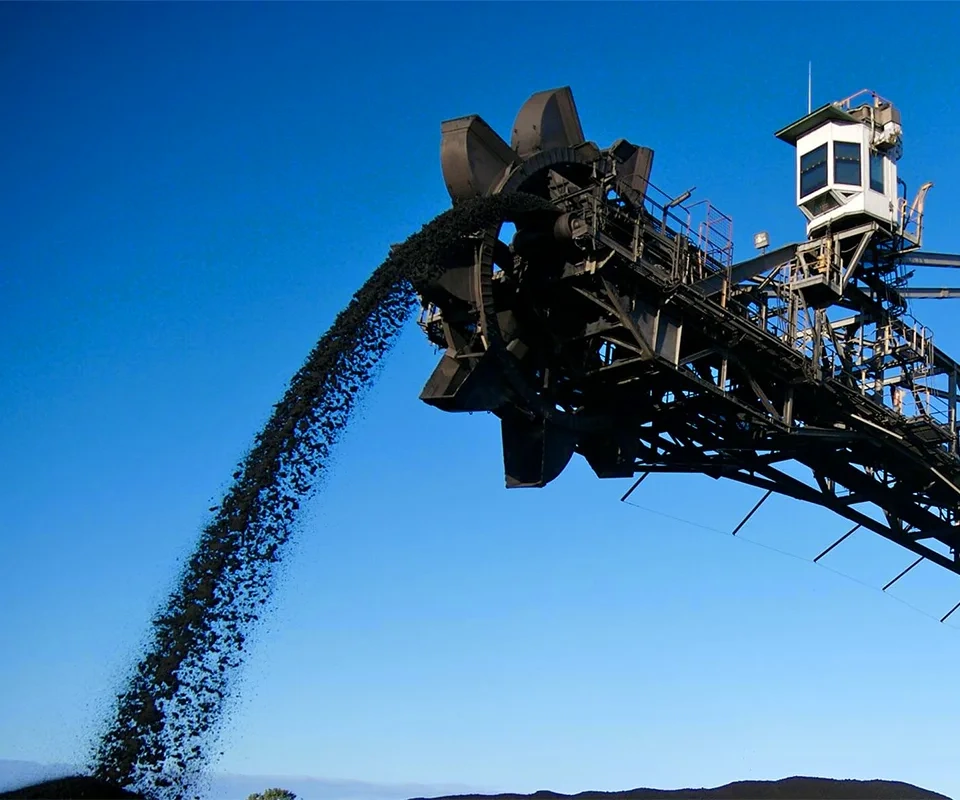
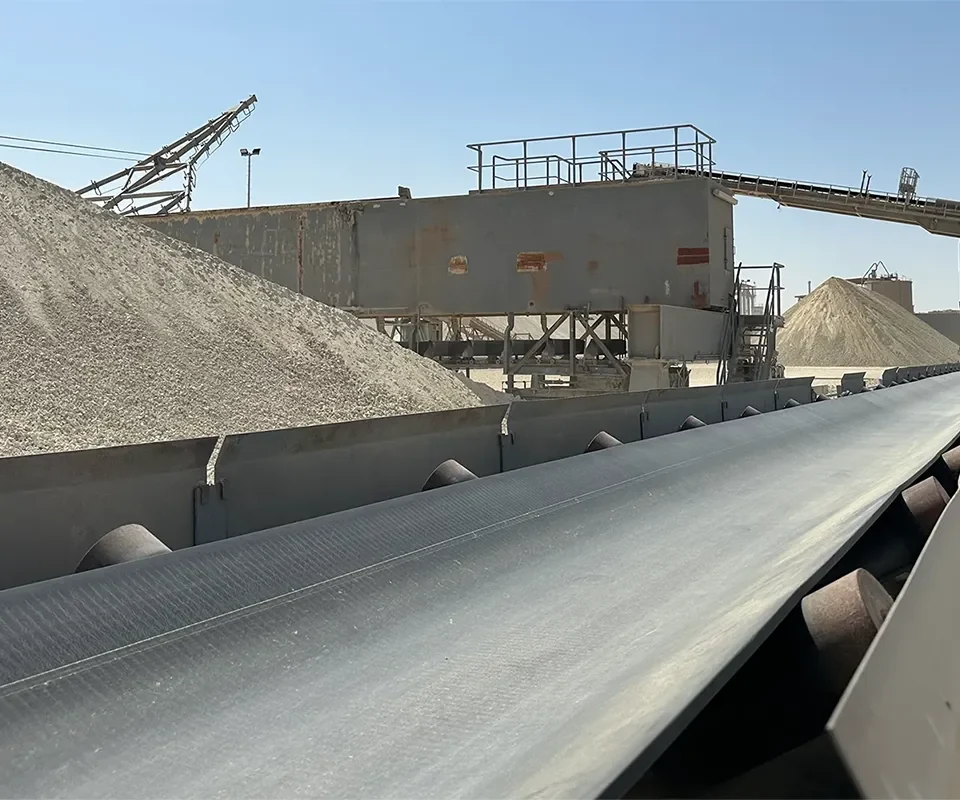
Choosing the right conveyor roller material for salt exposure is an important procurement decision for bulk terminals in the United Arab Emirates (UAE). Conveyor systems operating near the Arabian Gulf may be exposed to salt-laden air, high humidity, elevated temperatures, airborne dust, and occasional water contact. When the terminal also handles bulk salt, the conveyor rollers may experience direct contact with chloride-containing material and moisture.
These conditions can accelerate corrosion of conventional carbon steel rollers, especially around exposed shafts, bearing housings, welds, and damaged protective coatings. Corrosion can increase maintenance requirements, shorten roller service life, and contribute to bearing failures or seized rollers.
However, the best solution is not necessarily to replace every steel roller with stainless steel. HDPE rollers, polyurethane-coated rollers, stainless steel rollers, and suitably protected carbon steel rollers offer different advantages depending on mechanical loading, corrosion exposure, temperature, abrasion, and maintenance requirements.
This guide explains how to compare conveyor roller materials for salt exposure at UAE bulk terminals, identify the most vulnerable components, select appropriate sealing arrangements, and prepare a purchasing specification that balances corrosion resistance with mechanical reliability and cost.
Quick answer: For many salt-exposed bulk conveyor applications, HDPE rollers with suitable load capacity, UV resistance, and well-protected bearings are a practical option because the polymer shell does not rust. Polyurethane-coated steel rollers may be appropriate where mechanical strength and surface protection are both needed. Grade 316 or 316L stainless steel provides better chloride-corrosion resistance than grade 304, but it is not immune to pitting or crevice corrosion. Heavy-duty coated steel rollers can also be economical where the protective system is suitable and maintained. The best choice depends on the complete roller construction, not the shell material alone.
Why Salt Exposure Is a Challenge for UAE Bulk Terminals
Salt exposure at a bulk terminal can come from two different sources: the surrounding marine environment and the material being conveyed.
At coastal facilities in the UAE, salt-containing moisture and airborne deposits can accumulate on exposed machinery. When humidity increases or surfaces become wet, these deposits may form an electrolyte that promotes corrosion of susceptible metals.
At terminals handling bulk salt, direct contact with salt particles can create additional challenges. Dry salt deposits may accumulate around roller ends, while wet salt and saline residues can become particularly aggressive toward inadequately protected components.
Hot weather adds another consideration. Solar heating can increase the operating temperature of exposed rollers, while repeated wetting and drying can concentrate salt deposits in difficult-to-clean areas.
The exposure level therefore differs between a sheltered conveyor carrying dry aggregates, an open quay conveyor exposed to sea spray, and an enclosed conveyor handling damp industrial salt.
1. Understand Which Roller Components Are Vulnerable to Corrosion
A conveyor roller is not made from a single material. It normally consists of a cylindrical shell, shaft, bearing housings, rolling bearings, seals, and related retaining components.
These components may use different materials and therefore have different corrosion resistance.
For example, an HDPE roller may have a corrosion-resistant plastic shell while still containing a carbon steel shaft and conventional steel bearings. Similarly, a polyurethane-coated roller may have a protected outer surface but retain a steel shell underneath.
Corrosion can begin at the exposed shaft ends, damaged coating areas, interfaces between the shaft and bearing housing, or locations where saline moisture remains trapped.
Key procurement principle: A corrosion-resistant roller shell does not automatically make the entire roller corrosion-resistant. Buyers should evaluate the shell, shaft, bearings, seals, housings, and exposed connections as one complete assembly.
2. HDPE Conveyor Rollers for Salt Exposure
High-density polyethylene (HDPE) conveyor rollers are an important option for corrosive bulk-material handling environments.
Unlike ordinary carbon steel, HDPE does not undergo metallic rusting. It also offers low weight and useful resistance to many salts, moisture, and chemical contaminants.
These characteristics make HDPE attractive for certain port conveyors, salt-handling installations, fertilizer plants, mineral-processing facilities, and other applications where moisture and corrosive materials are present.
Advantages of HDPE Rollers
- The HDPE shell does not rust when exposed to saline moisture.
- Lower roller weight can simplify handling and certain maintenance operations.
- Suitable formulations provide useful resistance to abrasion and chemical exposure.
- Reduced shell corrosion can help maintain a consistent running surface.
- Engineered polymer constructions may offer reduced operating noise.
Limitations of HDPE Rollers
HDPE has different mechanical and thermal properties from steel. Its stiffness, long-term deformation behavior, thermal expansion, and temperature limits must be considered during design.
Some HDPE rollers use internal steel reinforcement to support longer spans or higher loads. Their internal metallic components must still be protected from salt and moisture.
For UAE outdoor installations, the supplier should confirm whether the HDPE formulation is UV-stabilized and suitable for the expected ambient and operating temperatures.
An HDPE roller should never be selected solely because the material is corrosion-resistant. The complete roller must meet the required load capacity, belt speed, shaft strength, and bearing-life requirements.
3. Stainless Steel Conveyor Rollers for Marine Environments
Stainless steel rollers may be considered where metallic construction, surface durability, and corrosion resistance are important.
However, stainless steel is not a single material grade. Its resistance to salt exposure depends on the alloy composition, surface condition, operating temperature, chloride concentration, and whether saline moisture accumulates in confined areas.
304 Stainless Steel
Grade 304 provides useful corrosion resistance in many general industrial environments, but it is more vulnerable to chloride-induced pitting than grade 316.
For rollers exposed to persistent marine deposits, damp salt, or repeated saline moisture, 304 should not automatically be considered the preferred stainless steel option.
316 and 316L Stainless Steel
Grade 316 contains molybdenum, which improves resistance to chloride-related corrosion compared with grade 304. Grade 316L offers similar general corrosion performance with a lower carbon content, which can be advantageous for certain welded constructions.
These grades are common candidates for marine atmospheric exposure, but they are not corrosion-proof. Warm saline deposits, stagnant seawater, and crevices can still cause localized corrosion.
For exceptionally aggressive chloride conditions, higher-alloy or duplex stainless steels may require evaluation. Such materials should be selected through project-specific corrosion and mechanical engineering assessment.
The higher cost of stainless steel should be justified by the required corrosion resistance, load characteristics, maintenance access, and expected operating life.
4. Polyurethane-Coated Conveyor Rollers
Polyurethane-coated rollers combine an underlying structural roller with a polyurethane outer layer.
The polyurethane coating can provide a protective running surface and offer useful wear resistance in certain applications. It may also reduce direct contact between the shell metal and corrosive material while the coating remains intact.
However, polyurethane coating is not equivalent to an entirely nonmetallic roller. If the coating is cut, abraded through, or poorly bonded, saline moisture may reach the underlying steel and initiate corrosion.
Coating performance depends on polyurethane formulation, hardness, thickness, bonding quality, temperature, wear conditions, and chemical compatibility.
For UAE bulk terminals, polyurethane-coated rollers may be an option where additional surface protection is useful and the underlying mechanical construction is suitable. Buyers should ask for evidence of coating adhesion, environmental suitability, and expected wear behavior.
5. Coated or Galvanized Carbon Steel Rollers
Carbon steel remains widely used in heavy-duty conveyor rollers because it offers high structural stiffness, established manufacturing methods, and practical load-carrying capability.
For marine or salt-exposed installations, additional corrosion protection may be specified through suitable coatings, zinc-based treatments, or other engineered surface-protection systems.
A protective system can make steel rollers economical in certain terminal environments, especially where direct saline exposure is limited and maintenance access is available.
However, damaged coatings, unprotected shaft ends, and poorly sealed bearing areas remain vulnerable. Zinc coatings also have a finite service life, particularly in aggressive chloride environments.
Coating selection should therefore reflect the actual atmospheric corrosivity, exposure duration, surface preparation, and planned inspection program.
6. Comparison of Conveyor Roller Materials for Salt Exposure
| Roller Material | Salt Resistance | Main Limitation | Potential Application |
| HDPE Shell | Shell does not undergo metallic corrosion | Thermal and load limits; metallic internals still need protection | Wet salt, corrosive bulk materials, selected return and carrying positions |
| 304 Stainless Steel | Better general corrosion resistance than plain carbon steel | Susceptible to chloride pitting | Less aggressive or controlled environments after assessment |
| 316/316L Stainless Steel | Improved chloride resistance compared with 304 | Higher price; pitting and crevice corrosion remain possible | Selected coastal and salt-exposed metallic roller applications |
| Polyurethane-Coated Steel | Coating provides a protective outer barrier while intact | Coating damage and exposed shaft or housing corrosion | Wear-sensitive applications requiring protected steel construction |
| Protected Carbon Steel | Depends on coating system and maintenance | Corrosion when protective barriers deteriorate | Heavy-duty positions with manageable exposure and suitable protection |
This comparison is a preliminary purchasing reference. None of these materials should be approved without checking the full roller design, operating load, shaft and bearing arrangement, and actual salt exposure.
7. Do Not Ignore Roller Bearings and Seals
In salt-exposed conveyors, the bearing and sealing system can be more important to roller life than the corrosion resistance of the outer shell alone.
Saline moisture and fine salt particles can enter inadequately protected bearing housings. Contamination may degrade the lubricant, promote corrosion, and accelerate bearing wear.
A suitable sealing arrangement may combine multi-stage labyrinth passages, protective end covers, contact seals, and appropriate grease barriers. The exact design should be selected for the expected water, dust, and salt exposure.
Bearings with integrated seals can offer additional protection, but these do not automatically eliminate the need for effective external roller-end sealing.
Important specification: Ask whether the proposed roller has been evaluated for salt-contaminated water, humid air, fine dust, or wet bulk material. Also confirm the shaft material or surface treatment, bearing protection, lubrication, and seal construction. A supplier’s description of a roller as “corrosion-resistant” is not enough to establish the complete assembly’s performance.
8. UAE Heat and UV Exposure Affect Material Selection
Outdoor conveyor equipment in the UAE may experience high ambient temperatures and strong solar radiation. Exposed components can become hotter than the surrounding air, especially when operating under direct sunlight.
For HDPE rollers, thermal expansion, shell stiffness, long-term deformation, and UV stability should be considered. A polymer material suitable for moderate indoor temperatures may not automatically be suitable for exposed summer conditions at an open bulk terminal.
For polyurethane-coated rollers, temperature can influence material hardness, elasticity, bonding, and wear behavior. The selected formulation must be compatible with the expected operating temperature.
Steel rollers generally have different thermal limitations, but their bearings, lubricants, seals, and protective coatings still require temperature verification.
The RFQ should specify both the expected maximum ambient temperature and any higher roller operating temperature caused by equipment duty or solar exposure.
9. Match Roller Materials to Different Terminal Locations
A large UAE bulk terminal may operate conveyors in enclosed storage buildings, covered galleries, outdoor transfer stations, and exposed quay areas.
Using one roller material throughout the entire facility may simplify spare-parts management, but it is not necessarily the most economical or technically suitable approach.
| Terminal Location | Main Exposure | Potential Material Approach |
| Enclosed Dry Bulk Storage | Dust and occasional salt deposits | Protected steel or suitable polymer rollers, depending on duty |
| Wet Salt Transfer Point | Damp salt, buildup, high contamination | Engineered HDPE or other corrosion-resistant assemblies with strong sealing protection |
| Open Quay Conveyor | Salt-laden air, humidity, weather, sunlight | UV-stabilized polymer, suitable stainless steel, or engineered coated steel |
| Heavy-Impact Loading Zone | High shock loads with possible corrosion | Mechanically rated heavy-duty rollers with appropriate corrosion protection |
| Return Conveyor Section | Salt carryback and roller buildup | Suitable corrosion-resistant return rollers with effective upstream belt cleaning |
These are possible approaches rather than fixed material assignments. Site measurements, load calculations, and existing failure records should guide the final choice.
10. Heavy Loads Can Change the Best Material Choice
Corrosion resistance should not be considered separately from roller mechanical performance.
Heavy-duty bulk terminals may use wide conveyor belts, substantial material loads, and relatively long roller spans. These conditions place demands on shell stiffness, shaft bending resistance, bearings, and frame construction.
Steel rollers can provide high stiffness and robust load-carrying capability, while engineered HDPE or composite rollers may achieve suitable performance through reinforced construction and carefully selected dimensions.
The manufacturer should confirm the allowable load and operating speed for the proposed roller diameter, length, shaft size, and bearing arrangement.
It is unsafe to assume that an HDPE roller and a steel roller with identical external dimensions have identical load ratings unless their designs have been verified for the intended duty.
For guidance on load, construction, and bearing selection, see Key Factors for Choosing Conveyor Rollers.
11. Salt Carryback and Roller Buildup
In conveyors handling bulk salt, material remaining on the belt after discharge can accumulate on return rollers and nearby structures.
Damp salt deposits may form uneven layers on roller surfaces. Repeated buildup can influence belt support, increase vibration, and contribute to tracking problems.
HDPE and other polymer roller surfaces may offer advantages in selected buildup-sensitive applications, but no roller material should be assumed completely resistant to salt adhesion.
Spiral or disc-type return rollers may also be considered in specific locations where their geometry helps manage deposits. Their suitability depends on the belt and conveyed material.
Most importantly, return rollers should not be used as substitutes for an effective belt cleaning system. Primary and secondary cleaning, appropriate discharge design, and regular maintenance remain essential.
12. Should Buyers Choose HDPE or Stainless Steel?
HDPE and stainless steel both offer advantages in salt-exposed environments, but they solve the corrosion problem in different ways.
HDPE is a nonmetallic shell material that avoids metallic corrosion of the shell itself. It may be attractive where low weight, saline moisture resistance, and appropriate load capacity are priorities.
Stainless steel maintains a metallic construction and can provide useful structural and environmental performance. However, its price is generally higher than conventional carbon steel, and chloride-related corrosion remains possible depending on grade and exposure.
A sensible decision should compare the complete installed roller, including shaft protection, bearings, seals, operating temperature, anticipated wear, replacement frequency, and initial purchase cost.
For many salt-exposed terminal applications, an engineered HDPE roller is worth evaluating first. For demanding metallic construction requirements, a properly specified stainless steel or protected heavy-duty steel assembly may be more appropriate.
13. Compare Total Operating Cost, Not Only Purchase Price
The cheapest replacement roller does not necessarily provide the lowest cost over its service life.
A carbon steel roller may have a lower initial purchase price but require more frequent replacement if its protective coating and bearing seals are unsuitable for the salt environment.
A more expensive stainless steel or engineered polymer roller may be economically justified if it reduces corrosion-related failures and maintenance interventions.
However, improved corrosion resistance is useful only when mechanical loading, temperature, sealing, and other performance requirements are also satisfied.
Total cost comparisons should include roller purchase, freight, installation, expected replacement frequency, maintenance labor, inspection, and potential downtime. When possible, evaluate service life using operating hours and actual failure records rather than calendar time alone.
14. What Information Should Be Included in the RFQ?
An accurate RFQ allows suppliers to compare HDPE, stainless steel, coated steel, and other designs using the same operating requirements.
| Category | Information Required |
| Terminal Location | UAE site, indoor or outdoor location, distance from direct marine exposure |
| Material Handled | Salt or other bulk material, particle size, moisture, density, abrasiveness |
| Corrosion Exposure | Salt dust, sea spray, humidity, standing water, washdown conditions |
| Conveyor Duty | Belt width, speed, capacity, operating hours, impact and load conditions |
| Roller Dimensions | Diameter, shell length, shaft size, shaft ends, mounting distance |
| Roller Materials | HDPE, stainless grade, coated steel, polyurethane, reinforcement |
| Internal Construction | Bearings, shaft protection, housings, seals, lubricant |
| Environmental Limits | Maximum operating temperature, solar exposure, UV resistance |
| Procurement | Quantity, drawings, samples, inspections, delivery date, destination |
15. A Practical Roller Material Selection Checklist
01. Identify whether salt exposure comes from the conveyed material, marine atmosphere, or both.
02. Confirm whether the material is normally dry, damp, or frequently wet.
03. Calculate the required roller load and operating speed.
04. Compare HDPE, stainless steel, polyurethane-coated steel, and protected carbon steel.
05. Verify the shaft, bearing, housing, and sealing materials.
06. Check maximum temperature and outdoor UV exposure.
07. Review carryback, buildup, and return-roller conditions.
08. Confirm mounting and roller-frame compatibility.
09. Compare corrosion protection, maintenance requirements, and projected replacement costs.
10. Approve a suitable sample or site trial where performance uncertainty is significant.
16. Common Mistakes When Buying Rollers for Salt Exposure
Mistake 1: Assuming HDPE Means the Entire Roller Cannot Corrode
The polymer shell may resist salt corrosion, but internal steel shafts, bearings, and exposed metal parts still require protection.
Mistake 2: Selecting 304 Stainless Steel for Severe Chloride Exposure Without Review
Grade 304 can experience pitting in chloride-rich conditions. A suitable stainless grade should be selected according to the actual environment.
Mistake 3: Ignoring UAE Summer Temperatures
High temperatures and solar exposure can influence polymer deformation, coating performance, bearing lubrication, and seal life.
Mistake 4: Choosing Corrosion Resistance Without Checking Load Capacity
A corrosion-resistant shell material does not guarantee adequate mechanical strength for long spans, heavy loads, or impact conditions.
Mistake 5: Overlooking Seal and Bearing Quality
Salt and moisture entering the bearing can cause premature failure even when the outer shell remains in good condition.
Mistake 6: Comparing Only Initial Purchase Prices
A lower-cost roller may be more expensive over time if it requires frequent replacement due to corrosion or contamination-related failure.
How to Compare Conveyor Roller Suppliers for UAE Bulk Terminals
A suitable supplier should understand both the corrosive environment and the mechanical requirements of the conveyor.
Ask suppliers to explain the complete roller construction, including shell material, shaft protection, bearing specification, sealing arrangement, and any coating or reinforcement.
For polymer rollers, confirm UV stabilization, operating-temperature limits, load capacity, and any internal metallic reinforcement. For stainless steel rollers, verify the actual material grade and exposed component construction. For coated steel, request the specified protective system and relevant inspection requirements.
Where possible, compare product samples, drawings, relevant test results, and operating experience under similar conditions. A site trial may be valuable when replacing a large population of rollers affected by repeated corrosion failures.
Corrosion-Resistant Conveyor Roller Solutions from SHENGYUAN
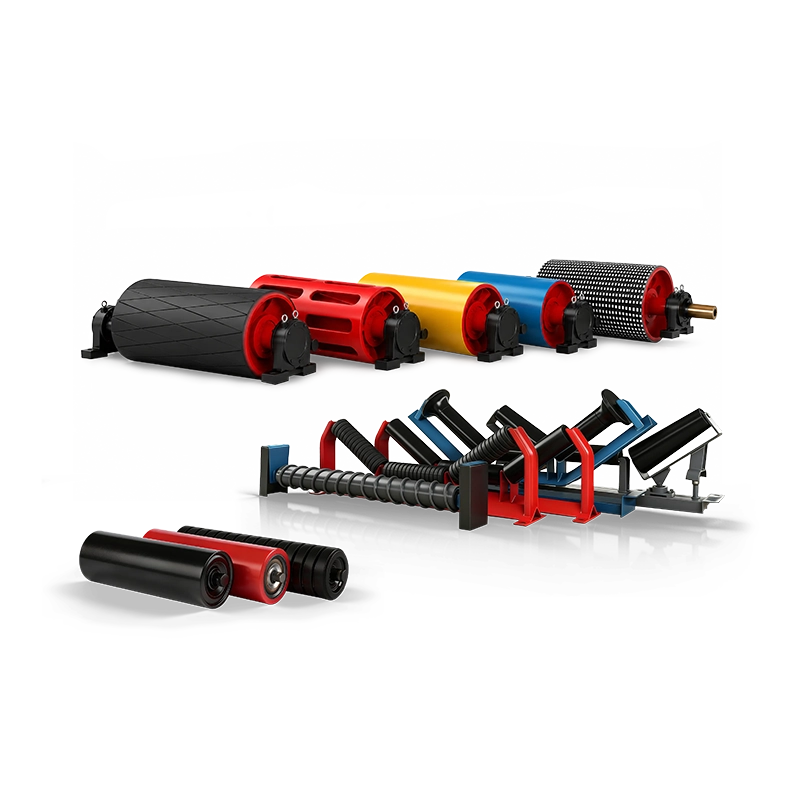
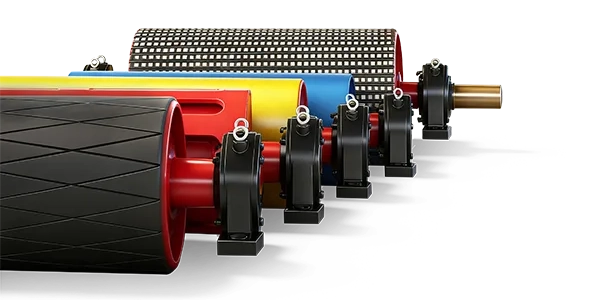
SHENGYUAN supplies conveyor rollers, idlers, pulleys, belts, cleaners, frames, and related components for mining, ports, bulk terminals, quarrying, cement, power plants, steel plants, and other industrial material-handling systems.
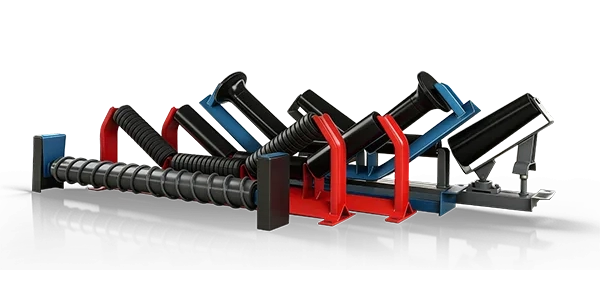
The SWCONS conveyor roller range includes steel, HDPE, polyurethane, carrying, return, impact, spiral, and other roller configurations for different operating conditions.
For UAE bulk terminals, roller specifications can be reviewed according to the level of salt exposure, material characteristics, humidity, temperature, conveyor loads, bearing protection, and mounting requirements.
Through custom conveyor solutions, replacement rollers can be specified using customer drawings, existing samples, field measurements, and operating data.
International shipment requirements can also be coordinated through customer service and logistics support, including packaging and delivery arrangements for the project.
Looking for corrosion-resistant conveyor rollers for a UAE bulk terminal?
Send the conveyed material, salt and moisture exposure, terminal location, roller dimensions, belt width and speed, load requirements, operating temperature, shaft and bearing specifications, required quantities, and existing corrosion or failure history. These details help determine whether HDPE, polyurethane-coated steel, stainless steel, or another protected roller construction is appropriate for the application.
Conclusion: Select Corrosion Resistance and Mechanical Strength Together
Selecting conveyor rollers for salt exposure at a UAE bulk terminal requires a balance between corrosion resistance, mechanical performance, operating temperature, maintenance requirements, and total cost.
HDPE rollers offer an attractive non-rusting shell for many corrosive applications, provided their load capacity, temperature resistance, and internal component protection are suitable. Stainless steel rollers can be considered where metallic construction is required, with grade 316 or 316L generally offering better chloride resistance than grade 304. Polyurethane-coated and suitably protected steel rollers remain useful alternatives where their complete construction meets the project requirements.
Bearing protection, sealing quality, shaft corrosion, salt buildup, UV exposure, and high ambient temperatures should all be included in the final specification. A sample evaluation or controlled field trial can help verify suitability before major replacement programs.
The best conveyor roller for salt exposure is not simply the one made from the most corrosion-resistant shell material. It is the complete roller assembly that resists the actual chloride environment, supports the required conveyor loads, protects its bearings, and delivers reliable service at a reasonable long-term cost.