

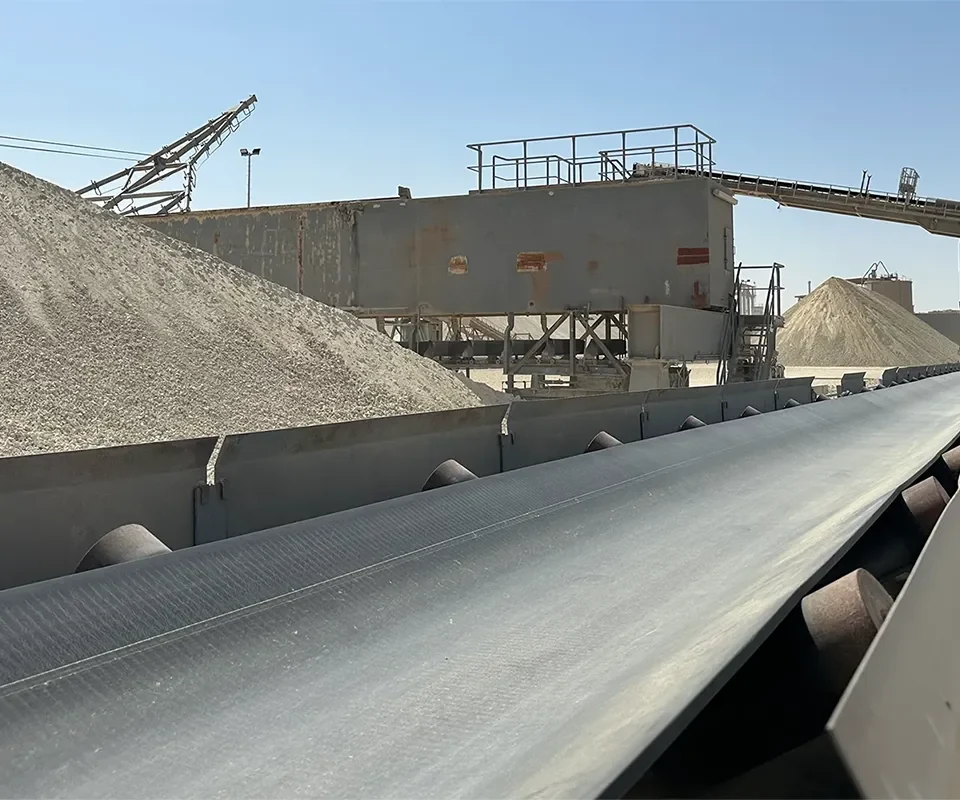
HDPE conveyor roller deformation is a concern in mining, quarrying, ports, cement plants, and other heavy-duty bulk-material handling operations. High-density polyethylene (HDPE) rollers offer advantages such as corrosion resistance, relatively low weight, and useful wear properties, but their mechanical behavior differs significantly from that of conventional steel rollers.
When an HDPE roller develops a flattened surface, excessive deflection, ovality, or permanent dimensional changes, maintenance teams may initially attribute the problem to high temperature or excessive loading. However, these conditions often interact, making the actual cause difficult to identify without reliable operating records and dimensional measurements.
Unlike steel, HDPE exhibits pronounced time-dependent mechanical behavior. Under sustained stress, it can continue deforming over time, a process known as creep. Elevated temperature can accelerate this process by reducing the material’s effective stiffness and increasing its deformation under load.
To determine whether roller deformation results primarily from temperature, sustained loading, or another mechanical problem, buyers and maintenance engineers should examine operating temperature, load magnitude, exposure duration, roller construction, deformation patterns, dimensional changes, and material properties.
Quick answer: HDPE roller deformation can be traced by comparing temperature history, sustained loading, deformation location, and dimensional changes over time. Temporary expansion that reverses after cooling suggests a thermal effect, while progressive deflection under continuous loading indicates possible creep. Deformation that increases during hotter operating periods and remains partly after cooling may indicate temperature-accelerated creep or another permanent damage mechanism. The diagnosis should also consider roller span, shell thickness, internal reinforcement, bearings, and manufacturing quality before assigning the root cause.
Why Can HDPE Conveyor Rollers Deform?
HDPE is a thermoplastic polymer with viscoelastic properties. This means its response to mechanical stress includes both elastic deformation and time-dependent deformation.
When a load is applied, an HDPE component can deform immediately. If the load remains applied, additional deformation may develop progressively, even without an increase in the applied force.
Higher temperature generally makes sustained deformation more pronounced. The response depends on the specific HDPE grade, additives, manufacturing process, geometry, and loading conditions.
For conveyor rollers, the visible result may include changes in shell roundness, local flattening, axial distortion, or increased runout. Not every distortion originates in the polymer shell: damaged bearings, displaced reinforcement, and incorrect assembly can produce similar symptoms.
1. Understand the Difference Between Thermal Expansion and Creep
The first diagnostic step is to distinguish changes caused by temperature from changes caused by sustained mechanical stress.
Thermal Expansion
HDPE expands as its temperature rises and contracts as it cools. When the material is free to expand and remains within suitable conditions, much of this dimensional change is reversible.
If expansion is restricted by internal steel reinforcement, end caps, or other components, the mismatch in expansion can introduce additional stresses and distort the roller assembly.
Creep Deformation
Creep is progressive deformation under sustained stress. It can occur even at moderate temperatures, while elevated temperature generally increases its rate.
Creep deformation may recover partly after unloading, but recovery can be delayed or incomplete. Therefore, a roller that does not immediately return to its original shape is not automatically evidence of irreversible damage.
| Characteristic | Thermal Expansion | Creep Deformation |
| Primary Driver | Temperature change | Sustained stress over time |
| Time Dependence | Follows thermal response | Accumulates with loading duration |
| Effect of Heat | Changes dimensions | Often accelerates deformation |
| Recovery | Generally reverses on cooling if unconstrained and undamaged | May be immediate, delayed, partial, or incomplete |
2. Record the Actual Roller Temperature, Not Just Ambient Temperature
Ambient temperature is useful, but it does not always represent the temperature experienced by an HDPE roller shell.
Outdoor conveyor rollers may be exposed to direct sunlight, warm conveyed material, frictional heating, and restricted ventilation. In some installations, the roller surface becomes significantly hotter than the surrounding air.
Record the roller surface temperature, ambient temperature, conveyed-material temperature, measurement location, and time of day. Repeated measurements during representative operating conditions are more informative than a single temperature reading.
Infrared measurements should account for emissivity, reflected radiation, viewing angle, and surface condition. Where safe and practical, use a suitable contact sensor or another validated measurement method to confirm questionable readings.
When deformation is concentrated on exposed outdoor rollers, compare them with equivalent rollers operating under shade or inside the plant.
3. Determine Whether the Roller Has Experienced Sustained Loading
Sustained loading is not determined simply by the weight of material on the conveyor. It also depends on how long the load acts and how stress is distributed within the roller.
During normal operation, the rotating roller shell passes repeatedly through the belt-contact zone. The material experiences a changing local stress pattern while the roller carries the conveyor load.
During extended shutdowns, a stationary roller may remain under belt contact pressure at approximately the same circumferential location. Depending on the actual load, construction, and temperature, this condition may contribute to localized, time-dependent deformation.
Record whether the conveyor operates continuously, intermittently, or experiences long periods of loaded shutdown. Also identify unusually heavy loading events and any changes in production capacity.
Diagnostic principle: A roller that deforms during a prolonged loaded shutdown may have a different failure mechanism from one that gradually develops increased runout during continuous operation. Record both load duration and the operating state before drawing conclusions.
4. Calculate the Actual Load on the HDPE Roller
To investigate sustained-load deformation, the maintenance team should establish the actual mechanical load carried by the roller or idler set.
Relevant factors include belt width, belt mass, bulk-material load, idler spacing, trough angle, roller arrangement, and local dynamic effects.
A carrying roller beneath a heavily loaded belt experiences different forces from a return roller supporting the empty belt. Impact rollers beneath a transfer chute may also face substantial transient loads that require separate assessment.
When reviewing a failed roller, compare the calculated loading with the manufacturer’s rating for the exact roller diameter, shell length, construction, and operating temperature.
A nominal load rating should not automatically be assumed valid at every temperature or over every operating duration. For more information, see Key Factors for Choosing Conveyor Rollers.
5. Identify the Pattern of Roller Deformation
The location and shape of deformation can help narrow the possible causes.
| Observed Condition | Possible Explanation | What to Check |
| Localized Flat Area | Prolonged localized pressure or mechanical damage | Loaded shutdown history and contact position |
| Progressive Shell Deflection | Long-term loading, inadequate shell stiffness, or internal damage | Load, span, shell thickness, reinforcement |
| Ovality or Increased Runout | Uneven deformation, manufacturing variation, or assembly defects | Diameter profile, concentricity, bearings |
| Axial Distortion Near Ends | Thermal expansion restraint or end-cap interference | End clearances and polymer-to-metal interfaces |
| Localized Cracking or Surface Damage | Impact, excessive stress, degradation, or repeated abrasion | Loading events, material condition, exposure history |
These observations are diagnostic clues rather than definitive evidence. Several failure mechanisms can produce similar visible deformation.
6. Measure Diameter, Ovality and Runout
Visual inspection alone is not sufficient for determining the severity or cause of HDPE roller deformation.
After the roller has been safely isolated and removed if necessary, measure its diameter at several axial positions. At each position, take measurements in multiple circumferential directions to identify local flattening or ovality.
Record overall shell length, visible end distortion, and any changes in roller geometry. Where applicable, inspect radial runout using a suitable fixture and measurement method.
The measurements should be compared with original manufacturing drawings, supplier tolerances, or an unused reference roller of the same construction.
Measurements taken at different temperatures should be identified clearly. A difference caused by ordinary thermal expansion should not be confused with permanent dimensional damage.
7. Use Cooling and Unloading Observations Carefully
One useful diagnostic method is to compare a suspect roller’s dimensions under different controlled conditions.
If deformation appears during high-temperature operation and largely disappears after cooling to a consistent reference temperature, ordinary thermal expansion or reversible thermal distortion may be contributing.
If deformation continues increasing under sustained load and some dimensional change remains after unloading, creep or other permanent deformation mechanisms become more plausible.
However, viscoelastic recovery can take time. Immediate measurement after unloading should not be treated as proof that all remaining deformation is permanent.
For controlled evaluation, record the temperature, load condition, elapsed time after unloading, and repeated dimensions using a defined measurement procedure.
Do not deliberately overload a conveyor or conduct unsafe in-service experiments to reproduce deformation. Any investigation should follow the site’s isolation, handling, and engineering safety requirements.
8. Compare Similar Rollers Operating Under Different Conditions
A comparison across rollers of the same construction can help separate environmental influences from design or manufacturing problems.
For example, if identical HDPE rollers operate at similar loads but only those exposed to higher temperatures show progressive deformation, the temperature difference deserves further investigation.
Conversely, if rollers at the highest-load positions deform while equivalent rollers in cooler or lighter-duty zones retain their original geometry, sustained mechanical stress may be a major contributor.
The strongest comparisons use matching roller dimensions, shell materials, manufacturing batches, service hours, bearing designs, and measured loads. Differences in these factors should be documented before drawing conclusions.
9. Check Roller Shell Thickness and Internal Reinforcement
HDPE conveyor rollers are available in different structural configurations. Some use polymer shells supported by engineered end assemblies, while others incorporate internal steel tubes or additional reinforcement.
These construction differences strongly influence shell stiffness and deformation resistance.
A longer roller span or thinner shell may experience greater deflection under a given load, depending on its material grade and internal construction. Reinforcement can improve structural performance, but interfaces between polymer and metal must accommodate their different thermal behavior.
If multiple rollers from the same batch show abnormal deformation, inspect representative units for shell-wall consistency, reinforcement position, bonding or mechanical retention, and end-cap assembly quality.
10. Investigate Bearing and Shaft Problems Before Blaming HDPE
Not every apparent shell-deformation problem is caused by inadequate polymer properties.
A damaged bearing can increase rotational resistance, generate abnormal heat, or create uneven roller movement. Shaft bending, incorrectly seated bearings, or displaced bearing housings can also produce apparent runout or belt-contact irregularities.
Excessive friction may raise local roller temperature, making it difficult to distinguish the original mechanical defect from its thermal consequences.
Inspect the bearings, shaft alignment, bearing housings, sealing arrangement, and free-rotation condition as part of the root-cause investigation.
A seized or visibly damaged roller should be managed under the site’s approved safety procedures rather than left in service for further observation.
11. Understand the Interaction Between High Temperature and Sustained Load
Temperature and sustained loading should not always be treated as separate causes.
An HDPE roller may perform adequately under a given load at moderate temperature but deform excessively when the same load is applied for a long period at a higher temperature.
This occurs because the effective mechanical stiffness of HDPE depends on temperature and loading duration. Short-term stiffness measurements alone may not predict long-term dimensional stability.
For engineering investigations, laboratory creep testing at controlled temperatures and stresses can help establish the behavior of the proposed material. Relevant methods include ISO 899-1 for tensile creep and ISO 899-2 for flexural creep.
These are material-specimen test methods; they do not automatically establish the allowable deformation or service life of a complete conveyor roller. Actual assembly geometry and operating conditions still require engineering evaluation.
12. Build a Root-Cause Investigation Record
An effective investigation should connect the observed deformation with operating history and measurable component conditions.
| Record Category | Information to Collect |
| Roller Identification | Model, supplier, batch, dimensions, installation position |
| Temperature History | Ambient, surface, material temperature, operating peaks |
| Load History | Normal load, peak load, loading duration, shutdown conditions |
| Operating Conditions | Belt speed, service hours, idler spacing, material characteristics |
| Dimensional Inspection | Diameter, ovality, runout, shell length, deformation location |
| Construction Details | HDPE grade, wall thickness, reinforcement, bearings, shaft |
| Comparison Evidence | Unaffected rollers, previous failures, inspection photographs |
Use consistent measurement methods so results collected on different dates can be compared meaningfully. A documented trend is more useful than an isolated observation.
13. How to Distinguish Temperature-Related and Load-Related Deformation
A practical investigation can use the following sequence to identify the most likely contributing factors.
Step 1: Confirm the defect. Measure roller geometry and distinguish actual shell deformation from buildup, damaged bearings, or installation misalignment.
Step 2: Review temperature exposure. Compare surface temperatures, ambient conditions, solar exposure, and conveyed-material temperatures.
Step 3: Review sustained loading. Determine normal and peak loads, loaded shutdown duration, roller span, and operating history.
Step 4: Compare equivalent rollers. Identify whether deformation is concentrated in hot locations, heavily loaded zones, or a specific manufacturing batch.
Step 5: Evaluate recovery. Compare dimensions after controlled cooling and unloading, allowing for delayed viscoelastic recovery.
Step 6: Review design and materials. Verify long-term material properties, shell construction, reinforcement, bearings, and assembly tolerances.
If the evidence indicates that elevated temperature and loading duration both contributed, record them as interacting causes rather than forcing the investigation to identify only one factor.
14. Preventing HDPE Roller Deformation in Heavy-Duty Conveyors
Preventing deformation begins with matching roller design to the actual operating conditions.
The supplier should evaluate the required load capacity and long-term dimensional stability at the intended temperature. Shell wall thickness, material grade, roller diameter, length, reinforcement, and bearing arrangement should be coordinated as one design.
In particularly demanding locations, reducing excessive idler spacing or changing the roller construction may improve load distribution, subject to conveyor engineering review.
For outdoor conveyors, UV-resistant materials and suitable thermal clearances may also be important. When operating temperatures or sustained loads exceed the verified capability of a proposed HDPE roller, an engineered reinforced polymer roller or steel alternative should be considered.
Different carrying, return, and impact positions may require different roller designs. See the Conveyor Idler Types and Applications Guide for related selection considerations.
15. What Should Buyers Ask HDPE Roller Suppliers?
Procurement teams should not evaluate HDPE rollers only by nominal dimensions, claimed service life, or corrosion resistance.
Ask the supplier to identify the HDPE material formulation, whether the construction includes steel reinforcement, and what mechanical design data support the rated operating conditions.
For applications involving elevated temperature or sustained heavy loading, request information on allowable load at the design temperature, long-term deformation behavior, thermal expansion, and material testing where available.
Also confirm the shaft, bearings, sealing arrangement, mounting dimensions, and inspection requirements. A polymer roller cannot be evaluated independently of its complete mechanical assembly.
16. HDPE Roller Replacement RFQ Checklist
| Category | Information Required |
| Roller Specifications | Diameter, shell length, shaft dimensions, mounting arrangement |
| Operating Duty | Belt width, speed, material, capacity, idler spacing, calculated load |
| Temperature | Ambient range, surface temperature, material temperature, solar exposure |
| Loading Duration | Daily operating hours, loaded shutdowns, sustained loading conditions |
| Roller Construction | HDPE formulation, wall thickness, reinforcement, bearings, seals |
| Failure History | Deformation location, measurements, photographs, service duration |
| Quality Requirements | Dimensional inspection, runout, material data, required performance verification |
| Procurement | Quantity, replacement schedule, drawings, delivery location |
Common Mistakes When Investigating HDPE Roller Deformation
Mistake 1: Blaming High Temperature Without Measuring the Roller
Ambient temperature alone does not establish the shell temperature or explain the observed deformation.
Mistake 2: Ignoring the Duration of Loading
A load that produces acceptable short-term deflection may create greater deformation over extended periods.
Mistake 3: Treating All Remaining Deformation as Permanent
HDPE may exhibit delayed recovery after unloading, so controlled measurement timing is important.
Mistake 4: Overlooking Bearings and Reinforcement
Bearing defects, shaft misalignment, and damaged internal structures can produce symptoms similar to shell deformation.
Mistake 5: Selecting Replacement Rollers from External Dimensions Alone
Two rollers with identical outside dimensions may have different HDPE grades, wall thicknesses, reinforcement, and allowable loads.
HDPE Conveyor Roller Selection and Customization with SHENGYUAN
SHENGYUAN supplies conveyor rollers, idlers, pulleys, belts, cleaners, frames, and related components for mining, quarrying, cement, coal handling, ports, steel plants, power stations, and other heavy-duty bulk-material handling applications.
The SWCONS conveyor roller range includes HDPE, steel, polyurethane, carrying, return, impact, and other roller configurations for different conveyor duties.
For HDPE roller replacement projects, specifications can be reviewed according to roller dimensions, load requirements, operating temperature, belt speed, shaft construction, bearing protection, and existing deformation problems.
Through custom conveyor solutions, replacement roller requirements can be coordinated using customer drawings, existing samples, site measurements, and operating data.
Experiencing HDPE conveyor roller deformation?
Send the roller diameter, length, shaft dimensions, loading conditions, belt speed, operating temperature, service hours, installation position, deformation photographs, and available dimensional measurements. Include information about loaded shutdowns, direct sunlight, bearing failures, and roller construction. These details help identify whether the replacement design should address temperature exposure, sustained loading, structural stiffness, or other mechanical problems.
Conclusion: Trace Deformation Through Temperature, Load and Time
HDPE conveyor roller deformation is rarely explained reliably by one observation. Temperature, stress magnitude, loading duration, shell construction, and internal mechanical components must be evaluated together.
Reversible dimensional changes that follow temperature variations may indicate thermal expansion. Progressive deformation under sustained load points toward creep, while elevated temperature can accelerate this time-dependent behavior. Bearing defects, manufacturing variation, and structural problems must also be excluded before assigning the root cause.
The most reliable investigation combines accurate temperature measurements, load history, dimensional inspection, comparisons with unaffected rollers, and relevant material information. Procurement teams can then use the findings to specify better-matched replacements rather than repeatedly ordering identical rollers.
The key is not simply determining whether heat or load caused the deformation. It is establishing how temperature, mechanical stress, and operating duration interacted with the roller’s actual construction—and ensuring the replacement design is suitable for those combined conditions.