


The loading zone is one of the most difficult areas of a belt conveyor to design correctly. Material arrives from a hopper or upstream conveyor with its own velocity, direction, lump size, and impact energy. If the chute and skirt board do not control that material properly, the result can be spillage, dust, belt mistracking, skirt wear, damaged rollers, and repeated cleanup around the transfer point.
A good conveyor skirt board and chute system should do more than prevent material from falling over the belt edge. It should guide material toward the belt centerline, reduce impact, stabilize the material stream, provide enough space for the load to settle, control dust, and maintain an effective seal without creating excessive friction against the belt.
For mining, quarrying, cement, coal handling, aggregates, ports, steel plants, and power stations, loading-zone design should therefore be considered as a complete system involving the transfer chute, guide chute, skirt boards, skirt rubber, impact idlers, belt profile, cleaners, and dust-control measures.
Quick answer: To reduce conveyor spillage and dust, keep the material stream centered, avoid loading too close to the belt edges, support the belt firmly beneath the skirt system, use enough chute length for material to settle, maintain controlled skirt contact, and provide suitable containment for displaced air and dust. A practical preliminary reference is for the guide chute bottom width to be about 1/2 to 2/3 of the belt width, but final dimensions must be checked against capacity, lump size, belt speed, trough angle, and material behavior.
What Is the Difference Between a Transfer Chute and a Skirt Board?
The transfer chute receives material from an upstream source and controls the direction in which the material enters the receiving conveyor. It may connect an upstream conveyor, hopper, crusher discharge, feeder, or storage system to the belt below.
The skirt board or guide chute runs along the sides of the belt in the loading zone. Its function is to contain the material while it lands, changes velocity, and settles into a stable cross-section on the moving belt.
Skirt rubber is normally installed along the lower edge of the skirt system to close the small gap between the fixed steel structure and moving conveyor belt.
These components should be designed together. A well-sealed skirt board cannot compensate for a transfer chute that throws material violently toward one side of the belt.
Why Does Spillage Occur at Conveyor Loading Points?
Spillage usually occurs when material reaches the belt faster, wider, deeper, or less centrally than the loading zone can contain.
Common causes include off-center loading, excessive chute width, insufficient skirt-board length, unstable belt support, worn skirt rubber, surging material flow, excessive drop height, large lumps, material buildup, and belt mistracking.
If material is already moving sideways when it enters the receiving conveyor, narrowing the skirt gap alone will not solve the problem. The incoming flow direction must first be corrected.
1. Keep the Material Stream Near the Belt Centerline
The most important principle of transfer design is to load material as close to the center of the belt as practical.
When material lands heavily on one side, the unequal loading force can push the belt laterally and contribute to mistracking. The overloaded side of the skirt system may also experience increased pressure, wear, and leakage.
If the belt runs correctly while empty but begins moving sideways as soon as material is loaded, inspect the transfer chute and incoming material stream before adjusting multiple idler sets.
For additional troubleshooting, see How to Identify and Fix Conveyor Belt Tracking Issues.
2. Choose the Correct Guide Chute Width
The guide chute should be wide enough to pass the required material flow without blockage, but narrow enough to keep material away from the belt edges.
For conventional bulk-material conveyors, a useful preliminary reference is to make the bottom width of the guide chute approximately 1/2 to 2/3 of the conveyor belt width.
| Belt Width | 1/2 Belt Width | 2/3 Belt Width |
| 800 mm | 400 mm | ≈533 mm |
| 1000 mm | 500 mm | ≈667 mm |
| 1200 mm | 600 mm | 800 mm |
| 1400 mm | 700 mm | ≈933 mm |
These values are starting references, not fixed dimensions. High-capacity conveyors, very large lumps, unusual trough profiles, or special transfer geometries may require different dimensions.
Design balance: Too wide and material can approach the belt edge, increasing spillage and skirt pressure. Too narrow and the chute can restrict flow, increase material depth, and create blockage or excessive wall pressure.
3. Provide Enough Skirt-Board Length for Material to Settle
Material does not become stable immediately after it reaches the belt. It may bounce, accelerate, spread laterally, and release trapped air before settling into its normal conveying profile.
If the skirt board ends too early, material may still be unstable when containment disappears. This can cause spillage immediately after the loading zone.
Required skirt length depends on belt speed, material velocity, lump size, flow rate, moisture, and transfer geometry. Faster conveyors and turbulent transfers generally require more attention to material-settling distance.
The correct approach is to observe where the material stream becomes stable rather than selecting skirt-board length from belt width alone.
4. Support the Belt Firmly Beneath the Skirt System
Effective sealing requires a reasonably stable belt surface. If the belt moves vertically between widely spaced support points, the gap between the belt and skirt rubber changes continuously.
This problem is especially serious at high-impact loading points. Falling material pushes the belt downward, while the fixed skirt system remains in the same position.
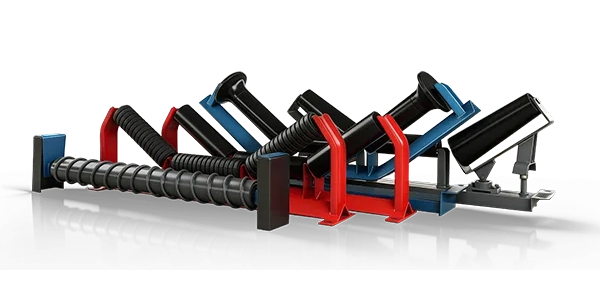
Impact idlers or an appropriate impact-support arrangement should therefore be installed beneath the loading zone. Closely spaced support reduces belt deflection and helps maintain more consistent sealing.
For information about loading-zone support, see conveyor rollers and impact idlers for carrying, return, impact, and special-duty applications.
5. Skirt Rubber Should Seal Without Excessive Friction
Skirt rubber provides the flexible interface between the stationary skirt board and the moving conveyor belt. It should contain fines and dust without pressing so aggressively against the belt that it creates excessive friction.
If contact pressure is too low, fine material escapes beneath the seal. If pressure is too high, the skirt can accelerate belt-cover wear and generate unnecessary heat.
Adjustment should also consider belt movement. A belt that mistracks sideways may run into the skirt structure and damage both the belt edge and skirt system.
Maintenance clue: If skirt rubber needs constant tightening to stop leakage, inspect belt support, loading position, chute pressure, and belt tracking. Excessive adjustment may be compensating for another loading-zone problem.
6. Reduce Material Drop Height and Impact Energy
High drop height increases impact energy and can cause material to bounce violently after contacting the belt.
This creates several problems at once: belt-cover damage, increased dust generation, greater pressure against skirt boards, and more difficult material containment.
Where possible, chute geometry should guide material onto the belt with controlled vertical and horizontal velocity rather than allowing a free fall directly onto the receiving conveyor.
For large lumps and high drop heights, the loading zone should be evaluated together with impact idler spacing and belt strength.
7. Match Material Direction to Belt Travel
Material entering the belt at a large difference in horizontal velocity can slide, tumble, and generate dust before it stabilizes.
Where practical, the chute should discharge material in a direction that is reasonably compatible with the belt travel direction. This reduces relative motion between the material and belt.
Reducing uncontrolled sliding can help reduce belt wear, material degradation, dust, and side pressure against the skirt boards.
8. Control Dust by Managing Air as Well as Material
Dust control is not only a sealing problem. When material falls into a chute, it displaces air. Fine particles can become suspended in that moving air and escape through gaps around the transfer point.
Simply closing every opening can sometimes increase internal pressure if displaced air has nowhere to go. Effective dust control therefore requires both material containment and controlled airflow.
Front curtains, rear curtains, chute covers, sealing strips, settling zones, and dust-extraction systems may be used depending on the application.
Fine cement, coal dust, dry limestone, fly ash, and similar materials usually require more attention to enclosure and air movement than coarse, damp material.
9. Use Wear Liners Where Material Attacks the Chute
Abrasive bulk material can wear through chute walls and skirt structures, particularly where the material stream repeatedly strikes the same surface.
Replaceable wear liners can protect the structural chute and make maintenance easier. Their material and thickness should match abrasion, impact, temperature, and the conveyed product.
However, liners should not project into the material flow in a way that creates ledges where material can accumulate. Buildup changes the effective chute shape and can redirect the material stream toward one side.
10. Belt Speed Influences Spillage and Dust
Higher belt speed can increase conveyor capacity, but it also changes loading-zone behavior. Faster belts create greater relative velocity at the transfer point and can make material settling more difficult.
Fine materials may generate more dust, while large or abrasive material can create greater wear as it accelerates to belt speed.
When repeated skirt leakage or dust occurs after a capacity increase, check whether belt speed or feed rate has changed from the conditions for which the loading zone was originally designed.
11. Carryback Can Create New Spillage Around the Loading Zone
Spillage is not always caused by material escaping directly from the chute. Carryback from the discharge point can travel on the return belt, fall from rollers, and accumulate around structures farther along the conveyor.
Material buildup can then interfere with rollers, pulleys, and the return belt. A complete dust and spillage strategy should therefore include effective belt cleaning.
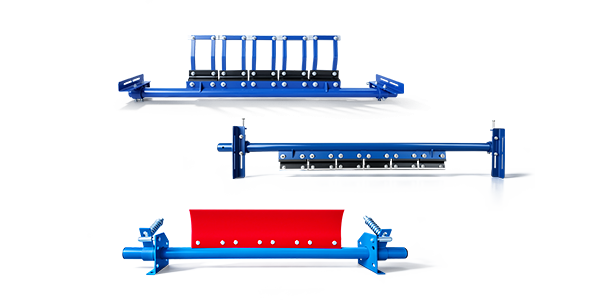
Primary and secondary cleaners should remove material near the discharge point, while empty-section protection helps keep loose material away from tail and take-up pulleys.
Common Skirt Board and Chute Design Mistakes
Mistake 1: Making the Guide Chute Nearly as Wide as the Belt
This leaves little free belt area near the edges and can increase side spillage, skirt pressure, and sensitivity to mistracking.
Mistake 2: Making the Chute Too Narrow
An excessively narrow opening can restrict the material stream, increase depth and wall pressure, and create blockage.
Mistake 3: Using Short Skirts for a Turbulent Transfer
If material is still bouncing or spreading when the skirt ends, spillage simply moves to the discharge end of the skirt system.
Mistake 4: Tightening Skirt Rubber to Solve Every Leak
Excessive sealing pressure can damage the belt. Check belt support, chute width, material pressure, and tracking first.
Mistake 5: Ignoring Air Movement
Dust-laden air needs to be contained and managed. A mechanically sealed chute can still leak dust if internal pressure becomes excessive.
Mistake 6: Ignoring Conveyor Components Around the Loading Zone
Chutes, idlers, belt tension, cleaners, pulleys, and tracking all interact. The Belt Conveyor Components Guide provides a broader overview of how the complete system works together.
A Practical Loading-Zone Design Checklist
01. Confirm belt width, belt speed, and trough angle.
02. Identify material bulk density and maximum lump size.
03. Confirm normal and peak conveyor capacity.
04. Control material direction and drop height.
05. Keep the material stream near the belt centerline.
06. Select guide chute width with enough edge clearance.
07. Provide enough skirt-board length for material to stabilize.
08. Support the belt firmly beneath the loading zone.
09. Adjust skirt rubber without excessive pressure.
10. Provide appropriate dust containment and airflow control.
11. Inspect wear liners, cleaners, idlers, and belt tracking during operation.
What Information Is Needed to Design or Improve a Skirt Board and Chute?
Provide: conveyor belt width;
belt speed and trough angle;
material type and bulk density;
maximum lump size;
normal and maximum capacity;
drop height and incoming material direction;
existing chute width, height, and length;
skirt rubber arrangement;
impact idler or belt-support arrangement;
current spillage and dust locations;
photos and transfer-point drawings.
Improve Loading-Zone Reliability with Coordinated Conveyor Components
SHENGYUAN supplies conveyor rollers, idlers, pulleys, belts, cleaners, frames, and related components for mining, quarrying, cement, coal handling, aggregates, ports, steel plants, power stations, and other heavy-duty bulk-material handling systems.
Loading-zone problems should be diagnosed according to their actual cause. Spillage may come from incorrect chute geometry, belt mistracking, inadequate support, worn skirting, or excessive feed surges. Dust may involve impact energy, fine material, open gaps, and uncontrolled air movement.
Through custom conveyor solutions, rollers, impact idlers, frames, pulleys, cleaners, and related components can be coordinated with existing conveyor dimensions and customer drawings.
Experiencing spillage or dust at a transfer point?
Provide the belt width, speed, capacity, material, bulk density, lump size, drop height, trough angle, chute dimensions, skirt arrangement, support spacing, photos, and drawings. Also show exactly where material or dust escapes. The leakage position often helps identify whether the problem is caused by loading direction, material pressure, insufficient settling length, belt movement, or sealing.
Conclusion: Control the Material Before Trying to Seal It
Effective skirt-board and chute design starts with controlling the material stream. Material should enter near the belt centerline, with manageable impact and a direction compatible with belt travel.
The guide chute should provide enough flow area without allowing material to spread too close to the belt edges. The skirt section should be long enough for material to settle, and the belt should remain firmly supported beneath the sealing system.
Skirt rubber should contain fines without excessive belt pressure, while dust-control measures should manage both material and displaced air. Wear liners, cleaners, idlers, and tracking should also be included in routine loading-zone inspection.
The most reliable way to reduce conveyor spillage and dust is not to apply more sealing pressure. It is to control material direction, impact, flow area, belt support, settling distance, and airflow so the sealing system only has to contain a stable material stream.