



The take-up system is one of the most important but frequently misunderstood parts of a belt conveyor. Its purpose is not simply to “tighten the belt.” A correctly selected take-up system maintains sufficient conveyor belt tension to help prevent slip between the belt and drive pulley, limits excessive belt sag between idler sets, and compensates for changes in belt length during operation.
For mining, quarrying, cement, coal handling, aggregates, ports, steel plants, and power stations, the appropriate take-up arrangement depends mainly on required take-up force, required travel, conveyor length, drive power, conveyor arrangement, and installation position.
Common arrangements include screw take-up, vertical gravity take-up, trolley gravity take-up, and fixed winch take-up. These systems are not interchangeable. A short, low-power conveyor can have completely different take-up requirements from a long-distance, high-capacity conveyor with large belt elongation and high tension.
Quick answer: Screw take-up is mainly suitable for short-distance, low-power conveyors. Vertical gravity take-up can automatically compensate for belt elongation and is useful where variable travel is required. Trolley gravity take-up is suitable for longer, higher-power inclined conveyors. Fixed winch take-up is used for long-distance conveyors requiring large travel, high capacity, and high take-up force.
What Does a Conveyor Take-Up System Do?
A conveyor belt must maintain sufficient contact with the drive pulley for torque to be transferred reliably. If belt tension becomes too low, the drive pulley may rotate without transmitting enough force to the belt, resulting in belt slip.
The take-up system also limits excessive sag between conveyor idlers. Excessive sag can affect material stability and normal belt operation. This is why take-up design and idler support are closely related.
Another important function is dealing with changes in belt length. Conveyor belts can require additional take-up travel during installation and operation, particularly on longer systems. A take-up arrangement must therefore provide both the necessary tension and enough movement to accommodate the conveyor’s required adjustment range.
Three core functions: maintain traction at the drive pulley, limit belt sag between idlers, and provide enough travel to accommodate belt-length changes.
What Happens If Conveyor Belt Tension Is Too Low?
Insufficient belt tension can cause several visible operating symptoms. The most obvious is slip between the conveyor belt and the drive pulley. A belt may hesitate during startup, move more slowly than the pulley surface, or slip when the conveyor is heavily loaded.
Low tension can also allow excessive sag between idler sets. On the carrying side, this can affect the material profile and make the conveyor less stable. On the return side, excessive sag may also interfere with normal belt support.
If a conveyor repeatedly experiences belt slip, the take-up system should therefore be one of the components inspected together with drive pulley condition, lagging, belt loading, and other drive-related factors.
Main Conveyor Take-Up Types at a Glance
| Take-Up Type | Typical Application | Reference Take-Up Force | Reference Travel |
| Screw Take-Up | Short-distance, low-power conveyors | About 9–38 kN | 500, 800 or 1000 mm |
| Vertical Gravity Take-Up | Applications requiring automatic compensation for belt elongation | About 8–63 kN | Variable |
| Trolley Gravity Take-Up | Long-distance, high-power inclined conveyors | About 8–63 kN | Commonly 3, 4 or 5 m |
| Fixed Winch Take-Up | Long-distance, high-capacity, high-tension conveyors requiring large travel | About 30–150 kN | Up to about 17 m |
These values are practical reference ranges rather than universal specifications. Final selection should be based on the actual conveyor layout, required tension, required travel, and installation conditions.
1. Screw Take-Up: Best for Short and Lower-Power Conveyors
A screw take-up is commonly used on relatively short conveyors with lower drive power. The take-up pulley or tail pulley position is adjusted through a screw mechanism to establish the required belt tension.
A practical take-up force range is approximately 9–38 kN, depending on belt width and conveyor requirements. Common reference take-up travels include approximately 500 mm, 800 mm, and 1000 mm.
When Is Screw Take-Up a Good Choice?
It is a practical starting option when the conveyor is relatively short, power requirements are modest, and the required take-up travel is limited. Its compact arrangement can also make it convenient where there is not enough room for a large gravity take-up structure.
When Is Screw Take-Up Not Ideal?
As conveyor length, power, belt elongation, and required travel increase, the limited movement available from a screw take-up becomes a more important consideration. Long-distance or high-capacity conveyors may therefore require a different arrangement.
Simple rule: Short conveyor + lower power + limited take-up travel → screw take-up is usually the first option to evaluate.
2. Vertical Gravity Take-Up: Automatic Compensation for Belt Elongation
A vertical gravity take-up uses a counterweight arrangement to maintain belt tension. One of its key advantages is that the take-up travel is variable and can automatically compensate for conveyor belt elongation as operating conditions change.
A typical reference take-up force range is approximately 8–63 kN.
This automatic movement makes gravity take-up attractive where belt-length changes are more significant than can conveniently be handled by a limited screw adjustment.
Why Is Automatic Compensation Important?
A conveyor belt does not necessarily remain at exactly the same effective length throughout its service. A take-up arrangement that can move as the belt changes length helps maintain the required operating tension without relying only on a fixed initial adjustment.
For customers concerned about belt elongation and repeated tension adjustment, this is one of the main reasons to consider a gravity take-up arrangement.
3. Trolley Gravity Take-Up: For Longer and Higher-Power Inclined Conveyors
A trolley gravity take-up uses a movable trolley combined with a counterweight arrangement. It is particularly suitable for longer-distance, higher-power inclined belt conveyors.
Where a counterweight tower is used, the available take-up travel can be increased. Practical reference travel options include approximately 3 m, 4 m, and 5 m, with a take-up force range of approximately 8–63 kN.
Compared with the much shorter travel of a screw take-up, this makes the trolley gravity arrangement more suitable when the conveyor requires a larger range of belt-length compensation.
Typical application direction: As conveyor distance, power, and required take-up travel increase, gravity-based systems become more relevant than short-travel screw arrangements.
4. Fixed Winch Take-Up: For Large Travel and High Take-Up Force
A fixed winch take-up is intended for demanding conveyor systems requiring substantial movement and take-up force. Typical applications include long-distance conveyors, high-capacity systems, conveyors requiring large take-up travel, and conveyors with high take-up force requirements.
A practical reference take-up force range is approximately 30–150 kN, while maximum take-up travel can reach approximately 17 m.
These values place the fixed winch arrangement in a very different application class from a screw take-up. It is a more appropriate option where the conveyor requires both substantial force and a large movement range.
Safety Around Large-Travel Take-Up Systems
For take-up systems with significant travel, the moving range must be properly protected. Limit switches and protective guarding should be provided within the take-up travel area so the system can operate safely.
Simple rule: Long distance + large travel + high capacity + high take-up force → fixed winch take-up should be evaluated.
Screw vs Gravity vs Winch Take-Up: How Do You Choose?
| Operating Requirement | Take-Up to Evaluate |
| Short conveyor and low drive power | Screw take-up |
| Need automatic compensation for belt elongation | Vertical gravity take-up |
| Long, high-power inclined conveyor | Trolley gravity take-up |
| Need approximately 3–5 m gravity travel | Trolley gravity take-up |
| Long-distance, high-capacity conveyor requiring large travel | Fixed winch take-up |
| Take-up force up to approximately 150 kN | Fixed winch take-up |
Take-Up Force and Take-Up Travel Must Be Considered Together
One of the most common selection mistakes is considering only take-up force while ignoring travel. A system may be capable of providing sufficient tension but still be unsuitable if it cannot move far enough to accommodate the required belt adjustment.
The opposite problem can also occur. A take-up arrangement may provide substantial travel but still need to be checked against the actual force requirement of the conveyor.
This is why practical selection should consider take-up force, take-up travel, and installation location together rather than choosing the device only by conveyor length.
How the Take-Up Pulley Fits into the System
Many gravity and winch take-up arrangements use a movable take-up pulley. As the take-up mechanism changes position, the pulley moves and changes the effective belt path, providing the required adjustment.
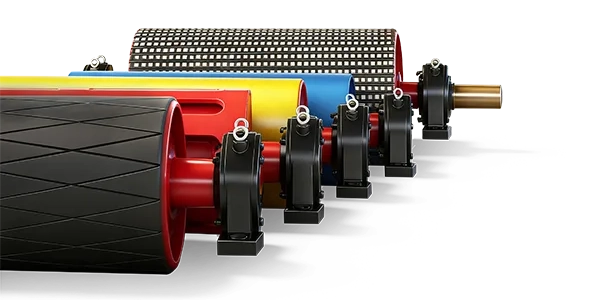
Because this pulley carries belt tension, its diameter, shaft, bearings, shell, and installation arrangement should match the actual conveyor duty. SHENGYUAN supplies conveyor pulleys for drive, tail, take-up, bend, snub, and other heavy-duty conveyor positions.
When replacing a take-up pulley, customers should not specify only the pulley diameter. Shaft dimensions, face width, bearing arrangement, belt width, tension, and installation drawing are also important.
Belt Elongation and Maintenance
Belt elongation is one of the main reasons the conveyor requires take-up travel. If the conveyor cannot accommodate the required change in belt length, the system may need repeated adjustment or may eventually reach the limit of its available travel.
For short conveyors with limited adjustment requirements, screw take-up can remain a practical solution. Where belt elongation requires more continuous compensation, vertical gravity take-up provides variable travel and automatic compensation.
Long conveyors requiring several metres of adjustment may instead use trolley gravity or fixed winch arrangements depending on required force, layout, capacity, and available space.
Common Take-Up Selection Mistakes
Mistake 1: Using Screw Take-Up on a Conveyor Requiring Large Travel
Screw take-up normally provides limited travel, with common reference values of 500, 800, or 1000 mm. A long conveyor requiring several metres of belt-length compensation should therefore be evaluated differently.
Mistake 2: Selecting Only by Conveyor Length
Conveyor length is important, but selection also depends on take-up force, required travel, drive power, conveyor inclination, and installation position. Two conveyors of similar length can require different take-up arrangements.
Mistake 3: Ignoring Belt Elongation
A take-up must have enough available movement to accommodate the belt over its operating range. This is particularly important for longer conveyors.
Mistake 4: Ignoring Safety Around the Take-Up Travel Area
Large-travel systems contain moving equipment and require appropriate protection. Limit switches and protective guarding should be included within the take-up operating range.
A Practical Take-Up Selection Process
01. Confirm conveyor length and arrangement.
02. Determine required take-up force.
03. Determine required take-up travel.
04. Confirm drive power and conveyor inclination.
05. Check the available installation position and space.
06. Evaluate whether automatic compensation for belt elongation is required.
07. Compare screw, vertical gravity, trolley gravity, and fixed winch arrangements.
08. Confirm the take-up pulley and supporting structure.
09. Include required limit switches and protective guarding.
10. Finalize the arrangement before manufacturing and installation.
What Information Should You Provide for Take-Up Selection?
For a more accurate recommendation, customers should provide enough information to understand both the conveyor duty and the required movement of the take-up system.
Provide: conveyor length and layout;
belt width and conveyor belt information;
drive power;
required take-up force;
required take-up travel;
conveyor inclination;
take-up installation position;
take-up pulley dimensions and bearing arrangement;
available installation space;
existing drawings and required quantity.
Why Choose SHENGYUAN for Conveyor Take-Up Components?
SHENGYUAN supplies conveyor pulleys, rollers, idlers, belts, and related components for mining, quarrying, cement, aggregates, coal handling, ports, steel plants, power stations, and other heavy-duty bulk material handling systems.
For take-up positions, pulley diameter, face width, shaft dimensions, bearings, hubs, surface configuration, and installation interfaces can be manufactured according to customer drawings and conveyor requirements.
Through custom conveyor solutions, take-up pulleys and related conveyor components can be coordinated with existing equipment dimensions, which is particularly useful for replacement projects and non-standard conveyor systems.
For international projects, component identification, technical confirmation, export packaging, and shipment coordination can also be arranged for distributors, EPC contractors, OEMs, mines, and maintenance companies.
Need to select a take-up arrangement?
Provide the conveyor layout, length, belt width, drive power, required take-up force, required travel, inclination, take-up position, pulley dimensions, bearing arrangement, available space, and existing drawings. These parameters make it easier to determine whether screw, vertical gravity, trolley gravity, or fixed winch take-up is the more appropriate starting option.
Conclusion: Choose the Take-Up by Force, Travel, and Conveyor Duty
A conveyor take-up system has two essential operating responsibilities: maintaining sufficient belt tension to prevent slip at the drive pulley and limiting excessive belt sag between idlers. It must also provide enough movement to accommodate changes in belt length.
Screw take-up is mainly suited to short-distance and lower-power conveyors, with typical force ranges of 9–38 kN and travel of 500, 800, or 1000 mm. Vertical gravity take-up provides variable movement and automatic compensation for belt elongation, with a practical force range of 8–63 kN.
Trolley gravity take-up is suitable for longer, higher-power inclined conveyors and commonly provides 3–5 m of travel with a force range of 8–63 kN. Fixed winch take-up is intended for more demanding long-distance, high-capacity applications, with approximately 30–150 kN of take-up force and travel reaching about 17 m.
The best take-up system is therefore not simply the largest or most expensive option. It is the arrangement that provides the required belt tension, sufficient take-up travel, appropriate installation position, and reliable operation for the actual conveyor duty.