


Conveyor belt mistracking is one of the most common operating problems in mining, quarrying, cement, coal handling, aggregates, ports, steel plants, and power stations. A belt that should run along the conveyor centreline gradually moves toward one side, repeatedly touches the structure, spills material, damages the belt edge, or activates a belt misalignment switch.
When this happens, many maintenance teams immediately think of installing more self-aligning idlers. Self-aligning idlers can be very useful, but they are not a universal cure. Belt mistracking is normally the result of an imbalance somewhere in the conveyor system. Loading position, pulley alignment, idler alignment, belt tension, material buildup, return-side contamination, conveyor structure, and the belt itself can all affect tracking.
The best solution is therefore to identify where the belt begins to move off centre and why it is being pushed or pulled toward one side. Correctly selected troughing forward-tilt idlers, self-aligning idlers, V-return idlers, and cleaning return rollers can then be used as part of a complete tracking strategy.
Quick answer: Yes, self-aligning idlers can help correct conveyor belt mistracking, especially moderate deviation caused during normal operation. However, they cannot permanently compensate for severe off-centre loading, misaligned pulleys, twisted structures, seized rollers, material buildup, incorrect tension, or a defective belt splice. The root cause should always be corrected first.
What Is Conveyor Belt Mistracking?
A correctly operating conveyor belt normally runs close to the designed centreline of the pulleys and idlers. Small movement from side to side can occur naturally, but the belt should remain within an acceptable operating position.
Mistracking occurs when the belt consistently travels toward one side instead of remaining centred. The problem may occur only on the carrying side, only on the return side, around one pulley, immediately after the loading zone, or throughout a long section of the conveyor.
This location is an important diagnostic clue. A belt that runs correctly when empty but moves sideways after loading probably has a different problem from a belt that mistracks continuously around the tail pulley.
Why Conveyor Belt Mistracking Should Not Be Ignored
Mistracking is more than an appearance problem. If the belt repeatedly contacts steel structures, the belt edge can become frayed, cut, or delaminated. Material can spill from one side of the carrying belt, increasing cleanup requirements and creating additional contamination around rollers and pulleys.
Severe deviation can also damage skirt systems, idler frames, pulley lagging, belt splices, and other conveyor components. In automated systems, repeated activation of misalignment protection devices can result in frequent production interruptions.
Troubleshooting principle: Do not start by asking, “Which self-aligning idler should I buy?” Start by asking, “At what point does the belt first move away from the centreline?” The first point of deviation often leads directly to the real cause.
Main Causes of Conveyor Belt Mistracking
| Possible Cause | Typical Symptom | What to Check |
| Off-centre loading | Loaded belt moves to one side | Chute position and material flow direction |
| Pulley misalignment | Belt consistently runs to one side around pulley | Pulley centreline and bearing positions |
| Idlers not square to belt | Deviation develops through one conveyor section | Idler frame alignment and installation |
| Material buildup | Tracking changes after wet or sticky operation | Pulleys, return rollers, belt cleaners |
| Seized or damaged roller | Local belt drag or unstable movement | Roller rotation, bearings, shell condition |
| Incorrect belt tension | Unstable tracking and excessive sag | Take-up system and belt tension |
| Belt or splice problem | Deviation repeats once per belt revolution | Splice alignment and belt condition |
1. Off-Centre Loading Is a Major Cause of Belt Mistracking
One of the first areas to inspect is the conveyor loading zone. Ideally, material should enter near the centre of the belt and move in approximately the same direction as the belt.
If a chute delivers most of the material onto one side, the uneven load can push the belt laterally. The problem may appear only when the conveyor is loaded, while the same belt runs normally when empty.
Installing a self-aligning idler downstream may temporarily push the belt back toward the centre, but the loading imbalance remains. Correcting the chute or material flow normally provides a more permanent solution.
Diagnostic clue: If the empty belt tracks correctly but starts running to one side immediately after material is loaded, inspect the loading chute before adjusting multiple idler sets.
2. Pulley Misalignment Can Pull the Entire Belt Sideways
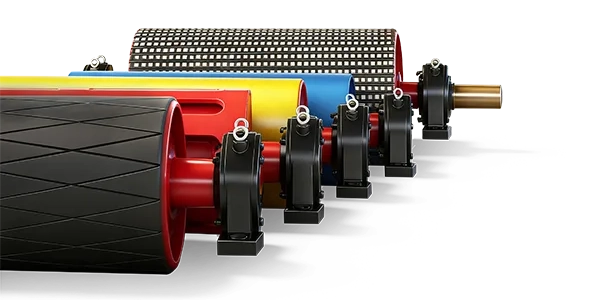
Head, drive, tail, take-up, bend, and snub pulleys all influence the path of the conveyor belt. If a pulley is not correctly aligned relative to the conveyor centreline, it can steer the belt toward one side.
This effect can be particularly noticeable around terminal pulleys because a large area of belt is in contact with the pulley surface. Incorrect bearing installation, uneven adjustments, structural movement, or material buildup on the pulley can change the effective belt path.
Before attempting to correct severe mistracking with idlers, inspect the conveyor pulleys and their bearing positions for alignment, buildup, wear, and installation accuracy.
3. Misaligned Idler Frames Can Steer the Belt
Conveyor idlers should be installed accurately relative to the conveyor centreline. If an idler frame is skewed unintentionally, one side of the belt can experience a different steering force from the other.
A single slightly misaligned idler may create only a small effect, but several incorrectly installed frames in the same direction can create persistent belt deviation.
Maintenance teams should check whether the idler frames are square, whether mounting holes have shifted, and whether the conveyor structure has distorted. Repeatedly adjusting one idler after another without measuring the structure can make troubleshooting more difficult.
4. Material Buildup Can Change the Belt Path
Sticky material remaining on the belt after discharge can accumulate on return rollers and pulley surfaces. If buildup is uneven, the effective diameter of the roller or pulley changes across its width.
The belt then no longer contacts a uniform cylindrical surface and may begin moving toward one side. This is why cleaning and tracking problems are often connected.
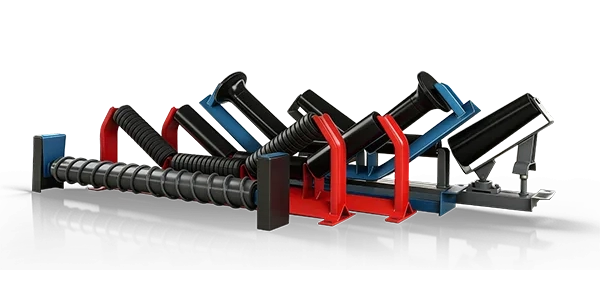
V-shaped comb return rollers and spiral return rollers are useful where material adheres to the belt. Their surface geometry helps remove or shed attached material, allowing the belt to run on a cleaner and more consistent return-side support surface.
These rollers assist cleanliness and stable running, but they should complement effective primary and secondary belt cleaners rather than replace them.
5. Damaged or Seized Rollers Can Affect Tracking
A roller with damaged bearings may rotate with unusually high resistance or stop rotating completely. The moving belt then drags across its surface instead of rolling freely.
Besides increasing wear and power consumption, this uneven resistance can contribute to unstable belt movement. A badly worn shell can also create an irregular contact surface.
Regular inspection of conveyor rollers and idlers should therefore include rotation, noise, bearing condition, shell wear, material buildup, and frame alignment.
6. Incorrect Belt Tension Can Make Tracking Unstable
The take-up system maintains sufficient tension so the belt can operate correctly around the drive pulley while limiting excessive sag between idler sets.
If the belt is too loose, excessive sag and unstable contact with idlers can make tracking more difficult. However, simply increasing tension is not a universal solution. Excessive tension increases loads on the belt, splices, pulleys, shafts, bearings, and take-up structure.
The correct approach is to confirm that the take-up system operates freely and maintains the intended tension rather than using excessive tension to force the belt to stay straight.
7. Belt and Splice Problems Can Cause Repeating Mistracking
If a splice is not square across the belt width, the belt can develop a lateral steering effect. Manufacturing damage, uneven belt stretch, edge damage, or deformation can create similar behaviour.
One useful diagnostic sign is repetition. If the mistracking changes at approximately the same point every time the belt completes one full revolution, inspect the belt itself and the splice rather than adjusting stationary conveyor components continuously.
Do Self-Aligning Idlers Really Work?
Yes, when they are used for the correct purpose. Self-aligning idlers are specifically designed to assist belt centring and correct moderate deviation on either the carrying or return side.
Common designs include friction-type and tapered self-aligning arrangements. When the belt moves away from the intended position, interaction between the belt and the self-aligning assembly creates a corrective steering action that encourages the belt to move back toward the centre.
For long conveyor sections where small tracking variations occur during normal operation, strategically positioned self-aligning idlers can provide useful automatic correction.
However, if the head pulley is badly misaligned or the loading chute continuously places the entire material stream on one belt edge, the self-aligning idler is forced to fight a continuous external steering force. In this case, it may reduce the symptom without eliminating the cause.
Correct use of self-aligning idlers: Use them to provide additional centring capability in a mechanically sound conveyor. Do not use them to hide incorrect pulley alignment, structural distortion, severe loading problems, or badly damaged belt components.
How Do Forward-Tilt Troughing Idlers Help Prevent Mistracking?
Standard troughing idlers support and shape the loaded belt. A forward-tilt troughing arrangement adds a small intentional angle to the wing rollers. A practical configuration uses 35° troughing side rollers tilted approximately 1.5° toward the direction of belt travel.
This small forward inclination creates a centring effect during normal belt operation, helping the belt maintain a more stable position and reducing its tendency to move sideways.
The key word is intentional. A correctly designed forward tilt is different from an idler frame that has accidentally been installed crooked. Randomly skewing idlers is not a substitute for correct conveyor alignment.
How Do V-Return Idlers Improve Belt Tracking?
On the return side, the empty conveyor belt is commonly supported by flat return rollers. For wider belts, V-return idlers can provide additional centring stability.
A V-return set uses two inclined rollers that support the empty belt in a shallow V shape. This geometry helps guide the belt toward a stable central position rather than allowing it to move freely across a single flat roller.
V-return and forward-tilt V-return arrangements can be particularly useful on wider belts. In suitable conveyor layouts, V and inverted-V arrangements may also be combined to improve the return belt’s resistance to lateral movement.
| Idler Arrangement | Main Position | Tracking Benefit |
| Forward-Tilt Troughing Idler | Loaded carrying side | Improves normal belt centring |
| Self-Aligning Idler | Carrying or return side | Actively assists correction of moderate deviation |
| V-Return Idler | Empty return belt | Improves return-belt centring and stability |
| Spiral or Comb Return Roller | Contaminated return side | Reduces buildup that can contribute to mistracking |
Which Solution Should You Use for Different Tracking Problems?
Problem: Belt Runs Off After Loading
Check the loading chute first. Confirm that material lands close to the belt centre and that the flow direction is compatible with belt travel. Self-aligning idlers may assist downstream, but they should not compensate for continuous side loading.
Problem: Loaded Carrying Belt Slowly Wanders Sideways
Inspect carrying idler alignment and the conveyor structure. Properly designed forward-tilt troughing idlers or carrying-side self-aligning idlers can then be considered to improve centring.
Problem: Wide Return Belt Is Unstable
Check tail and take-up pulley alignment, then evaluate V-return or V-type self-centring arrangements. Wider return belts can benefit from this additional geometric support.
Problem: Belt Mistracks After Handling Wet Sticky Material
Inspect carryback and material buildup on pulleys and return rollers. Improve belt cleaning and consider comb or spiral return rollers where sticky material repeatedly accumulates.
Problem: Belt Runs to One Side at a Specific Pulley
Measure the pulley installation and bearing positions before adjusting idlers elsewhere. A local deviation around one pulley often points toward pulley alignment or contamination rather than an idler problem.
A Practical Belt Mistracking Troubleshooting Sequence
01. Identify exactly where the belt first moves off centre.
02. Compare empty-belt and loaded-belt operation.
03. Check whether material is loaded centrally.
04. Inspect head, tail, drive, bend, and take-up pulley alignment.
05. Check idler frames for alignment and damaged rollers.
06. Remove material buildup from pulleys and return rollers.
07. Verify take-up operation and belt tension.
08. Inspect belt edges and the splice.
09. Evaluate forward-tilt, V-return, or self-aligning idlers where additional centring is needed.
10. Run the conveyor again under both empty and loaded conditions before making further adjustments.
Common Mistakes When Correcting Belt Mistracking
Mistake 1: Installing More Self-Aligning Idlers Without Finding the Cause
Self-aligning idlers can correct symptoms, but they cannot permanently overcome major mechanical errors. If the belt continuously receives an off-centre load, the loading system should be corrected.
Mistake 2: Randomly Skewing Standard Idlers
Intentional forward-tilt idlers are designed to create controlled centring forces. Randomly shifting ordinary frames can create conflicting steering effects and make future maintenance more difficult.
Mistake 3: Ignoring Return-Side Carryback
Material buildup can change roller and pulley contact geometry. If the tracking problem appears after handling wet or sticky materials, cleaning should be part of the investigation.
Mistake 4: Increasing Belt Tension Excessively
More tension is not always better. Excessive tension increases mechanical loads throughout the conveyor and can shorten component life without correcting the actual tracking cause.
What Information Is Needed When Selecting Tracking Idlers?
01. Belt width and belt speed
02. Carrying-side or return-side installation position
03. Existing trough angle
04. Roller diameter and face length
05. Frame and mounting dimensions
06. Material and conveyor capacity
07. Location where mistracking begins
08. Whether the problem occurs empty, loaded, or both
09. Dust, moisture, sticky carryback, and environmental conditions
10. Conveyor layout, photos, and existing drawings where available
Why Choose SHENGYUAN for Conveyor Tracking Idlers?
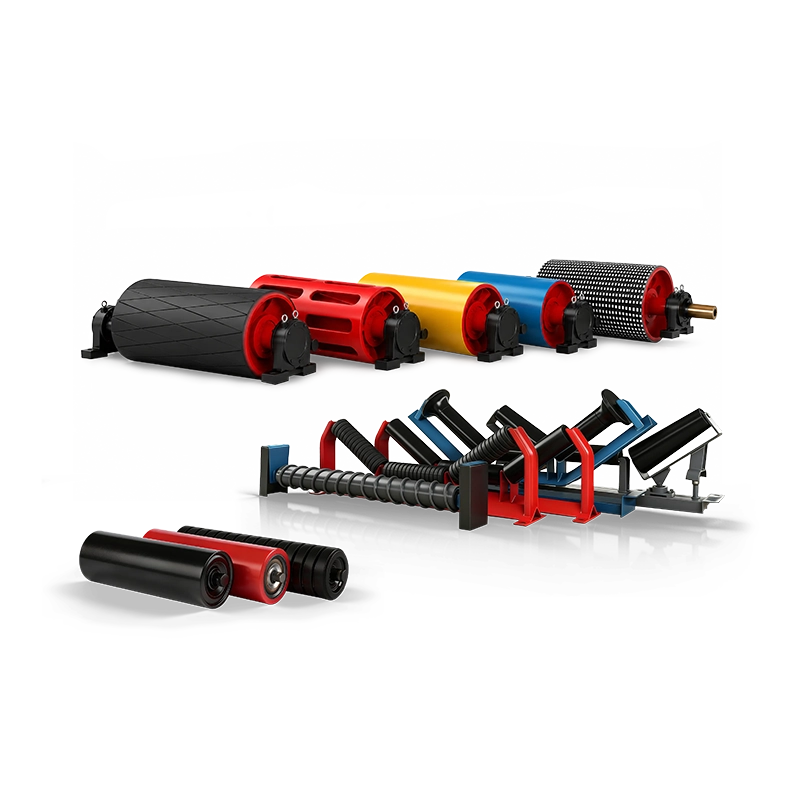
SHENGYUAN supplies conveyor rollers, idlers, pulleys, and related components for mining, quarrying, aggregates, cement, coal handling, ports, steel plants, power stations, and other heavy-duty bulk material conveyor systems.
For tracking applications, available configurations can include troughing idlers, forward-tilt carrying idlers, carrying-side self-aligning idlers, return self-aligning idlers, V-return arrangements, spiral return rollers, and other application-specific roller designs.
Through custom conveyor solutions, roller diameter, roller length, shaft ends, bearings, sealing, frame dimensions, trough angle, and mounting arrangements can be manufactured according to customer drawings and existing conveyor dimensions.
This is particularly useful when replacing idlers on older mining or industrial conveyors where standard catalogue dimensions do not match the original equipment.
For international projects, SHENGYUAN also provides service and logistics support for technical confirmation, component identification, export packaging, and shipment coordination.
Need to solve a belt mistracking problem?
Provide the belt width, speed, conveyor capacity, material, trough angle, roller dimensions, pulley arrangement, location where deviation begins, whether the problem occurs loaded or empty, current idler configuration, operating environment, photos, and conveyor drawings. These details make it easier to determine whether the problem requires self-aligning idlers, V-return support, cleaning rollers, component replacement, or correction elsewhere in the conveyor.
Conclusion: Self-Aligning Idlers Help, but the Root Cause Comes First
Conveyor belt mistracking can result from loading conditions, pulley alignment, idler installation, material buildup, damaged rollers, belt tension, belt condition, or several problems acting together.
Self-aligning idlers are effective components for assisting belt centring and correcting moderate deviation. Forward-tilt troughing idlers can improve carrying-side centring, while V-return arrangements can stabilize wider return belts. Spiral and comb return rollers can help reduce sticky buildup that contributes to unstable tracking.
However, no tracking idler can permanently compensate for severe mechanical misalignment or incorrect material loading. The most reliable solution is to identify the first point of deviation, correct the underlying conveyor problem, and then use the appropriate self-aligning or centring idler to improve long-term stability.