
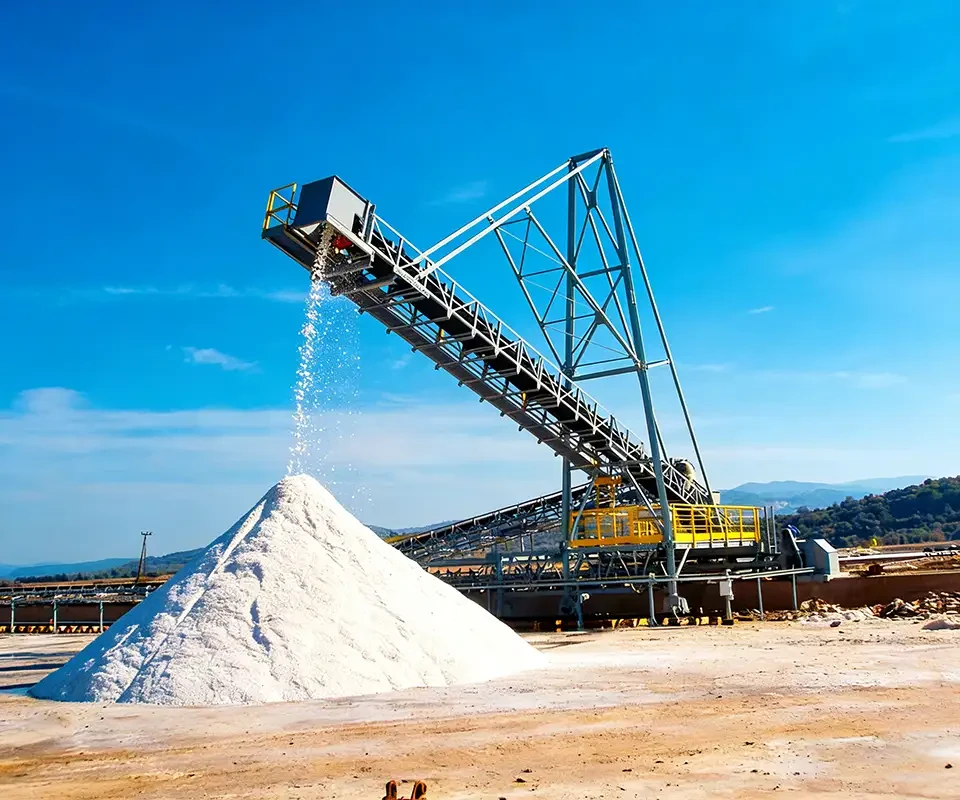
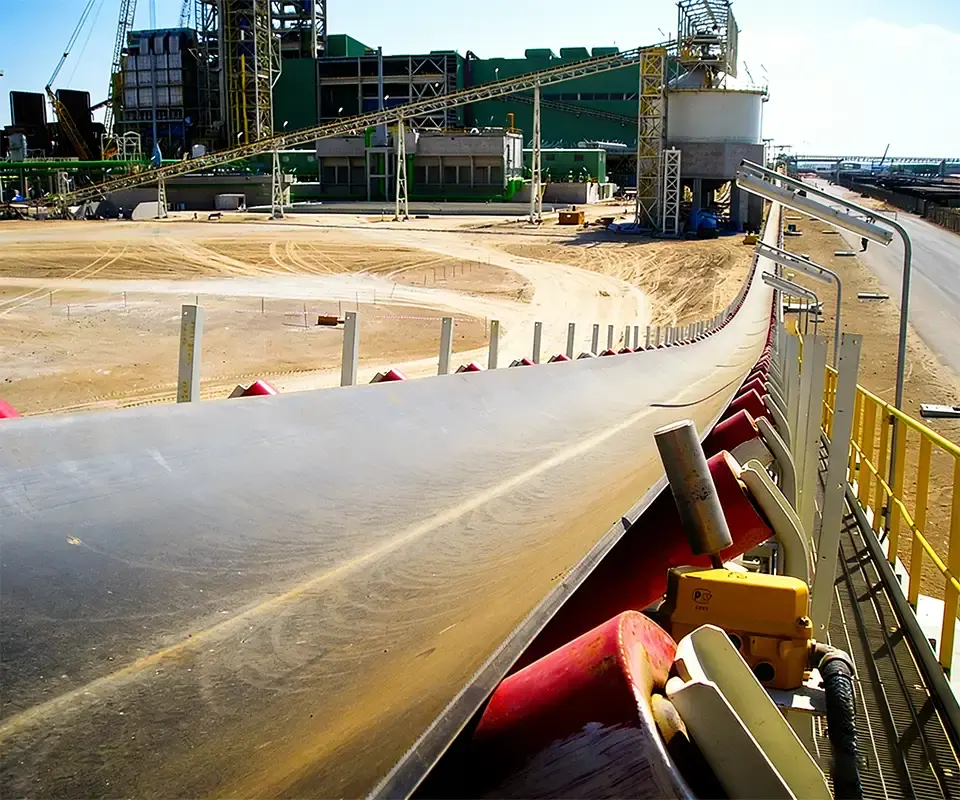
Wet salt conveyors create a difficult operating environment for return rollers. Moisture combines with chloride-rich salt to form a highly corrosive condition around roller shells, shafts, bearings, frames, and fasteners. At the same time, damp salt can adhere to the return side of the belt, build up on rollers, increase rotational resistance, and contribute to belt mistracking.
For these applications, HDPE return rollers are often considered because the polymer shell is corrosion resistant, lightweight, relatively low in surface adhesion, and does not rust like an unprotected steel tube. However, buying the right roller involves much more than specifying “HDPE roller for salt conveyor.”
The buyer should evaluate shell material, wall construction, shaft strength, bearing capacity, sealing arrangement, moisture protection, belt width, roller diameter, return load, belt speed, salt buildup, ambient temperature, UV exposure, and mounting dimensions. In wet salt service, the internal bearing and seal design can be just as important as the corrosion-resistant outer shell.
Quick answer: When buying HDPE return rollers for wet salt conveyors, do not select them from belt width alone. Confirm roller diameter and face length, shaft and mounting dimensions, bearing and seal design, actual return-side loading, belt speed, salt moisture level, washdown exposure, temperature, and whether sticky salt buildup is a recurring problem. Ask the supplier how the complete roller assembly—not just the HDPE tube—is protected against water and chloride contamination.
Why Wet Salt Is Difficult for Conveyor Return Rollers
Salt-handling conveyors may operate in ports, storage terminals, chemical plants, fertilizer facilities, food-grade salt operations, and bulk-material loading systems. The exact salt product may differ, but wet conditions create several common challenges.
Chloride-containing moisture can accelerate corrosion of carbon-steel surfaces. Carryback on the return belt may deposit damp salt onto return rollers. Once buildup becomes uneven, the effective roller diameter changes across the belt width and can influence belt tracking.
If moisture and fine salt enter the bearing area, lubricant contamination and corrosion can shorten bearing life. In severe conditions, the roller may become noisy, difficult to rotate, or completely seized.
This is why wet salt conveyors should be treated as a combined corrosion, contamination, sealing, and carryback application rather than simply a low-load return-roller application.
Why Consider HDPE Return Rollers?
HDPE, or high-density polyethylene, is used for conveyor roller shells in applications where corrosion resistance, reduced weight, and resistance to some forms of material adhesion are desirable.
Unlike an ordinary uncoated steel tube, an HDPE shell does not rust when exposed to water and salt. This can be a major advantage in wet return-side environments where conventional steel roller surfaces may corrode rapidly.
HDPE rollers are also generally lighter than comparable steel-shell rollers. Lower component weight can simplify manual handling during maintenance, particularly on long conveyors containing many return rollers.
For a broader comparison of roller materials and applications, see the Conveyor Rollers Guide: Types, Selection Factors and Applications.
1. Confirm Whether HDPE Is Suitable for the Actual Load
Return rollers normally support the empty belt rather than the full material load, so their load is typically lower than that of carrying idlers. However, this does not mean every HDPE roller construction is automatically suitable.
The roller must still support the return belt, belt splice, material carryback, local buildup, and any dynamic effects caused by belt vibration or mistracking.
Long face widths and wide belts can increase shell deflection. The manufacturer should therefore confirm roller tube construction, shaft diameter, bearing size, and allowable load according to the actual conveyor geometry.
Buying principle: “HDPE” describes the shell material, not the complete roller load rating. Two HDPE rollers with the same outside diameter can have different tube thicknesses, shafts, bearings, seals, and structural capacity.
2. Specify Roller Diameter and Face Length Correctly
Start with the existing conveyor dimensions. Record the roller outside diameter, roller face length, total shaft length, shaft-end type, and mounting-center dimensions.
Do not order a replacement based only on belt width. Two conveyors using the same belt width may have different roller face lengths, brackets, shaft ends, and mounting positions.
For an old conveyor where drawings are unavailable, measure an undamaged existing roller and compare it with another roller from the same position. This reduces the risk of reproducing dimensions from a worn or modified component.
3. Pay Special Attention to Bearing Sealing
In wet salt service, the outer HDPE shell may remain corrosion free while the internal bearing fails because moisture and chloride-rich contamination enter through the roller ends.
This makes the seal arrangement one of the most important purchasing points.
A properly designed roller may use multiple sealing barriers around the bearing area to reduce entry of water, salt fines, and dirt. Labyrinth-type sealing arrangements are commonly used in industrial conveyor rollers because they create a more difficult path for contamination to reach the bearing.
Ask the supplier to explain the sealing construction rather than accepting a general statement such as “waterproof bearing.” In conveyor service, complete protection depends on the bearing housing, end seals, shaft fit, labyrinth geometry, grease condition, and manufacturing accuracy.
For more detail on bearings, shafts, seals, and environmental selection, see Key Factors for Choosing Conveyor Rollers.
4. Do Not Ignore the Steel Shaft
An HDPE roller still normally contains a steel shaft. If the exposed shaft ends are not adequately protected, they can corrode even while the roller shell remains unaffected.
Corrosion around the shaft ends can complicate removal during maintenance, damage bracket interfaces, or reduce dimensional accuracy over time.
When requesting a quotation, describe the salt environment clearly and ask what shaft material or surface protection is proposed for exposed areas. The most suitable option depends on corrosion severity, cost, maintenance expectations, and site requirements.
5. Consider Wet Salt Buildup on the Return Belt
Return rollers often contact the dirty side of the belt. If the conveyor belt cleaner does not remove enough salt at the discharge point, damp carryback travels onto the return strand.
Sticky salt can then transfer from the belt to the rollers. Uneven buildup may increase roller diameter locally and create additional belt vibration or lateral steering effects.
HDPE surfaces can help reduce some adhesion compared with severely corroded or rough steel surfaces, but no roller material should be considered a substitute for effective belt cleaning.
If carryback is severe, the conveyor should be evaluated as a complete cleaning system involving primary or secondary cleaners, return-side protection, water management, and roller selection.
6. When Should Spiral or Disc Return Rollers Be Considered?
Some wet salt conveyors experience persistent material buildup despite normal belt cleaning. In these cases, special return-roller constructions may be evaluated.
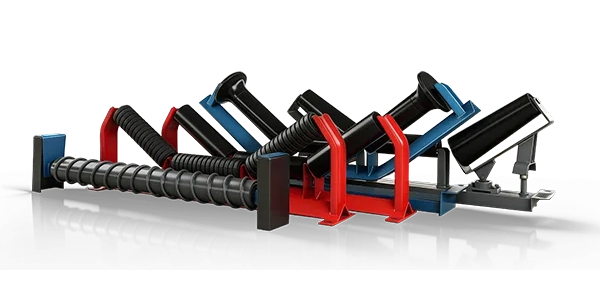
Spiral return rollers or disc-type return rollers are designed to reduce continuous full-width contact and can help disturb material adhering to the belt surface in suitable applications.
However, these rollers should not automatically replace every flat return roller. Their suitability depends on belt condition, material behavior, roller position, tracking requirements, and maintenance strategy.
A combination of conventional HDPE return rollers and strategically placed cleaning-type rollers may be more appropriate than using one design across the entire return strand.
7. Belt Speed Affects Bearing and Roller Duty
Roller rotational speed increases as belt speed increases and roller diameter decreases. Higher rotational speed places greater demands on bearing quality, balance, sealing, and manufacturing accuracy.
For long salt conveyors operating continuously, the supplier should know the actual belt speed rather than assuming the roller is a low-speed return application.
A roller that performs adequately on a slow stockpile conveyor may not provide the same bearing life on a faster terminal conveyor even if belt width and roller dimensions are identical.
8. Check Temperature Limits
HDPE is a polymer, so temperature should always be included in the application specification.
Normal wet salt handling may occur near ambient temperature, but conveyors can also operate outdoors in hot climates, near heated processes, or in locations with strong solar exposure.
Do not assume that a roller suitable for corrosion exposure is automatically suitable for every temperature. Ask the manufacturer for the recommended operating-temperature range of the specific HDPE construction being offered.
If the conveyed product itself can become hot, provide actual material temperature and the duration of roller contact.
9. Consider UV Exposure on Outdoor Salt Conveyors
Salt stockyards, ports, and terminals frequently use outdoor conveyors. Return rollers may therefore be exposed to sunlight for years.
The HDPE formulation should be suitable for outdoor service where ultraviolet exposure is significant. Ask whether the proposed roller material is intended for long-term outdoor conveyor use rather than assuming every polyethylene formulation has the same UV resistance.
10. Check Chemical Compatibility Beyond Sodium Chloride
“Salt conveyor” can refer to different materials and process environments. The product may be sodium chloride, potash-related material, fertilizer salt, mixed mineral salt, or another chloride-containing bulk product.
Cleaning chemicals, process additives, oils, or other contaminants may also contact the rollers.
Give the supplier the actual material name and any relevant chemicals rather than simply stating “salt.” Chemical compatibility should be checked for the complete roller construction, including polymer components, seals, grease, and exposed metal parts.
11. Compare HDPE and Steel Return Rollers for Wet Salt Service
| Selection Factor | HDPE Return Roller | Steel Return Roller |
| Shell Corrosion | Does not rust like carbon steel | Requires suitable material or corrosion protection |
| Weight | Generally lighter | Generally heavier |
| High Load Capability | Depends strongly on construction and span | Often preferred for very severe structural duty |
| Temperature | Must remain within polymer design limits | Generally more tolerant of elevated temperature |
| Wet Salt Environment | Strong shell-corrosion advantage | Protection level must be considered carefully |
The best choice depends on the complete duty. HDPE may be attractive for corrosion-prone return applications, while steel may remain appropriate where very high structural loads, elevated temperature, or unusual impact conditions dominate.
12. Return Roller Spacing Still Matters
Replacing steel rollers with HDPE rollers does not eliminate the need to check return-side support geometry.
If return roller spacing is excessive, the empty belt can sag significantly between supports. Carryback adds additional weight and can increase sag further.
The correct spacing depends on belt weight, belt width, belt tension, roller load capacity, conveyor geometry, and operating conditions.
For more detail on carrying, return, impact, and curved-section spacing, see the Conveyor Idler Spacing Guide.
Common Buying Mistakes for Wet Salt Conveyors
Mistake 1: Buying HDPE Rollers Only Because They Do Not Rust
The shell may resist corrosion, but bearings, shafts, seals, and fasteners still need to survive the environment.
Mistake 2: Ignoring Seal Construction
In wet salt service, contamination entering the bearing may determine roller life long before the HDPE tube wears out.
Mistake 3: Specifying Only Belt Width
Belt width does not define roller face length, shaft length, shaft ends, bearing capacity, or mounting geometry.
Mistake 4: Expecting the Roller to Solve Severe Carryback
A lower-adhesion shell can help, but persistent salt buildup usually requires better belt cleaning and transfer-point control.
Mistake 5: Ignoring Temperature and UV Exposure
Polymer roller performance depends on the actual material formulation and service environment. Outdoor and elevated-temperature conditions should always be stated in the RFQ.
What Information Should Be Included in the RFQ?
Provide: conveyed salt or chemical name;
moisture condition and whether brine is present;
belt width and belt speed;
roller outside diameter;
roller face length;
overall shaft length and shaft-end dimensions;
mounting method and bracket spacing;
return roller spacing;
operating temperature and outdoor UV exposure;
washdown frequency and water exposure;
carryback and buildup condition;
required quantity and spare-parts plan;
photos or drawings of the existing return roller installation.
How to Compare HDPE Return Roller Suppliers
A useful supplier comparison should go beyond unit price and roller diameter.
Ask each supplier to confirm the proposed HDPE shell construction, shaft diameter, bearing arrangement, seal design, dimensional tolerance, intended operating speed, environmental suitability, and mounting details.
For replacement projects, confirm that the shaft ends and overall dimensions match the existing brackets. A small difference in flats, slots, grooves, or mounting distance can prevent an otherwise suitable roller from fitting the conveyor.
Also ask how the supplier addresses corrosion on non-HDPE parts. A corrosion-resistant shell does not provide much value if exposed shafts or internal components fail prematurely.
Buying HDPE Return Rollers from SHENGYUAN
SHENGYUAN supplies conveyor rollers, idlers, pulleys, belts, cleaners, frames, and related components for mining, quarrying, salt handling, ports, cement, power plants, steel plants, and other bulk-material handling systems.
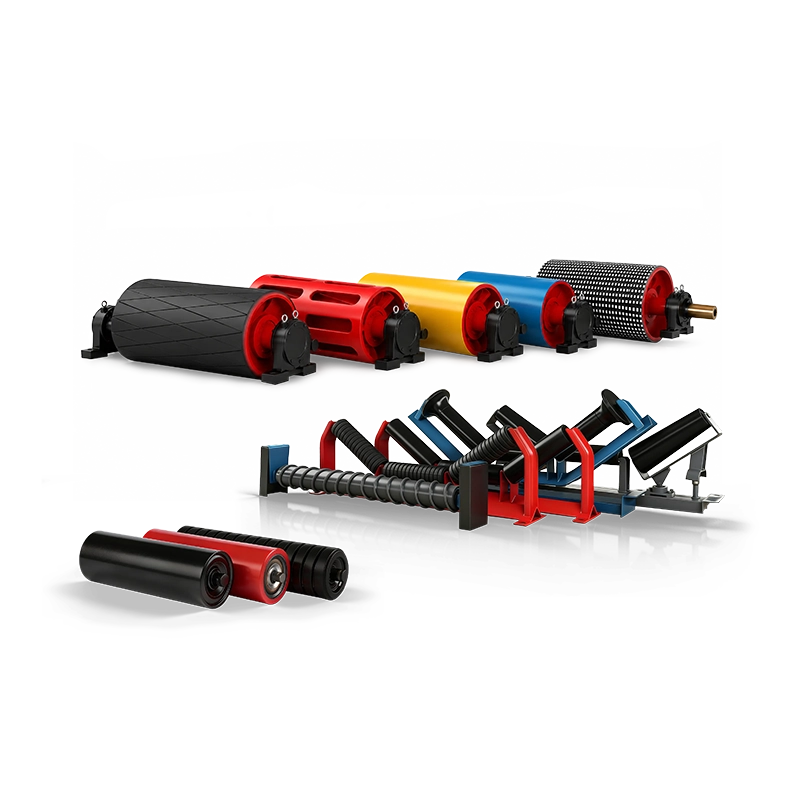
The conveyor roller range includes steel, HDPE, impact, return, self-aligning, spiral, polyurethane, ceramic, and other roller configurations for different operating conditions.
For wet salt applications, roller selection can be based on the complete environment rather than shell material alone. Roller diameter, face length, shaft dimensions, bearing capacity, sealing, moisture exposure, carryback, belt speed, and mounting arrangement should be reviewed together.
Through custom conveyor solutions, replacement HDPE rollers can also be manufactured according to customer drawings, old samples, or field measurements where existing conveyor dimensions must be maintained.
Need HDPE return rollers for a wet salt conveyor?
Send the belt width, belt speed, roller diameter, roller face length, shaft dimensions, mounting method, return spacing, salt type, moisture condition, washdown exposure, operating temperature, buildup condition, photos, and existing drawings. These details provide a much better basis for selecting the complete roller than specifying HDPE material alone.
Conclusion: Protect the Bearing System, Not Just the Roller Shell
HDPE return rollers can offer important advantages on wet salt conveyors because their shells resist rust, reduce component weight, and can provide a smoother corrosion-resistant belt-contact surface.
However, successful selection depends on the entire roller assembly. Shaft protection, bearings, labyrinth seals, face length, shell construction, belt speed, loading, temperature, UV exposure, and mounting dimensions all affect service life.
Wet salt carryback should also be controlled at the source. No roller material can fully compensate for ineffective belt cleaning, excessive buildup, or severe belt mistracking.
The right HDPE return roller for a wet salt conveyor is not simply a plastic roller that cannot rust. It is a complete roller system whose shell, shaft, bearings, seals, dimensions, and operating limits are matched to the corrosive and contaminated return-side environment.